bitcoin
ethereum
Institutional
Concentration Risk in Crypto ETFs: The Single-Custodian Problem
One entity custodies most US spot Bitcoin ETF assets, and Ethereum ETFs add validator concentration. Bitcoin’s custody risk can be reduced by issuers and the market, while Ethereum’s staking concentration can be shaped at the protocol level, including draft EIP-8363.
SEP 17, 2026
Last updated SEP 17, 2026 · V1
TL;DR
- Concentration risk in crypto ETFs often comprises two problems. One is a custody problem on Bitcoin; the other is a staking problem on Ethereum.
- Problem one (Bitcoin): as of April 8, 2026, roughly 80-84% of the $91.71 billion US spot Bitcoin ETF market is held by a single custodian, Coinbase. At the custody level it leads to a market-structure single point of failure.
- The segregated assets wrapper protects against misuse and commingling. It does not, however, remove operational single-point-of-failure risk such as an outage, breach, or access disruption.
- Problem two (Ethereum): ETH ETFs add a staking layer on top of custody, with about 35% of ETH supply (~43 million ETH) now staked. The concern extends to who runs the validators.
- The Ethereum protocol is debating a structural response, draft EIP-8363 (“Tapered Issuance Burn”). It remains at draft stage, with an open pull request and no place in the Hegota upgrade.
- EIP-8363 is contested: supporters say it curbs concentration, while critics warn it could push out solo stakers first and concentrate staking among large operators.
- Bitcoin’s problem could be addressed by issuer and market behavior; Ethereum’s can be addressed at the protocol layer, with separation of concerns as the shared principle.
Problem One: Bitcoin Crypto ETF Concentration Risk of Custodian
Coinbase holds roughly 80-84% of US spot Bitcoin ETF assets, which makes custodian concentration the dominant structural feature of that market. It leads to a single point of failure at the custody layer.
The numbers
As of April 8, 2026, the US spot Bitcoin ETF complex tracked by Bitbo held about $91.71 billion in total assets under management. Funds whose launch documents name Coinbase as custodian or primary custodian account for approximately $77.10 billion of that total, or 84.1% of the entire market.
A methodology that excludes funds with multi-custodian arrangements or undisclosed allocation splits still produces about $74.06 billion, or 80.8%.
The scale forms part of a much larger custody book. Coinbase reported roughly $376 billion in assets on platform at year-end 2025.
Coinbase CEO Brian Armstrong noted in a February 2026 statement that the company custodies 80%+ of the US BTC and ETH ETF assets. The table below breaks down the largest Coinbase-custodied Bitcoin funds as of April 8, 2026.
| Fund | Issuer | AUM | Custody note |
| IBIT | BlackRock | $55.70B | Coinbase; added Anchorage Digital Bank |
| Grayscale ETFs | Grayscale | $14.67B | Coinbase |
| BITB | Bitwise | $2.67B | Coinbase |
| ARKB | ARK | $2.59B | Coinbase |
There is a notable exception. Fidelity’s FBTC self-custodies through Fidelity Digital Assets instead of routing to the shared backbone.
VanEck’s HODL launched with Gemini and later added Coinbase. New money is not diluting the picture, because later entrants keep plugging into the same infrastructure.
Morgan Stanley’s proposed Bitcoin ETF names Coinbase Custody alongside BNY as Bitcoin custodians. That reinforces the existing concentration.
Why it is a single point of failure
The single-custodian structure means one operational failure at Coinbase could affect much of the Bitcoin ETF market at once. The clearest statement of the risk comes from an issuer executive.
Jean-Marie Mognetti, CEO and co-founder of CoinShares, made the point directly in May 2026. He argued that because the funds all rely on one custodian, the market carries a large concentration risk, and from a protection and diversification standpoint it is a zero.
His analogy: no hedge fund would accept a one consolidated prime broker, similarly the ETF market should not accept one custodian either. The abstract risk resolves into concrete failure modes.
Any one of the following, hitting the shared backbone, would affect much of the market at once:
- Operational outage disrupting creation and redemption across most of the 11 US spot Bitcoin ETFs at once.
- Security breach at the custody layer.
- Insolvency and open questions about bankruptcy-remoteness.
- Regulatory action against the custodian.
- A supply-chain or signing compromise, of the kind seen in the Bybit incident, affecting shared systems.
Why does the market structure work this way?
Qualified-custodian rules, asset segregation, insurance, and audits all mean to bound custodial risk: assets being stolen, misused, or commingled with the sponsor’s balance sheet, which was the FTX collapse.
They do nothing for operational single-point-of-failure risk, which needs its own controls:
- redundant signers,
- distributed validators,
- failover.
That category includes:
- an outage,
- a breach,
- an access disruption.
Segregated assets you cannot access on a given day are still inaccessible. Coinbase‘s concentration reflects market choice.
John D’Agostino of Coinbase Institutional and other Coinbase voices have framed the firm as one of the few full-service crypto primes. That full-service scope combines:
- trading,
- custody,
- financing,
- staking at scale.
On this view, issuers chose the most complete provider. Is this a real market choice, or a scarce-capacity artifact of the narrow ETF-launch window? Some issuers now disclose backup custodians, though disclosures have not yet moved meaningful amounts of actual Bitcoin.
Problem Two: Staking and Validator Concentration on the Ethereum Side
Ethereum ETFs add staking on top of custody, so concentration risk extends to who runs the validators. The Ethereum protocol and community are now debating a structural response, draft EIP-8363.
Why Ethereum’s version is different
Ethereum ETFs are now exploring staking and it changes the nature of the risk.
The Bitcoin question is who holds the keys. The Ethereum question adds who runs the validators and how much of total ETH is staked through a handful of large operators and intermediaries.
The context figures show why this is live. As of early September 2026, staked ETH reached about 43.4 million ETH, or roughly 35% of supply, up from about 29% at the start of the year.
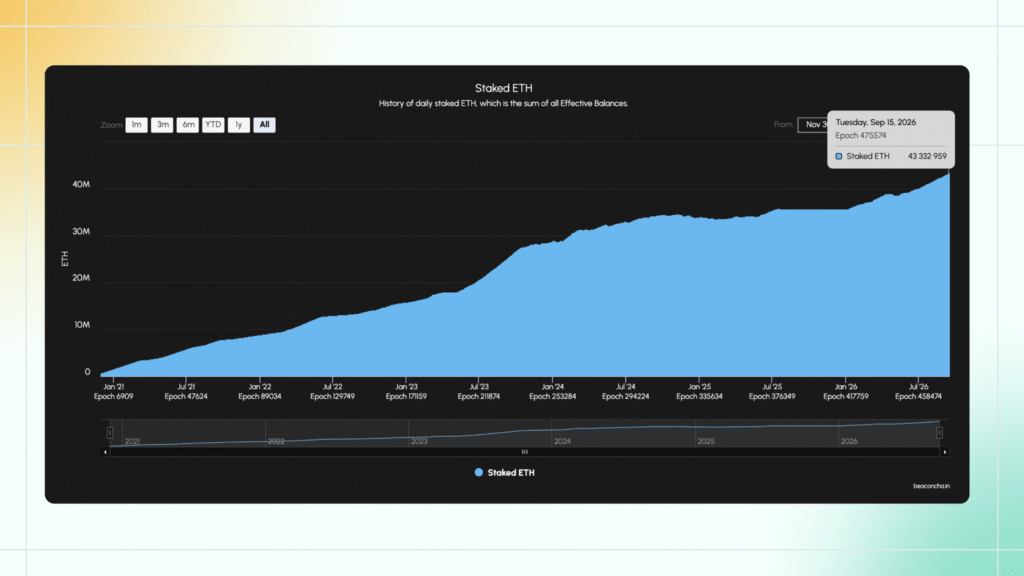
The 7-day staking reward rate has fallen to 2.66%, down from a peak of 5.06% in June 2023. More validators sharing a fixed issuance pool mechanically compresses per-validator rewards.
EIP-8363, described accurately
EIP-8363 is a draft proposal that would burn a rising share of validator rewards as more ETH is staked. The details are load-bearing, so status and mechanism are stated precisely.
EIP-8363, titled “Tapered Issuance Burn,” is a draft proposal published to the Ethereum EIPs repository on August 4, 2026.
EIP-8363 is not approved, not scheduled, and not part of the Hegota upgrade. As of September, 2026, its pull request remains open.
The mechanism keeps existing consensus rewards but burns a rising fraction of validator rewards as the staking ratio climbs. When 60.25 million ETH are staked, about 50% of the current supply, the deduction would reach 100%.
The changes would be introduced gradually over 18 months. Above that point, validator rewards would come only from tips and MEV.
Modeling in the draft suggests consensus reward rate would fall from roughly 2.6% to about 1.2% over the transition. The stated goals of EIP-8363 are threefold:
- remove the lower bound on staking reward rates,
- reduce the dilution of non-stakers,
- curb the ever-growing concentration of ETH among large operators and liquid-staking-token providers.
The table below summarizes the proposal at a glance.
| Attribute | Detail |
| Title | Tapered Issuance Burn |
| Number | EIP-8363 (draft) |
| Public draft date | August 4, 2026 |
| Saturation point | 60.25M ETH (~50% of supply) |
| Burn at saturation | 100% of consensus rewards |
| Phase-in | ~18 months |
| Untouched | Tips and MEV |
| Status | Draft; PR open; not in Hegota |
The debate
EIP-8363 is genuinely contested, and both sides have serious arguments. The case for the proposal rests on three points.
The case for:
- Lower issuance reduces unnecessary dilution of holders who do not stake.
- A smaller issuance footprint strengthens ETH’s monetary character.
- Preserving a large unstaked constituency helps the network resist validator capture.
The case against:
- Critics argue the change could increase operator concentration. Lower protocol rewards could make solo staking uneconomical while larger organizations keep operating, because independent validators lack the economies of scale that large operators enjoy.
- Researcher Koumoutsos stated that a solo validator has real costs, so a large share of marginal solo validators will exit and fewer new ones will enter.
- Large platforms stake for reasons beyond reward levels, such as customer retention and product integration, so they are less likely to pull back.
- There is a DeFi risk, since the staking rate serves as a benchmark for lending markets built on staked ETH and liquid staking tokens.
- Messari framed EIP-8363 as largely a solution in search of a problem, given that market forces may already be slowing participation.
The takeaway does not depend on whether EIP-8363 passes, and it may well not. The significance is that the protocol layer is attempting a structural defense against concentration, instead of hoping large players restrain themselves.
For a deeper treatment of the mechanism, see Everstake’s EIP-8363 Tapered Issuance Burn overview. We’ve also discussed related concepts in the Ethereum supply, issuance, and staking debate overview and the Ethereum Glamsterdam upgrade explainer.
Same Coat, Different Problems
Bitcoin ETF concentration is located at the custody layer, while Ethereum ETF concentration is located at the validator and staking layer. Placing the two side by side shows why treating them as one story goes wrong.
| Dimension | Bitcoin ETFs | Ethereum ETFs |
| Where concentration is located | Custody layer | Validator / staking layer |
| Nature of risk | Market-structure single point of failure | Operator and staking concentration |
| Who can fix it | Issuers and the market | The protocol, plus market behavior |
| Example lever | More custodians, real backup arrangements | EIP-8363-style mechanisms, operator diversity |
| Structural stack | Issuer to single custodian | Issuer to custodian to validator/staking layer |
The common thread is the same at both layers. A scarce, shared piece of infrastructure becomes a systemic dependency.
When that happens, a problem at one node becomes a problem for the whole market. The repair path is what differs.
Bitcoin concentration can only be reduced by issuer and market behavior. Ethereum concentration can also be shaped by the protocol itself.
The milestone of more than half of ETH supply having passed through the proof-of-stake contract marks how central this layer has become. Everstake covers that milestone in its Ethereum staking milestone piece.
What Mitigation Looks Like
Concentration could be reduced by separating custody, exchange, ETP, and staking functions across independent parties. The practical measures differ by chain, though the underlying principle is the same.
On the Bitcoin side:
- Multi-custodian arrangements instead of a single provider.
- Disclosed backup custodians, with actual holdings distributed beyond paper disclosures.
- Growing qualified-custodian diversity as bank and OCC-supervised entrants such as Citi, BNY, and Standard Chartered mature.
On the Ethereum side:
- Validator-set distribution across a large set of independent operators.
- Protocol mechanisms, of which EIP-8363 is one contested example, as a possible lever.
- Separation of the staking layer from custody, exchange, and ETP functions.
The neutral principle that ties both together is separation of concerns. When one infrastructure provider owns custody, the exchange, the ETP, and staking at once, systemic dependency compounds.
Splitting those roles across independent parties is what lowers the correlated-failure risk. We talk about it more in our article on specialized crypto infrastructure and advantages of multiple vendors.
Where Everstake Sits
Everstake operates a validator-only business, separate from custody, ETP, and exchange functions, so our incentive points toward a distributed validator layer.
Everstake has historically operated 130+ networks to date for dozens of institutional clients. It runs validators only. It does not also custody client assets, issue an exchange-traded product, or operate a trading venue.
That separation shapes its incentives. A custodian benefits from concentrating assets under one roof; an exchange benefits from routing order flow through itself. A pure validator operator benefits from the opposite: spreading stake across many independent validators, because concentration in one operator raises correlated slashing and downtime risk for the clients it serves.
Neutrality is not a stated value on top of the operation, it falls out of the fact that Everstake has no custody, trading, or issuance arm whose interests would compete with running validators well.
Conclusion
Crypto ETF concentration risk is two problems, and treating it as one hides more than it reveals. Bitcoin’s problem is a custody single point of failure that the market must fix through more custodians and real distribution of holdings.
Ethereum’s problem is a staking-concentration question that the protocol is actively trying to address, whether or not any proposal succeeds. The structural point holds at every layer.
Concentration risk is ultimately about shared dependencies. The durable answer, in custody and in staking alike, is separation and distribution.
FAQ
Who custodies most Bitcoin ETFs?
Coinbase custodies most Bitcoin ETFs, holding roughly 80-84% of US spot Bitcoin ETF assets as of April 8, 2026. Coinbase is the primary custodian for the large majority of US spot Bitcoin ETF assets, tracked at $91.71 billion in total.
Is my Bitcoin ETF protected if Coinbase has a problem?
Fund assets in a Bitcoin ETF are segregated from the sponsor and the custodian, which guards against misuse and commingling. That segregation does not remove operational single-point-of-failure risks such as an outage, a breach, or an access disruption.
What is EIP-8363?
EIP-8363 is a draft Ethereum proposal called “Tapered Issuance Burn,” published August 4, 2026, that would burn a rising share of validator rewards as more ETH is staked. EIP-8363 is not adopted and is not part of the Hegota upgrade.
Does Fidelity’s Bitcoin ETF use Coinbase?
Fidelity‘s FBTC does not use Coinbase. Fidelity self-custodies its Bitcoin ETF through Fidelity Digital Assets.
Why is Ethereum ETF concentration different from Bitcoin’s?
Ethereum ETF concentration is different because ETH ETFs add staking and validator operation on top of custody. That addition means the Ethereum concern extends to who runs validators and how much ETH is staked through a few large operators.
Would EIP-8363 reduce or increase validator concentration?
EIP-8363‘s effect on validator concentration is contested. Supporters say EIP-8363 curbs concentration among large operators and LST providers, while critics argue it could harm solo stakers first, because lower rewards make small-scale staking uneconomical before it affects large operators.
Share with your network