Cardano
Cardano Turns 9: Nine Years of Shipping
Cardano started 9 years ago as a centralized network with a roadmap and a small, determined community. Today that community runs the network, votes on its upgrades, and decides how its treasury is spent. Here’s to the next nine years!
SEP 23, 2026
Last updated OCT 10, 2026 · V1
TL;DR
- Cardano moved from a centralized federated launch on September 29, 2017 to community-run stake pools with Shelley in July 2020.
- Smart contracts arrived with Alonzo on September 12, 2021, after token locking in Allegra and native assets in Mary.
- Block production continued through a November 21, 2025 chain partition, and mainnet passed 123 million transactions by September 2026.
- On-chain governance went live with Chang in 2024 and Plomin in 2025, and DReps now vote on a treasury of 1.621 billion ADA (April 2026).
- Van Rossem, activated on July 18, 2026, was the first hard fork approved entirely through on-chain votes by all 3 governance bodies.
- The institutional path expanded in 2026 with the Midnight privacy mainnet and CME ADA futures.
- Leios projects 10x to 65x throughput capacity, with Dijkstra Phase 1 targeting code completion in Q4 2026 and Peras in Q2 2027.
- Delegated ADA has no lock-up, and holders can delegate governance votes to a DRep separately.
- Everstake has run Cardano stake pools since 2020.
Cardano marks 9 years and 11 hard forks
Cardano has two birthdays. The genesis block was minted on September 23, 2017, and the mainnet launched on September 29, 2017, introducing the ADA cryptocurrency.
Every couple of years, someone declares Cardano empty, slow, or finished, and each time, the network answers with a release.
At Everstake we are proud to have run Cardano stake pools since the Shelley era opened block production to the community. Everstake’s ESTK pool, for example, was registered on November 23, 2020.
During this time, Cardano has activated 11 major updates from Byron to Van Rossem, each through the hard fork combinator while the network kept running. That design lets node operators move between eras without restarting the chain.
| Date | Upgrade | Protocol version | What shipped |
| Sep 29, 2017 | Byron | 1.0 | Mainnet and ADA |
| Jul 29, 2020 | Shelley | 2.0 | Staking and stake pools |
| Dec 16, 2020 | Allegra | 3.0 | Token locking |
| Mar 1, 2021 | Mary | 4.0 | Native assets |
| Sep 12, 2021 | Alonzo | 5.0 | Plutus smart contracts |
| Sep 22, 2022 | Vasil | 7.0 | Script and throughput efficiency |
| Feb 14, 2023 | Valentine | 8.0 | Cross-chain cryptography |
| Sep 1, 2024 | Chang | 9.0 | First governance features |
| Jan 29, 2025 | Plomin | 10.0 | DReps and full governance |
| Jul 18, 2026 | Van Rossem | 11.0 | First community-governed fork |
Cardano’s roadmap groups its upgrades into 5 eras. Each era adds one capability to the network.
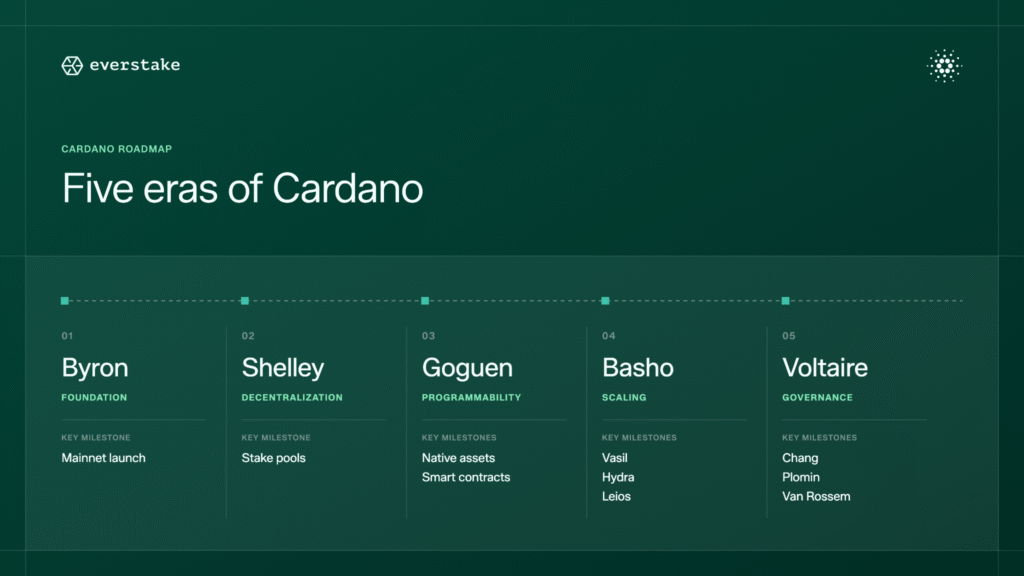
Cardano has drawn more public criticism than most major networks. Nine years later, it still follows its original five-era roadmap, now steered by a tight-knit community that votes on each upgrade.
Claim 1: It Will Never Decentralize
Byron launched in 2017 as a federated network. All block production ran on core nodes operated by the 3 founding entities, which led to the early days criticism of the centralization.
However, Cardano decentralized block production with Shelley on July 29, 2020, when community stake pools took over from federated nodes. The first wallets were Daedalus, a full-node desktop client, and later Yoroi, a lighter option. These gave early holders a way to store and move ADA.
Shelley changed who produces blocks. It introduced staking and decentralization features, moving Cardano from a federated to a decentralized system. Shelley also brought Ouroboros Praos. Under Praos, stake pool operators (SPOs) are selected to produce blocks in proportion to delegated stake.
For infrastructure providers, Shelley set the operating model still used today. Holders delegate ADA to a pool while the tokens stay in their own wallet.
Claim 2: No Smart Contracts
Cardano had been live almost four years when Alonzo activated, while Ethereum had contracts from 2015, so “ghost chain” jokes filled that period. Cardano has supported smart contracts since Alonzo activated on September 12, 2021.
Goguen arrived in 3 steps:
- Allegra, December 2020: added token locking, a prerequisite for smart contract functionality.
- Mary, March 2021: brought native tokens, letting users create and transact with custom tokens.
- Alonzo, September 2021: introduced smart contracts using Plutus, enabling decentralized applications.
The progression runs from ADA to native assets to smart contracts to applications. Native assets on Cardano do not need a smart contract to exist, which keeps basic token transfers simple.
Claim 3: It’s Too Slow for Real Applications
Cardano improved application performance through Vasil in September 2022 and Valentine in February 2023.
Vasil focused on how applications interact with the eUTXO model. It improved network scalability and performance and was named after Vasil Dabov, a Cardano community member.
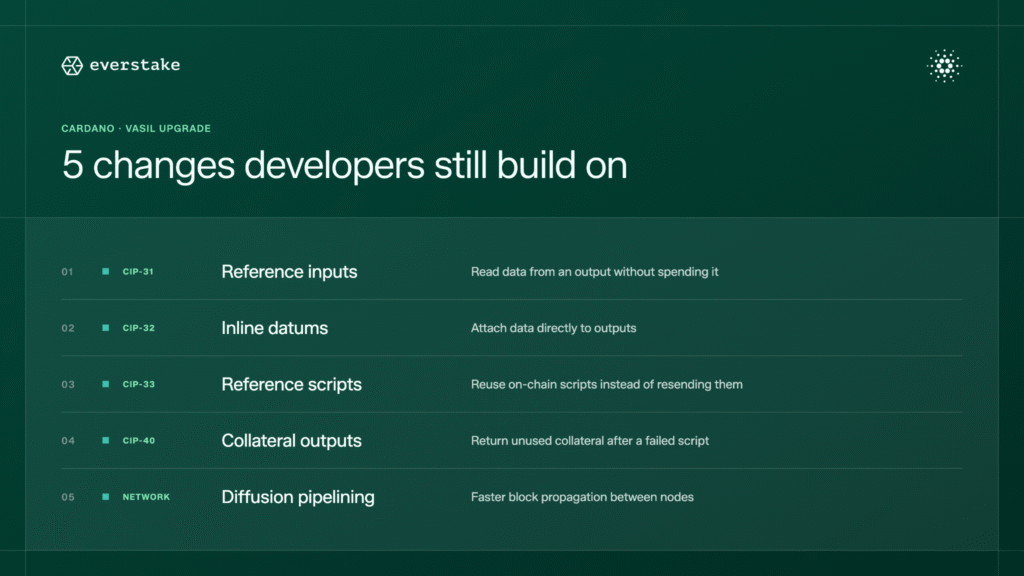
Valentine, in February 2023, added Plutus support for ECDSA and Schnorr signatures over SECP256k1. This lets Cardano applications verify signatures used on other blockchains, including Bitcoin and Ethereum.
Claim 4: It Will Break Under Load
Critics argued that heavy demand or a software bug could halt Cardano. The first test came on January 20, 2022, when the SundaeSwap launch congested the network and users saw failed orders within 2 minutes.
Blocks kept being produced throughout. Orders already on-chain were processed as demand eased, and the Vasil upgrade later raised network throughput.
The harder test came on November 21, 2025, when a malformed transaction exploited a software bug and split the chain in two. Block production continued, the chain returned to a single history after operators upgraded, and Intersect reported no user funds lost.
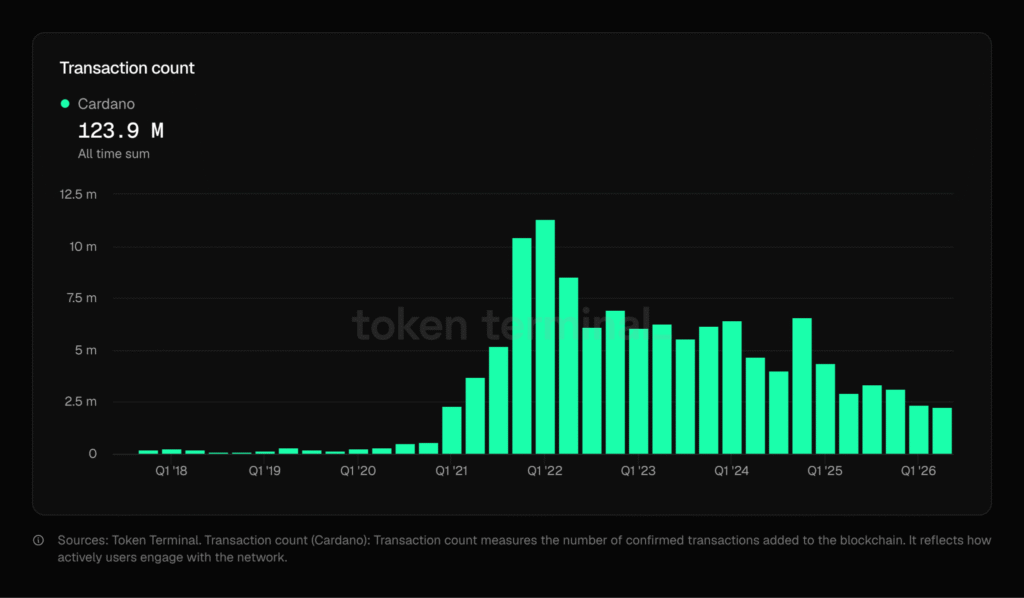
Neither event stopped the network, and community trackers report no full halt in 9 years. By September 2026, mainnet had processed over 123 million transactions.
Claim 5: Governance Is Just a Slogan
Voltaire governance stayed on the roadmap for about 7 years, from the 2017 launch until 2024. Critics questioned whether control over protocol decisions would ever leave the founding entities.
Shelley decentralized block production. The Conway era decentralized protocol decisions. Chang introduced the first CIP-1694 features in September 2024, and Plomin added DReps and treasury withdrawals in January 2025. Every protocol change now needs approval from 3 voting bodies.
The votes have real consequences. DReps rejected a 7.8M ADA Cardano Summit 2026 request at 65.21%, 1.46 points short of the threshold, and the event was cancelled.
Community votes now control upgrades and a treasury of 1.621 billion ADA (April 2026). The open question is concentrated DRep voting power, which Cardano discussed at an official roundtable on April 17, 2026.
Cardano is one of the few major networks where holders vote on both protocol upgrades and treasury spending, and the only one that splits that power across 3 separate bodies under a written constitution.
Claim 6: No Privacy, No Institutional Path
In the past, institutions interested in Cardano faced a problem that Cardano’s main ledger is fully public, so it cannot keep business transaction data confidential.
Cardano now has a privacy chain, Midnight, and regulated ADA futures on CME.
Midnight launched its federated mainnet in March 2026. Its node operators include:
- Vodafone
- MoneyGram etc
It uses selective disclosure to keep transaction data hidden from the public while still visible to authorities.
Regulated market access followed. CME launched ADA futures on February 9, 2026, and Volatility Shares listed 2 futures-based ADA funds in April 2026. Institutions now have regulated futures exposure and a privacy chain for confidential data.
The spot ETF path remains open after Grayscale voluntarily withdrew its registration on August 7, 2026.
Claim 7: It Can’t Scale
Critics tie the “ghost chain” label to Cardano’s low transaction throughput.
Cardano is scaling today through Hydra on layer 2, while Leios and Peras on layer 1 remain in development.
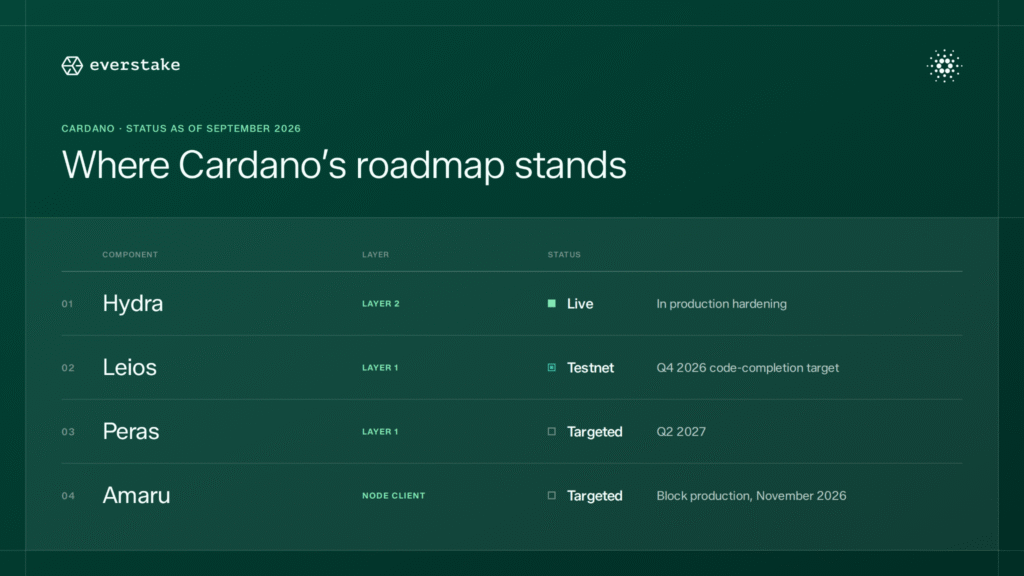
Leios is the main throughput upgrade. IOG requested ₳27.7M to mature Leios into a mainnet-ready release candidate, targeting 10x to 65x throughput capacity through a phased rollout.
The 10x to 65x figures are projections for future mainnet phases. IOG says mainnet capacity would scale from 2x to 30x, with full capacity shown on testnet first.
Hydra extends the layer 2 path. IOG’s 2026 portfolio pairs Hydra production hardening with a Midgard mainnet launch, targeting sub-second finality for applications layer 1 cannot serve alone.
Cardano’s throughput is scheduled to grow, with Hydra shipped and Leios and Peras on public timelines. Whether users fill that capacity is a separate test, and throughput upgrades alone will not settle it.
What Comes Next: Dijkstra, Leios, Amaru
The next hard fork is Dijkstra, split into 2 phases:
- Phase 1: introduces the Dijkstra ledger era and Linear Leios, with a Q4 2026 code-completion target.
- Phase 2: activates Ouroboros Peras through an intra-era hard fork targeted for Q2 2027.
The published schedule treats these dates as estimates. Testing and on-chain governance can extend them.
Peras targets faster settlement. It adds a voting mechanism where committees of SPOs vote on recent chain tips.
Amaru is an open-source Rust node that adds client diversity. Its current status:
- relay capable
- validates to chain tip
- targets mainnet block production for November 2026
What This Means for Institutions
Cardano’s operating model offers 5 features relevant to institutional desks and custodians:
- No lock-up. Delegated ADA stays in the holder’s wallet. There is no lock-up period on Cardano.
- Predictable cadence. Epochs last 5 days, and rewards are distributed per epoch.
- Governance rights. Holders can delegate voting power to a DRep separately from their stake pool choice.
- Live upgrades. Hard forks activate at epoch boundaries through the hard fork combinator, without migrating assets.
- Operator accountability. SPOs vote on hard forks, so pool choice affects protocol decisions.
Everstake operates Cardano pools with:
- enterprise-grade hardware
- backup nodes
- continuous monitoring
Everstake’s pool listings state a reliability rate of 99.98% across supported chains.
Is Cardano Dead?
No. By the measurable signals, the network is active and still shipping.
- Transactions: over 123 million on mainnet by September 2026.
- Upgrades: Van Rossem activated in July 2026 through community votes.
- Governance: treasury proposals pass and fail on-chain every budget cycle.
- Roadmap: Dijkstra, Leios, Peras, and Amaru each have public targets.
The “dead” label usually comes from token price or DeFi activity comparisons. Those comparisons measure market activity, while block production and protocol upgrades measure network operation.
Happy 9th Birthday, Cardano
Cardano started 9 years ago as a federated network with a roadmap and a small, determined community. Today that community runs the network, votes on its upgrades, and decides how its treasury is spent.
In the tradition of the culture of builders, every major critique of Cardano got addressed via a release. The network kept building, one hard fork at a time, and brought its community along at each step.
Year 10 already has a full calendar. Dijkstra and Linear Leios target code completion in Q4 2026, and Amaru targets mainnet block production in November 2026.
The next hard fork will go to the same on-chain vote that approved Van Rossem. For the first time in its history, Cardano enters a new year with its future decided by its own holders.
Everstake has produced blocks on Cardano since 2020 and looks forward to the next era alongside the stake pool operators, DReps, and builders who made the first 9 years possible.
Happy birthday, Cardano. Here’s to the next nine.
Stake and Delegate on Cardano
Share with your network