Institutional
solana
How Solana DvP Standardizes Institutional Settlement
Solana DvP is an open-source escrow program from the Solana Foundation that settles a tokenized asset and its payment in one atomic transaction. It replaces settlement built for each deal, and arrives when the Alpenglow upgrade now targets about 150 ms finality on Solana.
OCT 26, 2026
Last updated OCT 26, 2026 · V1
TL;DR
- On October 5, 2026, the Solana Foundation released Solana DvP, an open-source escrow program for delivery-versus-payment (DvP) settlement on Solana.
- The program gives financial institutions one shared standard for exchanging a tokenized asset against cash in one atomic transaction.
- J.P. Morgan provided input on institutional settlement practices during development.
- The program is the latest of 4 steps in 2026 to speed up institutional settlement on Solana, alongside the Solana Developer Platform, slot times cut from 400 ms to 150 ms finality.
How Institutions Settled Onchain Deals Before Solana DvP
Before Solana DvP, each institutional deal on Solana used settlement mechanics built or arranged for that specific deal or platform. As a result, numerous bespoke smart contracts were created from scratch, and two counterparties could not reuse it.
Traditional securities markets achieve DvP through clearinghouses and central securities depositories. That process ties up capital for 1–2 days per trade.
For example, let’s take the Galaxy Digital deal to see how this worked in practice: the arranger created the token and ran settlement for that one issuance. On December 11, 2025, J.P. Morgan announced it had arranged a U.S. commercial paper issuance for Galaxy Digital on Solana, bought by Coinbase and Franklin Templeton and paid in USDC.
J.P. Morgan created the onchain USCP token and facilitated the DvP settlement of the primary issuance as arranger.
The Settlement Agent Pattern
Before Solana DvP, an institution that wanted atomic settlement on Solana had to assemble it from existing token features. The Solana developer documentation describes a reference pattern for this, built on Token-2022 extensions and USDC:
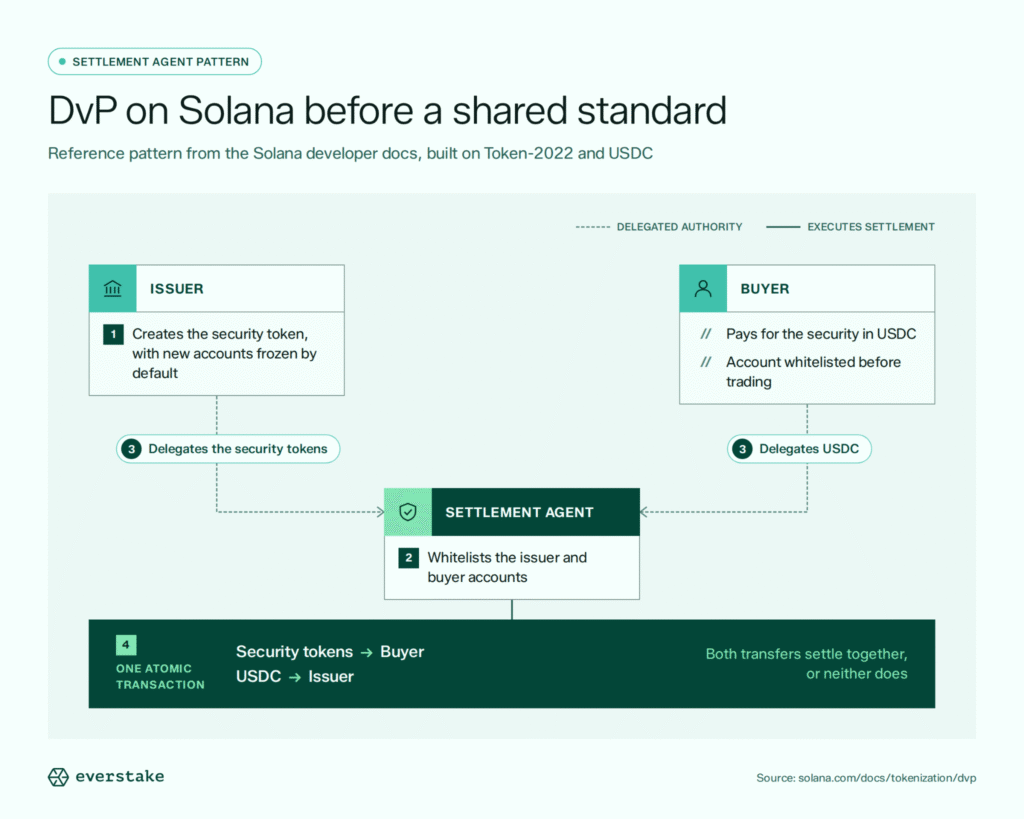
- The issuer creates the security token with new accounts frozen by default.
- A trusted settlement agent whitelists the issuer and buyer accounts.
- The issuer delegates the security tokens, and the buyer delegates USDC, to the settlement agent.
- The settlement agent executes both transfers in one transaction.
The documentation labels this code an educational reference that requires security audits and legal review before production use. Each institution that adopted the pattern had to build and audit its own version.
With Solana DvP, the same process would be repeated through one shared program in 3 steps:
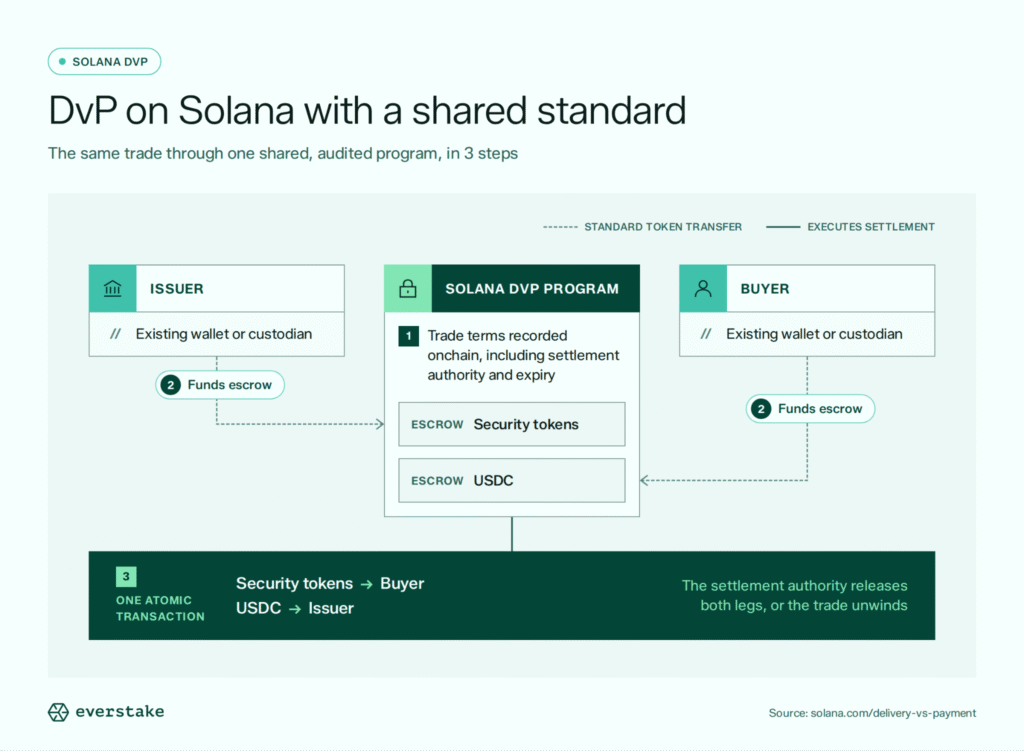
- The trade’s terms, including the settlement authority and expiry, are recorded onchain.
- Each party funds its own escrow account with a standard token transfer from its existing wallet or custodian.
- The settlement authority releases both legs in one atomic transaction, or the trade unwinds.
What Solana DvP Is
Solana DvP is an open-source escrow program, released under the MIT license, that settles both legs of a trade in one atomic transaction. Either the asset and the cash both move, or neither moves.
The Solana Foundation announcement lists 3 core properties:
- atomic settlement of both legs,
- isolated escrow for each trade,
- enforced settlement deadlines.
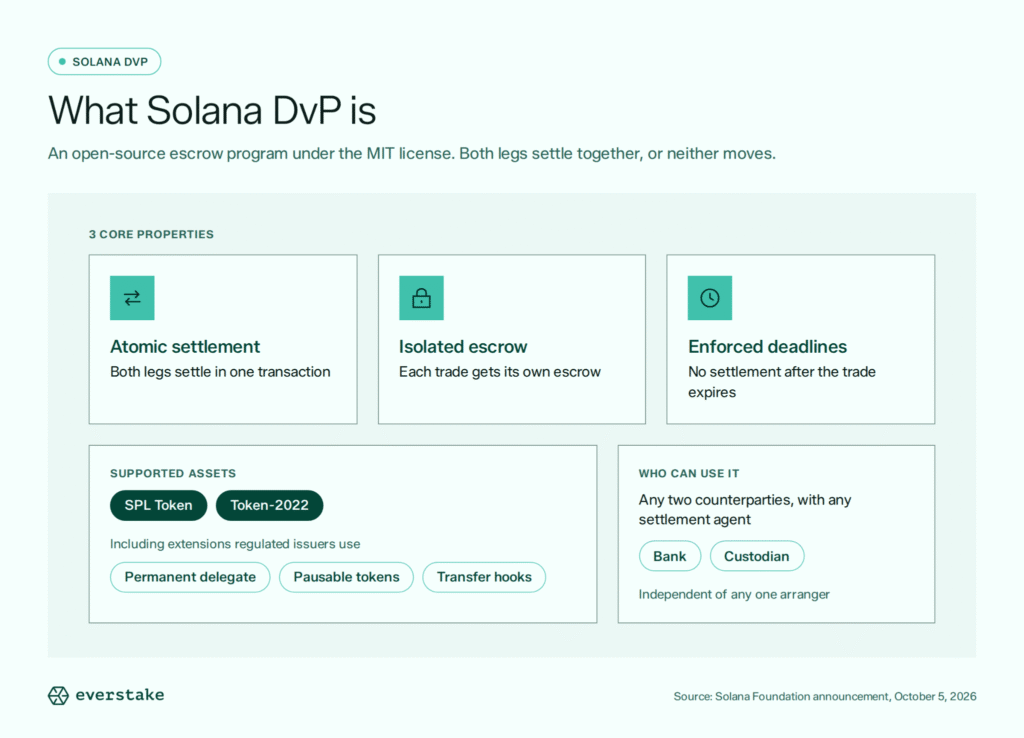
The program supports SPL Token and Token-2022 assets, including the extensions regulated issuers use:
- permanent delegate,
- pausable tokens,
- transfer hooks.
Any two counterparties can use the program with any settlement agent, such as a bank or a custodian. This keeps the program independent of any one arranger.
Cantina reviewed the code in May 2026 and reported 21 findings, including 4 medium-risk issues that were all fixed. The Solana Foundation states the program is ready for use with real funds.
The Solana Foundation is also accepting design partners ahead of a production release and plans to add confidential settlement.
What Changes Now
Solana DvP turns institutional settlement on Solana from a per-deal build into one audited program that any institution can integrate. A deal like the Galaxy Digital issuance can now settle through shared code, with the arranger acting as settlement agent on the common program.
The practical changes for institutions:
- One codebase to review. Risk and compliance teams assess one open-source, externally audited program, and each new deal reuses it.
- Choice of settlement agent. Counterparties pick the agent per trade, and the agent cannot change payment destinations after the trade is created.
- Sub-second settlement. Both legs finalize together in one Solana transaction, with Alpenglow targeting about 150 ms finality, compared with 1–2 days in traditional clearing.
- Compliance controls stay on the token. Token-2022 compliance extensions keep working inside the escrow, and issuers keep their freeze and pause powers.
- Deadlines are enforced onchain. The program rejects settlement after a trade’s expiry time, and either party can recover its funded leg before settlement.
For institutions already settling on Solana, the main change is integration cost. A team that integrates Solana DvP once can settle with every counterparty using the same program.
Solana DvP Is One Step in a Series of Institutional Settlement Upgrades
Solana DvP is the most recent of 4 steps the Solana ecosystem has taken in 2026 to make institutional settlement faster. Each step targets a different part of the settlement path.
- Solana Developer Platform. Payment companies including Mastercard and Western Union joined the platform as early users in 2026 for stablecoin settlement and payments. Solana DvP is available through the platform’s Markets module.
- Reduced slot times. Block time on Solana fell from 400 ms to 200 ms in 4 stages that completed in October 2026.
- Alpenglow consensus upgrade. Alpenglow went live on Solana mainnet at the start of epoch 1064 on October 21, 2026, replacing TowerBFT. The upgrade targets about 150 ms finality, compared with 12.8 seconds under TowerBFT.
Solana DvP standardizes the settlement layer, but atomic settlement is only as reliable as the network confirming it. Institutions settling tokenized securities on Solana still depend on the validator set that processes and finalizes those transactions.
Everstake operates validator infrastructure for tokenization platforms and payment providers, including production validators on Solana, non-custodially and optionally under the institution’s own validator identity. Settlement logic, custody and the settlement agent role remain with the platform, the custodian and the counterparties.
FAQ
What is Solana DvP?
Solana DvP is an open-source escrow program from the Solana Foundation that settles both legs of a trade, the tokenized asset and the cash, in one atomic transaction so that either both move or neither does.
Did J.P. Morgan build Solana DvP?
No, J.P. Morgan provided advisory input on institutional settlement practices, and the Solana Foundation states the bank did not design or endorse the program.
Has Solana DvP been audited?
Yes, Cantina reviewed the code in May 2026 and reported 21 findings, including 4 medium-risk issues that were all fixed.
Can counterparties choose their own settlement agent?
Yes, any 2 counterparties can pick a settlement agent per trade, such as a bank or custodian, and the agent cannot change payment destinations after the trade is created.
Do issuers keep their freeze and pause powers inside the escrow?
Yes, Token-2022 compliance extensions, including permanent delegate, pausable tokens, and transfer hooks, keep working inside the escrow.
How fast does Solana DvP settle a trade?
Both legs finalize together in one Solana transaction, with Alpenglow targeting about 150 ms finality compared with 1–2 days in traditional clearing.
Share with your network