Institutional
Tokenized Assets and the Changing Nature of Stake Demand
Institutions now compare staking to the tokenized U.S. Treasury funds. Growing tokenized value also raises demand for compliant validators and diversified operator sets that secure proof-of-stake settlement.
OCT 23, 2026
Last updated OCT 23, 2026 · V1
TL;DR
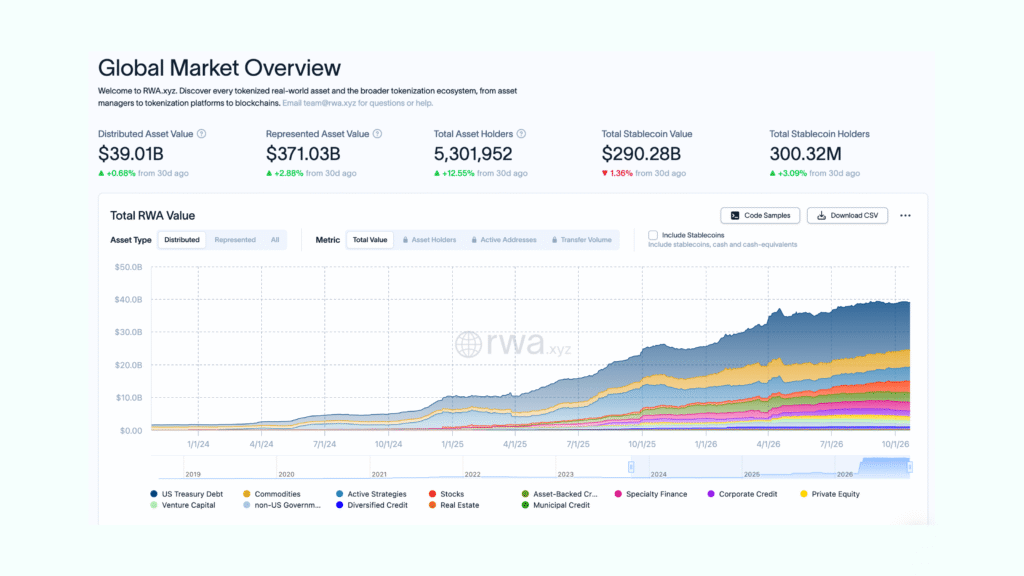
- Tokenized RWAs reached $39.01B in distributed value on October 23, 2026, led by U.S. Treasury funds at $14.64B.
- Those funds showed a 3.61% 7-day rate, a benchmark that ETH staking, at 2.63% gross in Q3 2026, now has to beat.
- Institutional stake increasingly arrives through ETFs and DATs that require predictable reporting and managed exits.
- Tokenized assets raise the value PoS networks protect, so issuers treat stake as infrastructure.
- Exit timing often decides the staking route, because stake must meet redemptions.
- Institutions choose settlement chains per use case, by finality and cost.
- Validator operators compete on accountability and audited controls across chains.
How Large Is the Tokenized Asset Market in 2026?
Tokenized real-world assets (RWAs) held $39.01B in distributed value and $371.03B in represented value as of October 23, 2026, according to the RWA.xyz market overview. Tokenized U.S. Treasury funds held $14.64B on the same date, about 38% of distributed value (RWA.xyz Treasury fund data).
How Come Tokenized Treasuries Set the Benchmark for Staking?
Tokenized Treasuries give institutions an onchain reference rate, so in some sense staking is viewed in comparison to it. Risk teams calculate the spread after deducting:
- slashing risk,
- exit and liquidity terms,
- price volatility of the native asset.
| Instrument | Reference rate | Period | Main exposure beyond the rate |
| Tokenized U.S. Treasury funds | 3.61% (7-day) | October 23, 2026 | Issuer, smart contract |
| ETH native staking | 2.63% gross | Q3 2026 | ETH price, slashing, queues |
| SOL native staking | 5.99% gross | Q3 2026 | SOL price, slashing, issuance |
| Bitwise BSOL | 5.80% net (90-day) | August 2026 | SOL price, fund fees |
ETH staking rate is below the tokenized cash benchmark, while SOL staking rate is above it with more native-asset exposure. Over 96% of Ethereum staking rewards and about 90% of Solana‘s come from new token issuance, according to the Bitwise Staking Report, Q4 2026.
Staking is a distinct position that combines network participation with native-asset exposure.
Where Is Institutional Stake Demand Going?
Institutional stake increasingly enters networks through regulated wrappers that own the client relationship. Bitwise‘s BSOL crossed $1B in AUM in late August 2026 according to Crypto Briefing.
BlackRock‘s iShares Staked Ethereum Trust ETF (ETHB) stakes 70% to 95% of its ETH. Blackrock and the execution agent retain 18% of gross staking rewards (The Block).
Wrapper buyers need four commitments from the staking behind a product:
- reward reporting with a specified calculation method,
- Clear conditions for redemptions,
- slashing coverage or protections defined in contract,
- clear jurisdiction for the staking entity.
Issuers report rewards on different bases, such as gross quarterly rates or 90-day net averages, so allocators must normalize them.
Why Does Tokenization Increase Demand for Network Security?
Tokenized assets raise the value a PoS network protects, giving issuers a direct interest in the stake securing their chain.
Ethereum hosted $16.05B of distributed RWA value on October 23, 2026, against 43.8M ETH staked, roughly $107B at late-October prices.
Bernstein has argued that stablecoin expansion and RWA tokenization support ETH, with fee-driven staking rewards accruing value from Ethereum activity. For an issuer, stake then secures:
- settlement finality,
- collateral positions,
- programmable cash management.
What Limits Stake Demand: Liquidity or Reward Rate?
Liquidity often decides the staking route, because exit timing determines whether stake can meet redemptions. Ethereum‘s entry queue held about 2.5M ETH on July 22, 2026, a wait above 43 days.
Multi-day exit queues and restaking risk could be viewed as asset-liability issues for ETH treasury companies.
How Does Operator Concentration Become a Client Risk?
Concentration among a handful of operators creates a direct risk for institutional clients. Vitalik Buterin has warned that large asset managers accumulating ETH pose a risk to Ethereum‘s decentralization.
On Solana, the validator count fell from 696 to 678 in Q4 2026 as smaller operators exited under cost pressure. Risk teams now treat operator diversification across entities and jurisdictions as a selection criterion.
Which Chain Fits Institutional Settlement?
Institutions typically judge settlement chains on:
- finality,
- cost,
- legal certainty,
- composability.
| Attribute | Ethereum | Solana | Polygon PoS |
| Distributed RWA value (October 23, 2026) | $16.05B | $4.87B | $503.89M |
| Finality | About 12.8 minutes | About 400 ms confirmation | About 5 seconds |
| Staked supply | 35.9% | 69% | 3.6B POL |
| Institutional reference point | ETHB staking ETF | BSOL above $1B AUM | About $0.01 per transaction |
Ethereum offers the deepest liquidity and largest security budget, which suits issuance and collateral. Solana‘s fast confirmation suits trading, and Polygon PoS‘s low costs suit payments and fund distribution.
What Do These Trends Mean for Infrastructure Providers?
Wrapper growth compresses commissions for plain node operation, so competition moves to:
- contractual SLAs and slashing coverage,
- audited controls such as SOC 2 Type II and ISO 27001, DORA assessment etc
- multi-chain coverage,
- reconcilable reward reporting.
The same trends widen demand for independent operators:
- every new wrapper needs validator partners,
- tokenized assets need nodes and RPC endpoints,
- risk teams prefer stake spread across independent operators.
Everstake, founded in 2018, has historically operated 130+ networks and holds SOC 2 Type II and ISO/IEC 27001:2022 certifications. Its Everstake institutional staking service is non-custodial, and Everstake Validator-as-a-Service runs dedicated validators for issuers and custodians.
What Could Weaken This Thesis?
- The RWA base remains small and concentrated in cash equivalents.
- Lower short-term interest rates would reduce the tokenized Treasury benchmark.
- Wrapper growth could commoditize staking faster than providers diversify.
- Institutional networks may default to validator sets run by banks or custodians.
What Should Institutional Allocators Ask a Staking Provider?
- What is the risk-adjusted spread over tokenized T-bills?
- What does the liquidity path look like under stress?
- How are rewards reported and audited?
- What protects against slashing and operator concentration?
- Can the provider support the client’s tokenization roadmap beyond staking?
FAQ
Is ETH staking higher than tokenized Treasuries in 2026?
No, Ethereum‘s gross staking rate was 2.63% in Q3 2026, below the tokenized Treasury rate.
What is a staking ETF?
A staking ETF is a regulated fund that holds a PoS asset and stakes it through a validator partner, such as BSOL or ETHB.
Why is validator concentration a risk for institutions?
It weakens network decentralization and exposes clients to correlated downtime or slashing events.
Which certifications should an institutional staking provider hold?
Clients generally expect SOC 2 Type II and ISO/IEC 27001, with DORA alignment for EU-regulated clients.
Does Everstake take custody of client assets?
No, Everstake operates validators non-custodially while clients keep control of their keys and assets.
Share with your network