Injective
Injective Veyra Upgrade: What Changes on November 24 After 5 Years of Mainnet
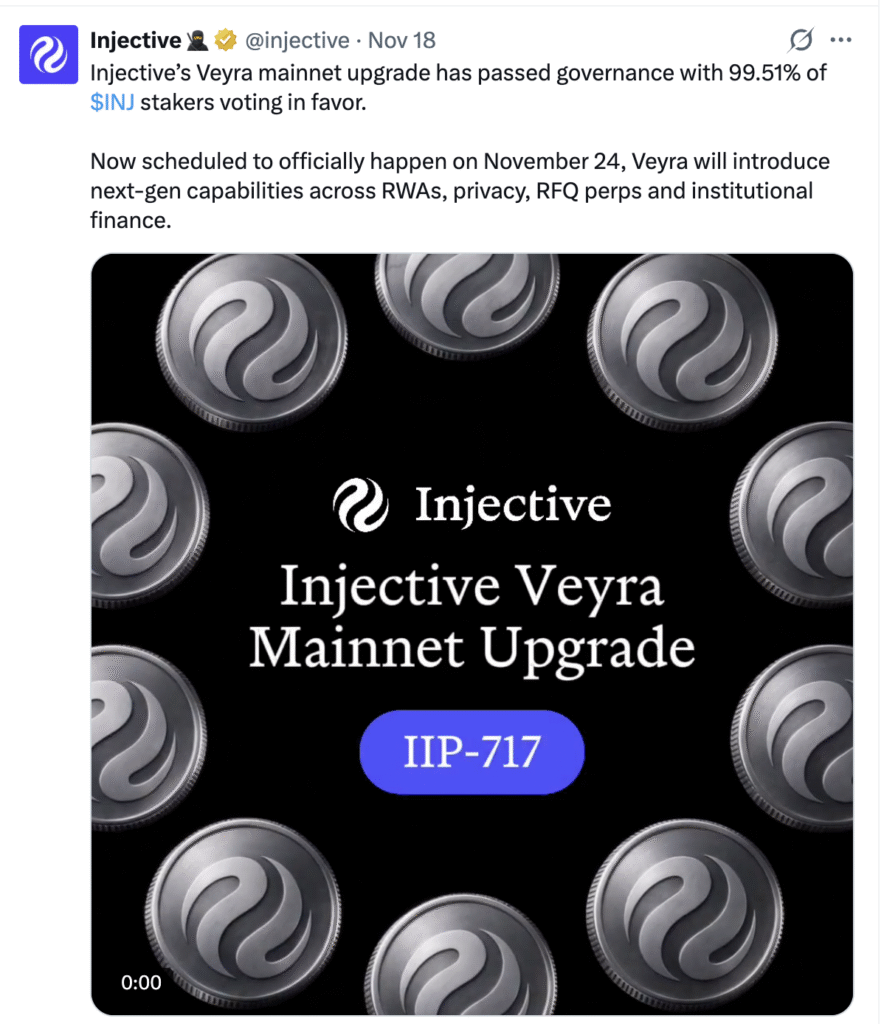
Veyra is the final major mainnet upgrade of 2026 for Injective, and it activates at block 193,145,000 on November 24, 2026. INJ stakers approved it as proposal IIP-717 in the same month the network marked 5 years on mainnet.
NOV 20, 2026
Last updated NOV 20, 2026 · V1
TL;DR
- Veyra (IIP-717, v1.21.0) is going to activate at block 193,145,000 on November 24, 2026, after passing with 99.51% of non-abstaining votes.
- The upgrade adds RWA and RFQ tooling for institutions, plus IBC transfers from the Injective EVM to connected chains.
- CypherOS privacy is in progress, Veyra adds only its groundwork, with no architecture or audit report public yet.
- INJ delegators, including those staked with Everstake, need no action.
- Injective enters its sixth year on mainnet with a record 58.8M INJ staked and the INJC staked ETF listed on Nasdaq.
Injective Veyra upgrade at a glance
Veyra is governance proposal IIP-717, which moves Injective to software version v1.21.0 at block height 193,145,000 on November 24, 2026.
Voting was open from November 12 to November 16, 2026, and the proposal passed with 99.51% of non-abstaining voting power.
| Parameter | Value |
| Proposal | IIP-717 |
| Software version | v1.21.0 (injectived and peggo) |
| Halt height | 193,145,000 |
| Target date | November 24, 2026 |
| Voting period | November 12 to November 16, 2026 |
| Result | Passed with 99.51% of non-abstaining votes |
| Previous major upgrade | Meridian (IIP-701), September 24, 2026 |
What Veyra adds
Veyra brings three groups of capabilities to the Injective mainnet, expanding its support for institutional financial workflows:
- RWA infrastructure for issuing and managing tokenized assets, alongside expanded enterprise access.
- RFQ trading and broader atomic swap capabilities.
- IBC transfers between the Injective EVM and connected chains.
Institutional RWA infrastructure and enterprise gateways
Veyra expands the infrastructure institutions need to bring real-world assets (RWAs) on-chain, manage them, and access Injective through dedicated enterprise gateways. These additions build on Meridian, which introduced regulated RWA token standards to the network on September 24, 2026.
The upgrade also builds on three institutional initiatives already underway across the Injective ecosystem:
- Injective Institutional Services secured SEC transfer agent registration in August 2026, enabling services for maintaining ownership records, processing distributions, and managing corporate actions.
- Institutional Rail, introduced on November 2, 2026, provides dedicated API endpoints that connect institutions to block production while allowing them to retain custody of their assets.
- POSCO International began testing tokenized trade receivables with LG CNS and Injective in July 2026, demonstrating how the network can support the digitization of existing financial instruments.
Together, these developments point to a broader role for Injective in institutional finance. Tokenized assets issued on the network rely on its validator infrastructure for transaction processing and settlement. INJ delegators help secure that infrastructure, connecting the network’s staking economy to the growth of on-chain financial activity. The distinction between announced tokenization volumes and assets actually settled on public blockchains remains important, as explored in our analysis of how much tokenization is actually on-chain.
Everstake provides validator infrastructure for tokenization platforms, supporting the networks on which these assets are issued and transferred.
RFQ trading and expanded atomic swaps
Request for quote (RFQ) gives traders a way to request firm execution prices from liquidity providers before committing to a trade. This approach is particularly relevant to large orders, where execution price and available liquidity matter more than they do for smaller trades.
Veyra also expands atomic swap capabilities, allowing both sides of a trade to settle within a single transaction. Either both transfers complete or neither does.
Together, these capabilities address two important requirements for institutional trading desks:
- Price certainty: Traders can review a firm quote before executing a large order.
- Coordinated settlement: Both sides of a trade settle atomically, removing the risk of completing only one transfer.
RFQ introduces a quote-based execution option alongside the Injective on-chain orderbook, which processed $12.86 billion in trading volume between November 2025 and November 2026. This gives traders an additional way to access liquidity on the network, complementing its existing orderbook infrastructure.
IBC transfers between Injective’s EVM and the interchain
Veyra adds Inter-Blockchain Communication (IBC) support for assets on the Injective EVM, so tokens issued there can move to connected Cosmos chains. The change gives tokenized products issued on the EVM side access to liquidity on other IBC networks.
Native EVM support went live on November 11, 2025, and EVM applications share liquidity with WebAssembly (WASM) applications through the Injective MultiVM design.
CypherOS: what Veyra prepares, and what is not live yet
CypherOS remains in development. Veyra introduces preparatory components, but privacy features will remain inactive after the upgrade goes live on November 24, 2026.
Injective has outlined three planned CypherOS features:
- Shielded transactions could hide transfer details from public view.
- Confidential trading would allow traders to keep their positions and orders private.
- Private RFQ transactions could extend confidentiality to quote-based trades.
Private RFQ testing began with the Meridian upgrade, activated on September 24, 2026. The full privacy suite is expected in a later chain upgrade, although Injective has not announced a release date.
For institutional desks, confidentiality is essential because public order data can expose trading positions and strategies to other market participants. Auditors and regulators, however, must still be able to trace activity. This balance is central to confidential but traceable blockchains.
Other networks already use confidential transfer designs that hide transaction amounts while allowing selective disclosure to auditors. These mechanisms are explored in our overview of confidential transfers. Once Injective publishes the CypherOS architecture and audit, institutions will be able to assess how its design addresses these requirements.
How the November 24 upgrade works for validators
At block 193,145,000, the chain stops producing blocks, and validators replace their node software with the v1.21.0 binary before restarting. Block production resumes once validators holding more than 2/3 of voting power are online with the new version.
The anticipated upgrade agenda:
- The chain halts at height 193,145,000.
- Operators stop the old injectived process and install the v1.21.0 injectived and peggo binaries, or pull the injectivelabs/injective-core:v1.21.0 Docker image.
- Operators check the binary version against commit a13b8b7 and verify the libwasmvm checksum listed in the v1.21.0 release notes.
- Nodes restart, and consensus resumes after validators with more than 2/3 of voting power sign the first new block.
A mismatched libwasmvm hash leads to consensus errors after the restart, so operators verify the checksum before the halt height. The canonical v1.21.0 upgrade guide lists each step.
Since September 9, 2026, Injective publishes release binaries without source code. Operators verify each release through commit hashes and checksums, because the source code is closed.
Injective mainnet paused block production on 2 dates in 2026 before Veyra:
- On August 31, 2026, contributors coordinated an accelerated network upgrade after an exploit hit binary options applications in the ecosystem, and Injective described the event as an upgrade.
- On November 9, 2026, block production stopped at height 191,016,661, and exchanges including Upbit and Bithumb suspended INJ deposits and withdrawals until the chain resumed.
What INJ stakers need to do
INJ delegators need no action for Veyra, and delegations carry through the upgrade unchanged. Staked INJ stays in the delegator’s wallet, bonded to the same validator, at the same amount.
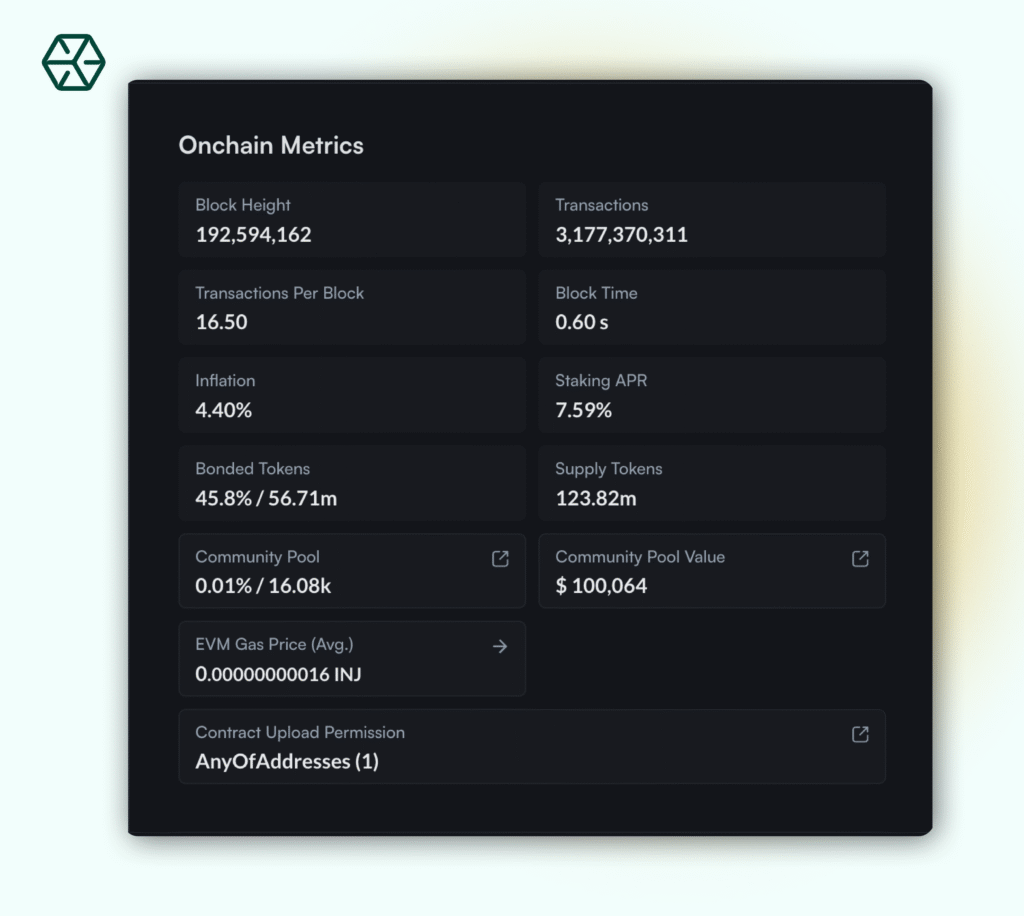
During the halt, block production pauses, and per-block staking rewards pause with it. Rewards resume with the first block on v1.21.0, and Injective distributes them every block, roughly every 0.6 seconds.
Delegators who did not vote on IIP-717 inherited their validator’s vote under standard Cosmos SDK governance rules. A delegator’s own vote replaced the validator’s vote only when cast before voting closed on November 16, 2026.
Transactions submitted during the halt, including new delegations and reward claims, wait until block production resumes.
To delegate INJ after the upgrade, pick a wallet guide:
Delegators can stake INJ with Everstake from the protocol page, which lists the 10% commission and the 21-day unbonding period. Find wallet-by-wallet instructions for other networks in our staking guides.
Five years of Injective mainnet
Injective mainnet launched on November 8, 2021, and its fifth year closed with record staking and a staked INJ ETF listed in the US. Veyra is the first upgrade of the network’s sixth year on mainnet.
Year-five figures, November 2025 to November 2026:
- $12.86B traded on the onchain orderbook, including $1.8B in RWA perpetuals.
- A record 58.8M INJ staked as of September 7, 2026.
- 7,295,039 INJ burned since 2021, of which 517,692 INJ came from 14 Community burn rounds.
- INJ issuance reduced by governance in January 2026 to a range of 2.2% to 4.4% per year.
- The Canary Capital staked INJ ETF, ticker INJC, began trading on Nasdaq on November 5, 2026.
INJC gives allocators access to staked INJ through a brokerage account, while direct delegation keeps custody and governance votes with the holder. The custody and control trade-offs are compared in staking ETFs vs. direct staking.
FAQ
When is the Injective Veyra upgrade?
The Veyra upgrade activates at block 193,145,000, targeted for November 24, 2026, with no fixed time of day.
Do I need to do anything with staked INJ?
No, delegations carry through the Veyra upgrade automatically, and only per-block rewards pause while the chain is halted.
Is CypherOS live?
No, CypherOS remains in development, and Veyra adds only preparatory components for it.
What is IIP-717?
IIP-717 is the governance proposal that approved the Veyra upgrade to v1.21.0, passing with 99.51% of non-abstaining votes.
What happens to INJ transactions during the halt?
Transactions submitted during the halt wait until validators restart the chain on v1.21.0 and block production resumes.
Can institutions stake INJ with a dedicated setup?
Yes, Everstake offers Institutional Staking for custody-compatible delegation and Validator-as-a-Service for a dedicated Injective validator.
Share with your network