The ABCs of Crypto
Non-Custodial Wallet Explained: How It Works and How to Secure It (2026)
A non-custodial wallet keeps private keys with the user, so only the holder can sign transactions and recovery depends on their own backup.
NOV 09, 2026
Last updated NOV 09, 2026 · V1
TL;DR
- A non-custodial wallet keeps the private keys with the user, so only the user can authorize transactions and recovery depends on the holder’s own backup.
- Wallets derive keys from a BIP-39 seed phrase of 12 to 24 words, sign transactions locally, and broadcast the signature to the network.
- There are 4 wallet types with different key-storing and access-recovery techniques, from MetaMask and Trezor to ERC-4337 smart-contract wallets.
- A custodial wallet suits small balances and frequent trading, a non-custodial wallet suits long-term holdings and treasuries, especially in post FTX and Mt. Gox era.
- Staking from a non-custodial wallet means signing a delegation transaction, while Everstake operates validator infrastructure with its own keys.
- Institutions assess multisig or MPC quorums and signer visibility, and Everstake published an independent DORA controls assessment on June 22, 2026.
What Is a Non-Custodial Wallet?
A non-custodial wallet is a wallet where the user holds the private keys and no third party can move the funds. The coins stay recorded on the blockchain, and the wallet stores the keys that authorize spending.
Custodial services hold keys on behalf of users. FTX filed for Chapter 11 protection on November 11, 2022, and customers lost access to balances held on the platform.
The U.S. Department of Justice (DOJ) alleged in a June 9, 2023 press release that attackers gained unauthorized access to Mt. Gox wallets around September 2011 and took about 647,000 BTC over nearly 3 years. One compromised custodian key could expose every customer balance at once.
Control brings responsibility. No support desk can reset a lost seed phrase, so recovery depends on the holder’s own backup.
How Does a Non-Custodial Wallet Work?
A non-custodial wallet generates random numbers, converts them into a seed phrase, derives keys from it, and signs transactions on the user’s device.
The process typically comprises 6 steps:
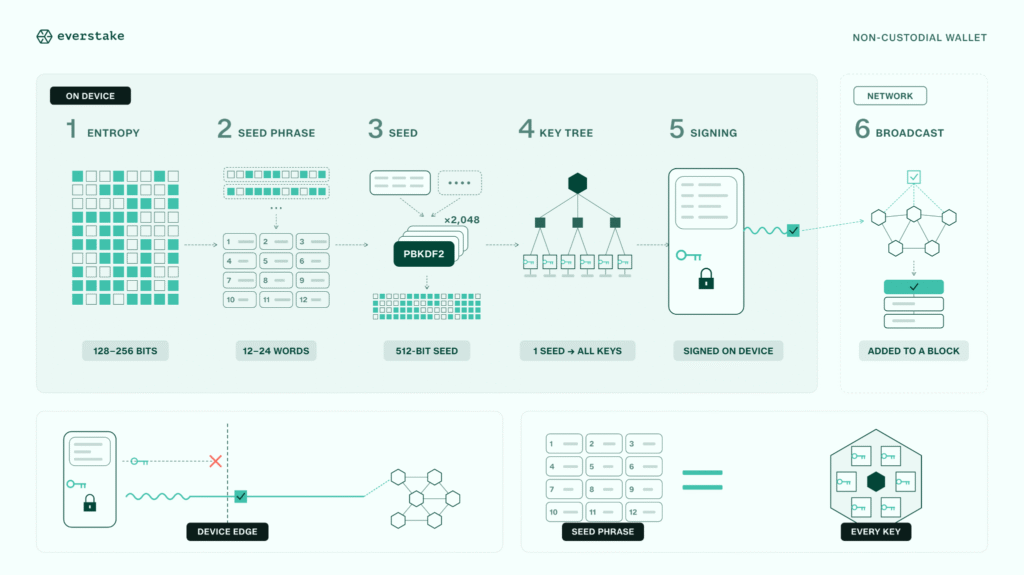
- Entropy generation. The wallet or hardware chip creates 128 to 256 bits of random data.
- Seed phrase encoding. BIP-39 adds a checksum and divides the data into 11-bit segments, and each segment selects one word from a fixed list of 2,048 words. The result is 12 to 24 words.
- Seed derivation. The phrase and an optional passphrase pass through PBKDF2 with HMAC-SHA512 for 2,048 iterations. The output is a 512-bit seed.
- Key derivation. BIP-32 derives a hierarchy of key pairs and addresses from that seed, so one backup restores every account.
- Signing. The wallet builds a transaction and signs it with the private key on the device. The network verifies the signature against the public key.
- Broadcast. The signed transaction reaches network nodes through an RPC endpoint, and validators include it in a block.
Only the signature leaves the device. Anyone holding the seed phrase can recreate every key, so the phrase carries the same authority as the wallet itself.
Which Types of Non-Custodial Wallets Exist?
Non-custodial wallets fall into 4 types, defined by key storage and how the wallet recovers access.
| Type | Examples | Where the key lives | Recovery method | Main exposure |
| Software | MetaMask, Phantom, Exodus, Keplr, Trust Wallet | Encrypted storage on a phone or browser | Seed phrase | Device malware and phishing approvals |
| Hardware | Trezor, Ledger | Secure chip on an offline device | Seed phrase | Blind signing and tampered supply chain |
| Smart-contract (ERC-4337) | Safe | Contract rules plus signer keys | Signer rotation or social recovery | Contract bugs and tampered interfaces |
| Seedless card | Tangem | Chip inside a card | Backup cards | Loss of all cards |
ERC-4337 reached Ethereum mainnet on March 1, 2023. It routes UserOperation objects through an EntryPoint contract, so the account itself defines which signatures are valid.
EIP-7702, activated with the Pectra upgrade in May 2025, extends smart-account features to existing Ethereum externally owned accounts. Wallets such as Trust Wallet have added support for it.
MPC wallets divide a key into shares held by different parties or devices, so no single device holds the full key. The Everstake guide to cold wallet advantages and disadvantages covers hardware storage, MPC, and hybrid setups in more depth.
What Are the Real Attack Paths Against a Non-Custodial Wallet?
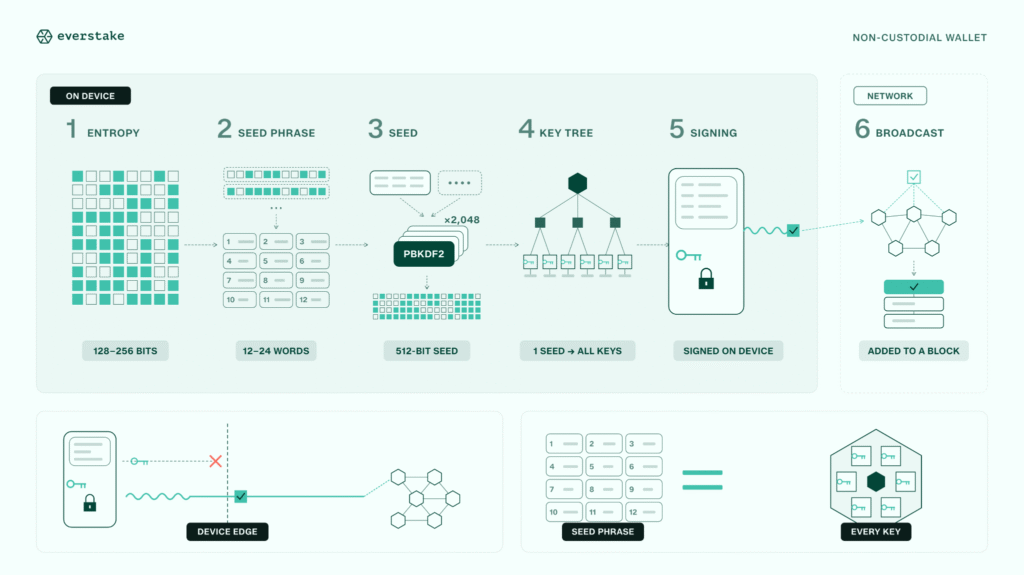
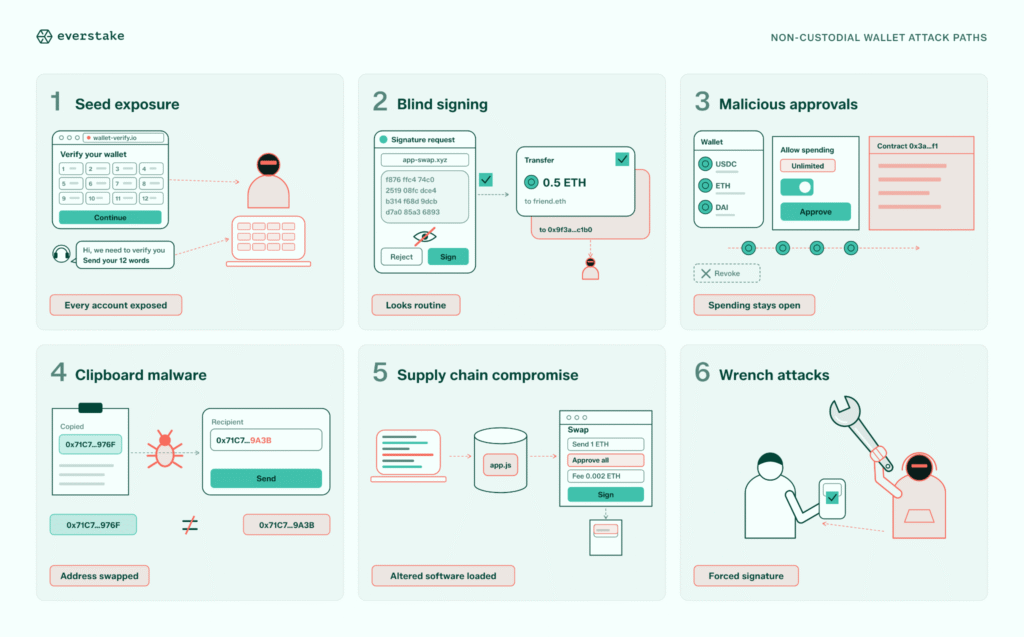
Six attack paths recur in documented non-custodial wallet losses:
- Seed exposure. Phishing pages and fake support agents ask for the phrase, and anyone who obtains it controls every derived account.
- Blind signing. The wallet shows raw data the holder cannot read, so a malicious transaction looks routine.
- Malicious approvals. A token approval lets a contract spend funds until the holder revokes it.
- Clipboard malware. Malware replaces a copied address with the attacker’s address.
- Supply chain compromise. Attackers alter the software that wallets and signers load.
- Wrench attacks. Criminals use physical coercion to force a holder to sign.
On February 21, 2025, attackers drained about 401,347 ETH, valued at roughly $1.4B to $1.5B, from a Bybit cold wallet. Forensic reports found that they had compromised a Safe{Wallet} developer machine and injected malicious JavaScript into the interface Bybit signers used.
The signers approved an altered transaction, and the FBI attributed the theft to the TraderTraitor group linked to North Korea. The cryptography worked as designed, and the displayed transaction differed from the signed one.
CertiK verified 72 wrench attacks in 2025, up 75% from 41 in 2024, with confirmed losses above $40.9M. Its dashboard shows 52 incidents in H1 2026 against 39 in H1 2025.
CertiK reported $1.32B in hack losses in H1 2026, down 46.8% from H1 2025, a period that included the Bybit theft. Quarterly totals were $508.2M in Q1 2026 and $807.5M in Q2 2026.
Five controls reduce exposure to these paths:
- Verify the recipient address and amount on the hardware device screen.
- Use wallets and signers that decode transaction data for clear signing.
- Revoke token approvals that are no longer needed.
- Store the seed phrase offline and consider a BIP-39 passphrase.
- Send a small test transaction before moving a large balance.
Custodial vs Non-Custodial Wallet: Which Fits Which Use Case?
A custodial wallet fits small balances and frequent trading with provider support, and a non-custodial wallet suits holders who want sole control of their keys.
| Factor | Custodial wallet | Non-custodial wallet |
| Key holder | Exchange or service provider | The user |
| Recovery of lost access | Account reset through the provider | Seed phrase or backup cards |
| Counterparty exposure | Provider solvency and security, as in FTX and Mt. Gox | None for key custody |
| Transaction approval | Provider policy and withdrawal limits | The user verifies each signature |
| Typical fit | Frequent trading and small balances | Long-term holdings, treasuries, and staking delegation |
Decision guidance by balance and use case:
- Small balance with frequent trading: a custodial account with strong authentication.
- Long-term holdings: a hardware wallet with an offline seed backup.
- Shared team funds: a multisig smart-contract wallet or an MPC setup.
- Staking from personal keys: a non-custodial wallet that supports delegation.
The Everstake analysis of custodial and non-custodial staking compares the same choice for staked assets.
What Happens When You Stake From a Non-Custodial Wallet?
The wallet signs one transaction that delegates or deposits funds, and the validator never receives the wallet’s private key. The validator operates its own signing keys to attest and propose blocks, and those keys cannot move delegated funds.
Learn more about non-custodial staking from Everstake’s step-by-step guides for 5 wallets:
- Trezor (ETH): the user enters a PIN and confirms the transaction on the device, with a minimum of 0.01 ETH per the guide updated September 10, 2026.
- MetaMask (ETH): the user approves the staking transaction in MetaMask Portfolio.
- Phantom (SOL): the user signs a delegation to an Everstake validator.
- Keplr (ATOM): the user signs a delegation message on the Cosmos network.
- Exodus (ETH): the user approves staking inside the mobile app.
At Everstake, we use states that use multisig and hardware security modules (HSMs) for validator keys, as described in our validator security and key management overview. Wallet builders can add the same staking flow through the Wallet SDK and the Exchanges and Wallets solution.
What Should Institutions Check Before Using Non-Custodial Wallets?
Institutions evaluate a non-custodial setup against the controls that auditors and risk committees review. These checks apply to treasuries, asset managers, and custodians:
- Quorum policy: multisig or MPC thresholds, such as 3 of 5 approvers.
- Signing visibility: hardware signers that display decoded transaction details, since Bybit signers approved an altered transaction.
- Interface integrity: independent simulation of each transaction before approval.
- Role assignment: initiators, approvers, and auditors held by different people.
- Audit trail: a log of every signature request and approval.
Multi-Party Computation (MPC) wallets split private key control into multiple cryptographic shares distributed among participants or devices. A predefined threshold of participants must cooperate to sign a transaction without reconstructing the complete private key. For example, a 2-of-3 configuration requires two participants to authorize a transaction. MPC distributes signing responsibilities while typically producing a single standard blockchain signature.
Multisignature (multisig) wallets require approvals from multiple independent private keys before executing a transaction. They follow an M-of-N model, where a minimum number of signers must approve each transaction. For example, a 2-of-3 wallet requires two out of three signers. Multisig provides shared control, reduces reliance on individual key holders, and supports transparent authorization processes for institutional treasuries and DAOs.
Institutions that stake from their own wallets keep control of their keys, while Everstake operates the validator. The Everstake institutional staking offering and its non-custodial versus managed staking risk framework address custody and slashing risk for finance teams.
Everstake publishes its infrastructure as audited and globally distributed, aligned with:
- SOC 2 Type II,
- ISO 27001,
- NIST CSF 2.0.
Everstake also completed an independent assessment of its ICT controls against selected EU DORA requirements, reviewed by Prescient Security under ISO 19011 and announced on June 22, 2026. The report is available through the Everstake Trust Center for due diligence by EU clients.
FAQs
Is MetaMask a non-custodial wallet?
Yes, MetaMask is a non-custodial wallet because the seed phrase and keys stay with the user.
Can a non-custodial wallet be hacked?
Yes, through compromised software or a seed phrase exposed to attackers.
What happens if I lose my hardware wallet?
The funds stay on the blockchain, and the seed phrase restores access on a new device.
What happens if I lose my seed phrase?
A working device can still move funds to a new wallet, and with the device also lost, no recovery exists.
Is a non-custodial wallet the same as a cold wallet?
No, non-custodial describes who holds the keys, and cold describes whether the keys stay offline.
Can I stake from a non-custodial wallet?
Yes, the wallet signs a delegation or deposit transaction, and a validator such as Everstake operates the infrastructure.
Does a validator hold my wallet keys?
No, a validator holds its own signing keys, which cannot move delegated funds.
Share with your network