solana
web3 infrastructure
Solana Validator Scoring After Alpenglow: What Replaced Timely Vote Credits
Solana’s Alpenglow upgrade removed timely vote credits on Oct 21, 2026, ending the vote-latency score that delegation programs used to rank validators. Stake pools now score validators on vote reward ratios, so commission, skip rate and vote funding matter more.
OCT 29, 2026
Last updated OCT 29, 2026 · V1
TL;DR
- Solana activated the Alpenglow consensus upgrade, retiring TowerBFT and on-chain vote transactions on October 21, 2026.
- The upgrade also removed timely vote credits (TVC), the per-vote latency score that stake pools and the Solana Foundation Delegation Program (SFDP) had used to rank validators since 2024.
- As of October 27, 2026, the largest delegation programs score validators on whether they receive the vote rewards their stake entitles them to.
- Vote latency no longer affects most of these scores.
What Did Timely Vote Credits Measure?
Timely vote credits on Solana measured how fast each validator’s votes landed on-chain under TowerBFT. A vote received a maximum of 16 credits when it landed within 2 slots, then 1 credit less for each additional slot, down to a minimum of 1.
SIMD-0033 introduced the mechanism, and validators approved it in a 2024 governance vote with 98.4% of votes in favor. Its purpose was to remove the incentive to delay votes, a tactic validators used to avoid voting on forks the cluster later abandoned.
Inflation rewards were proportional to credits, so TVC gave every validator a public, latency-sensitive performance score at no extra cost. Delegation programs built their rankings on it:
- SFDP required at least 93% of the cluster average vote credits.
- Jito StakeNet required a vote-credit ratio of at least 97% in every epoch of its 30-epoch scoring window.
- Marinade calculated validator uptime from a stake-weighted average of vote credits.
- Shinobi gave vote latency metrics about 67% of the weight in its score.
Operators tuned hardware and network routing specifically to raise these numbers.
Why Did Alpenglow Remove Timely Vote Credits?
Alpenglow removed on-chain vote transactions, so no vote latency remains for the protocol to grade. Validators now exchange votes directly and aggregate them into BLS certificates, as specified in SIMD-0326.
Vote rewards now follow a pass-or-miss rule:
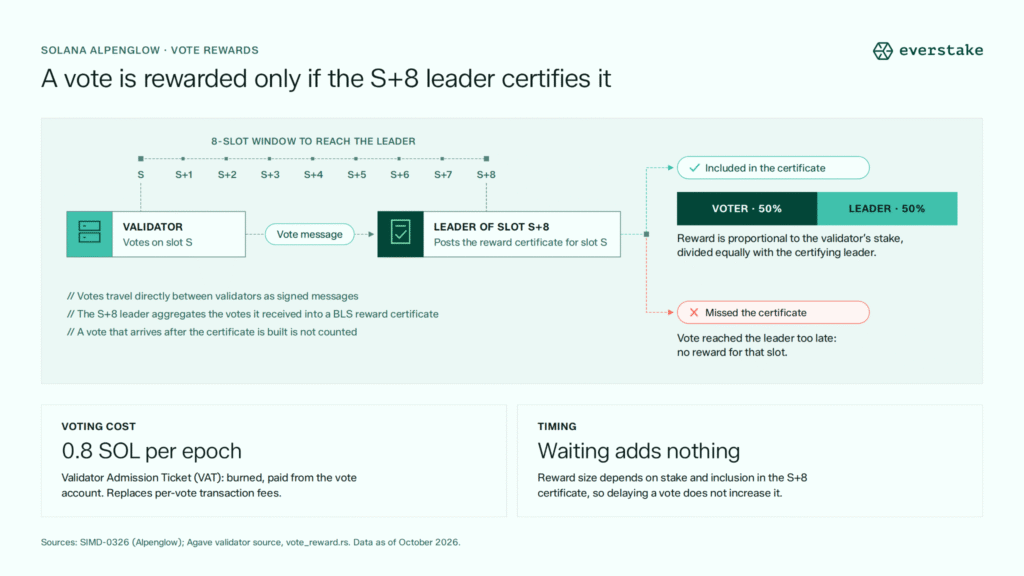
- The leader of slot S+8 posts a reward certificate with the votes it received for slot S.
- A vote included in that certificate receives a reward proportional to the validator’s stake, and a vote that misses it receives nothing.
- Each vote reward is divided equally between the voter and the leader that certified it.
The design removed the incentive to wait before casting a vote. A 0.8 SOL per-epoch Validator Admission Ticket (VAT), burned and paid from the vote account, replaces per-vote fees.
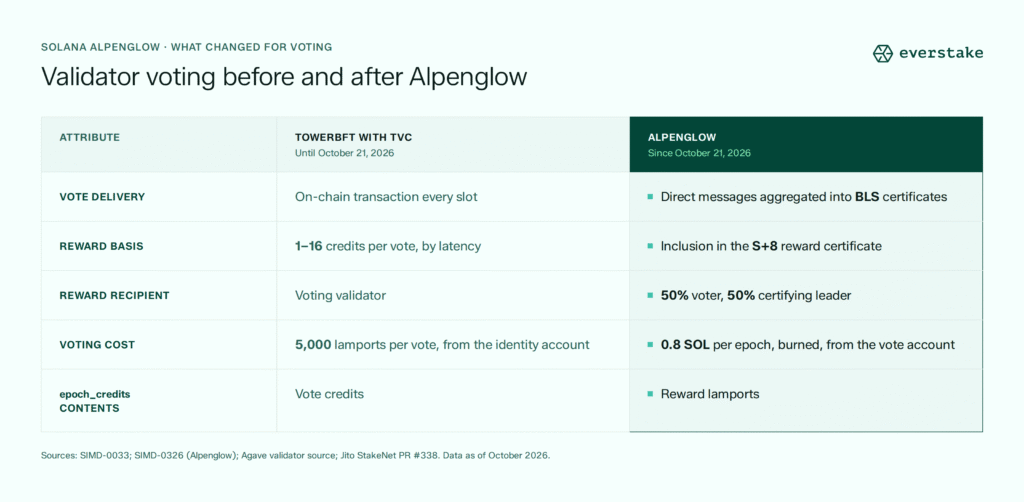
The
epoch_creditsfield in each vote account now records reward lamports, including the leader share. Scoring tools that still read this field as vote credits produce incorrect results.
How Do Delegation Programs Score Validators After Alpenglow?
Programs that have published changes have taken three approaches:
- Reward ratios that divide actual vote rewards by expected rewards (Jito StakeNet, Marinade).
- Dropping the vote-credit threshold (SFDP).
- Location-based selection that no longer uses vote timing (Shinobi).
| Program | Performance input after Alpenglow | Status on October 27, 2026 |
|---|---|---|
| SFDP | Vote-credit threshold at 0%; skip rate retained | Published for epoch 1067 |
| Jito StakeNet | Actual reward ÷ expected reward by stake share | Released October 15, 2026; leader-slot fix in review |
| Marinade | Vote reward ÷ expected reward, on epoch E-1 stake | Merged October 19, 2026 |
| Shinobi | Frontier Score: distance from the network’s stake, measured by global ping probes | Live as the Shinobi Frontier Pool; 65 validators staked in epoch 1066 |
| BlazeStake, JPool | No published post-Alpenglow method | Unverified |
Solana Foundation Delegation Program
SFDP has neutralized its vote-credit criterion. For epoch 1067, mainnet validators need at least 0% of the cluster average vote credits, down from 93% before Alpenglow.
Skip rate is the program’s published performance metric for stake matching: matching stake requires a 5-epoch average skip rate no more than 5 percentage points above the cluster average. Commission caps and data-center concentration limits still apply.
Jito StakeNet
Jito StakeNet scores each Alpenglow epoch as actual reward lamports divided by expected lamports, where expected equals the validator’s stake share of epoch inflation. The ranking order is unchanged:
- Inflation commission.
- MEV commission.
- Validator age.
- Reward ratio.
Instant unstaking judges each Alpenglow epoch after it ends, because rewards are paid at the epoch boundary, and treats missing data as unscorable. A fix approved by 1 reviewer on October 26, 2026 would measure the leader half of rewards against scheduled leader slots, so a small validator with an unlucky leader schedule does not fall below the delinquency threshold.
Marinade
Marinade replaced vote credits with a vote performance ratio: the validator’s Alpenglow vote reward compared with the reward its stake share should receive. The calculation uses epoch E-1 stake, because Agave pays epoch E rewards on a stake snapshot frozen at the start of E-1.
Low-performance alerts trigger below a ratio of 0.5. Marinade‘s public eligibility documentation still describes uptime as a stake-weighted average of vote credits.
Shinobi and Other Pools
Shinobi replaced its latency-based performance pool with the Shinobi Frontier Pool, which stakes well-run validators located far from the network’s stake concentration. Probes around the world ping each validator’s network endpoint to bound its location, and the pool stakes the most remote validators.
In epoch 1066, the pool staked 65 validators with 939,949 SOL, out of 229 qualified and 652 scored validators.
BlazeStake and JPool had not published post-Alpenglow scoring changes as of October 27, 2026.
What Does Alpenglow Scoring Mean for Stakers Choosing a Validator?
Reward-ratio scoring gives a validator that votes in every slot and produces all its blocks a score of about 1.0, so performance scores now separate fewer validators. Stakers comparing validators can focus on the factors that still differ:
- Commission and MEV commission, which rank first and second in Jito StakeNet scoring.
- Skip rate, the only performance test in SFDP and a direct cause of lower reward ratios.
- Vote account funding: a validator whose vote account lacks 0.8 SOL above its rent-exempt minimum at epoch start does not vote or produce blocks in the next epoch, and its delegators receive no protocol rewards for that epoch.
- Client version, since SFDP requires at least Agave 4.3.2 or Jito-Solana 4.3.2, and Harmonic Salsa 4.3.2.
Leaderboards that rank validators by fast-finalization percentage can mislead stakers. In the first hours after activation, an active validator in Rotterdam recorded 0% fast certificates while a passive node in Frankfurt recorded more than 99%, because the metric depends mostly on where the observer is located.
FAQs
Does Solana still use timely vote credits after Alpenglow?
Alpenglow removed timely vote credits (TVC) on October 21, 2026, because votes no longer land on-chain as transactions.
How are Solana validators rewarded for voting under Alpenglow?
A vote is rewarded only when the leader of slot S+8 includes it in a reward certificate, and each reward is divided 50/50 between the voter and the certifying leader.
What does the epoch_credits field show after Alpenglow?
Since October 21, 2026, the epoch_credits field in each vote account records reward lamports, including the leader share.
How much does voting cost a Solana validator under Alpenglow?
Voting costs a flat 0.8 SOL per epoch Validator Admission Ticket (VAT), burned and paid from the vote account.
How do Solana stake pools score validators after Alpenglow?
Jito StakeNet and Marinade divide actual vote rewards by expected rewards, SFDP has set its vote-credit threshold to 0%, and the Shinobi Frontier Pool selects validators by distance from the network’s stake.
What should stakers compare when choosing a Solana validator after Alpenglow?
Commission, MEV commission, skip rate and vote account funding now separate validators more than performance scores do, since any validator that votes in every slot scores about 1.0.
Share with your network