Institutional
solana
What Is Solana Skip Rate and How Is It Calculated?
Solana skip rate measures the share of a validator’s assigned leader slots that end without a block in the canonical chain. What changed after Alpenglow went live on October 21, 2026?
NOV 18, 2026
Last updated NOV 18, 2026 · V1
TL;DR
- Solana skip rate is the share of a validator’s assigned leader slots that ended without a block in the canonical chain.
- Since Alpenglow went live on October 21, 2026, a slot is skipped once a skip certificate gathers votes from at least 60% of stake.
- In order to fairly compare skip rate, use the same epoch range for every validator, because one epoch can mislead.
What Is Solana Skip Rate?
Solana skip rate is the percentage of a validator’s assigned leader slots that end without a block in the canonical chain. A lower figure means the validator built blocks in more of the turns the network handed it.
Before each epoch starts, the network fixes a leader schedule. Validators receive leader slots in proportion to their stake, and each leader builds in a window of 4 consecutive slots.
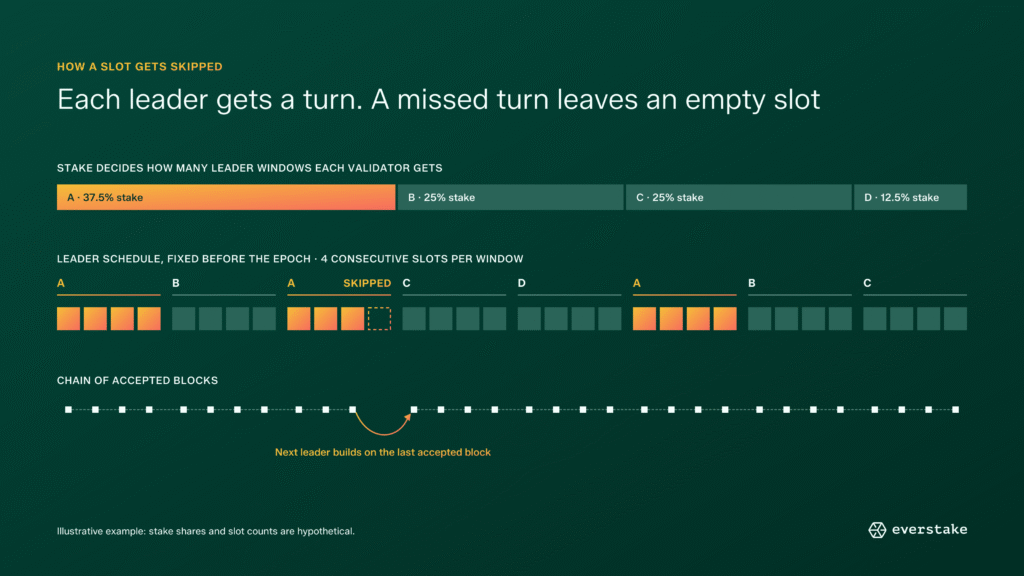
When a leader misses its turn, that slot stays empty and the next leader builds on the last accepted block. The chain keeps moving, though users might see a short pause before their transaction lands.
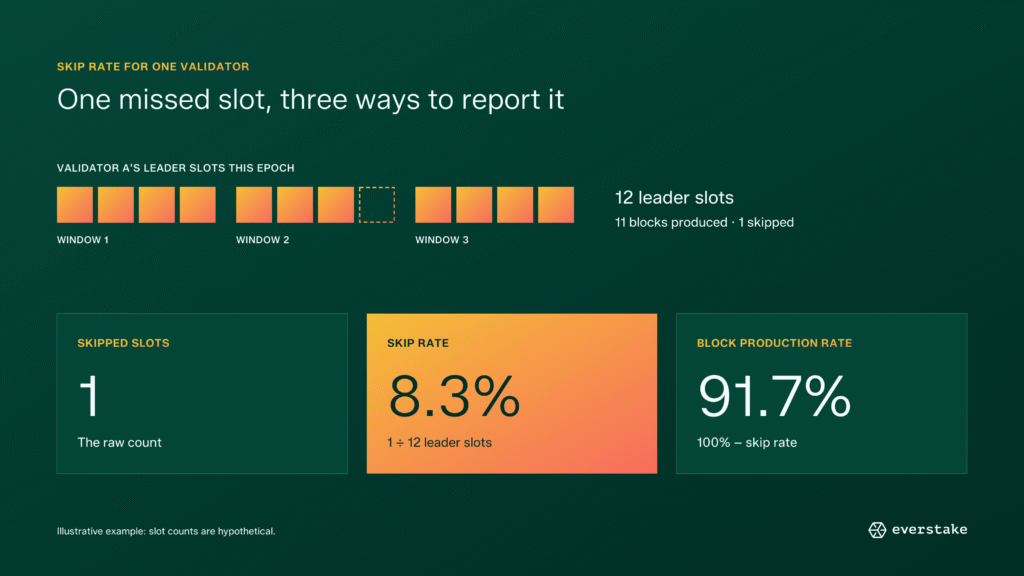
The metric has been in use since Solana mainnet launched, and it still applies under Alpenglow, Solana’s consensus protocol since October 2026. Dashboards and reports may label it differently:
- Skipped slots: the raw count behind the percentage.
- Block proposal miss rate: the label some analytics platforms use.
- Block production rate: the inverse figure, equal to 100% minus the skip rate.
The leader and leader-window design under Alpenglow kept this slot-based structure, so a skip rate measured today reads the same way as one measured in 2024.
How Is Solana Skip Rate Calculated?
Skip rate equals the leader slots a validator missed, divided by all leader slots it was assigned, expressed as a percentage. Both inputs come from one public RPC call.
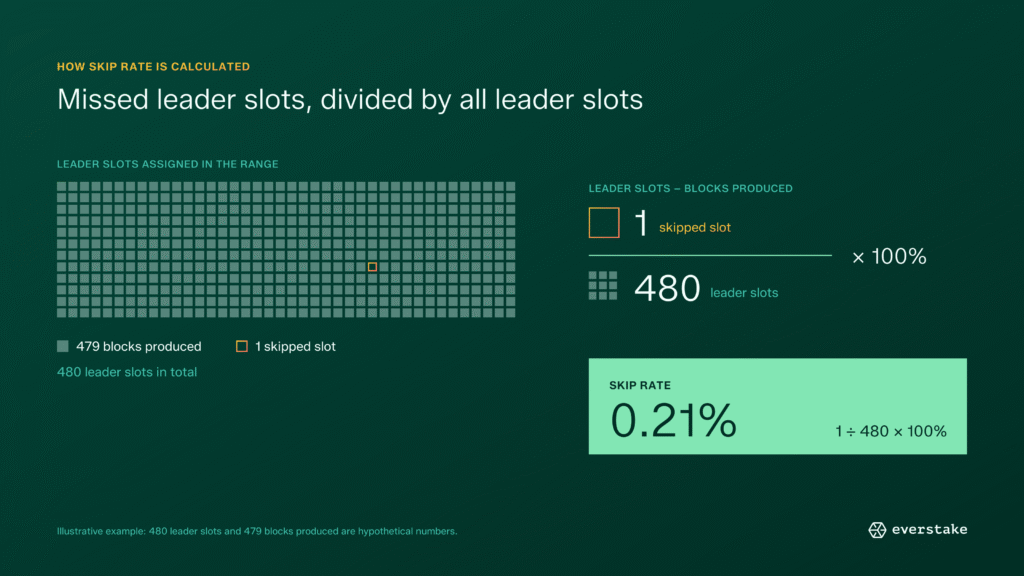
Skip rate = (leader slots − blocks produced) ÷ leader slots × 100%
The getBlockProduction RPC method returns leaderSlots and blocksProduced for each validator identity. It covers the current epoch by default, so a full past epoch needs explicit firstSlot and lastSlot values.
Every epoch holds 432,000 slots, which means epoch 1080 starts at slot 466,560,000. A request for one validator across that epoch would look like this:
{
  "jsonrpc": "2.0",
  "id": 1,
  "method": "getBlockProduction",
  "params": [{
    "identity": "<VALIDATOR_IDENTITY_PUBKEY>",
    "range": { "firstSlot": 466560000, "lastSlot": 466991999 }
  }]
}
If a validator was assigned 480 leader slots and produced 479 blocks. Its skip rate for that range is 1 ÷ 480, or about 0.21%.
Now imagine the same validator had lost one more full leader window of 4 slots. It would have produced 475 blocks, and the skip rate would have climbed to about 1.04%.
Per-Validator, Network-Wide and Stake-Weighted Skip Rate
A per-validator skip rate uses only that validator’s leader slots. A network-wide skip rate divides all skipped slots in the range by all slots in the range.
Large validators hold more leader slots, so they weigh more in the network figure, while a plain average of per-validator rates gives every operator equal weight.
Measurement Window Impacts the Percent
At the 200ms slot target, 432,000 slots lasted about 24 hours, the first full epoch at that target, epoch 1053, averaged 218.3ms per slot and lasted about 26.2 hours. Validators with less stake get fewer leader slots, so one bad window can swing their percentage far more than a large operator’s.
A validator holding 100 leader slots in an epoch would jump from 0% to 4% after one missed window. That is why skip rate should be read across a run of consecutive epochs before anyone draws a conclusion.
What Causes Skipped Slots on Solana?
Slots get skipped when a leader cannot build and share its block in time, or when the network moves on before that block arrives. Some causes fall within the operator’s control, while others come from the network around it.
When slot times were shortened, leaders being offline stayed an operational issue and showed no link to the faster pace.
Operator-side causes:
- The node is offline or restarting during its leader window.
- Replay falls behind, so the leader is not ready to build when its turn comes.
- A client bug blocks production, as the Agave 4.3.2 first-window issue did in October 2026.
- A missed urgent upgrade leaves the node on a minority fork.
- Hardware, bandwidth or data center limits slow block building and propagation.
Network-side causes:
- The previous leader’s block arrives late, which shortens the next leader’s working time.
- Long-distance leader handoffs add latency, and in 2026 data the highest skip rates appeared on Asia to Oceania and Europe to Oceania handoffs.
- Congestion during traffic spikes can delay shreds and votes.
A validator’s location can influence its numbers, a point covered in Everstake‘s research on geographic clustering of validators. The physical setup plays a part as well, and validator hardware choices shape how fast a leader can replay and build.
A validator can keep voting while it misses leader slots. Skip rate and voting uptime therefore describe different parts of a validator’s job, and due diligence should track both.
How Did Alpenglow Change Skip Rate?
Alpenglow kept the formula and changed the process that decides whether a slot counts as skipped. Since epoch 1064, which began on October 21, 2026, validators vote on every slot, and a skip certificate forms once at least 60% of stake votes skip in either of two rounds.
Under TowerBFT, a skipped slot was one that never got a block on the winning fork. Under Votor, the network records an explicit outcome for each slot: notarized, finalized or skipped.
| Aspect | TowerBFT | Alpenglow / Votor |
|---|---|---|
| How a slot ends up skipped | No block lands on the fork the network adopts | A skip certificate reaches 60% of stake |
| Vote data location | Vote transactions inside blocks | Certificates in the block footer, including a skip reward certificate |
| Target slot time | 400ms | 200ms |
| Finality | About 12.8 seconds | Target of about 150ms |
| Voting cost per validator | About 1 SOL per epoch in vote fees | 0.8 SOL per epoch VAT, burned |
Because votes left the block, any tool that parsed vote transactions to track participation had to change. Skip rate itself still comes from the same getBlockProduction data.
Slot time fell from 400ms to 200ms in 4 stages that completed in October 2026. During those stages, the network skip rate stayed stable while the dead time from consecutive skips got shorter.
The Launch-Week Client Issue
The first weeks of Alpenglow showed how a client bug can move skip rates. In epoch 1068, nodes on Agave 4.3.2 skipped 51.9% of first-window slots against 0.05% of other slots, a pattern one stake pool analysis tied to a client fix that had not yet shipped.
Agave 4.4.0, carrying that fix, shipped as a stable release on October 28, 2026. Anyone comparing validators across epochs 1064 to 1079 should keep this event in mind, since it inflated skip rates for operators on the affected version.
What a Skipped Window Costs Now
A leader that skips its window loses the transaction fees and MEV tips that block would have carried. Under Alpenglow, leaders also place reward certificates in their block footers, so a skipped window can reduce staking rewards linked to that work as well.
For deeper context, Everstake has covered what replaced timely vote credits and the fast, slow and skip outcomes under the 20+20 security model.
What Is a Good Solana Skip Rate?
A good skip rate is at or below the network-wide figure for the same epoch range, and it stays there across consecutive epochs. No fixed number works for every period, because the network baseline itself has moved over the years.
Before Alpenglow, the network skip rate reached 0.10% in October 2025, up from 0.07% in September 2025. Earlier that year, the network average had been 0.60% in January 2025.
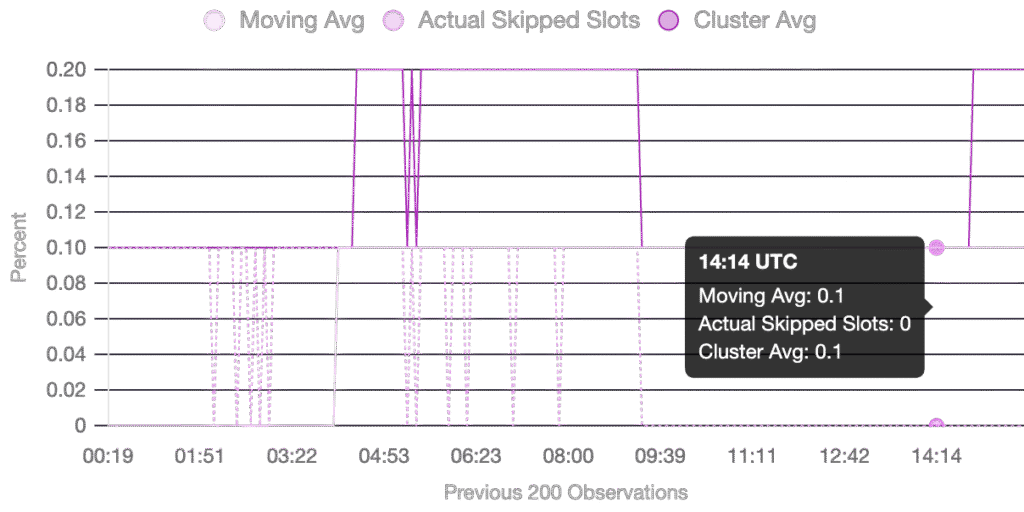
Three checks will make any skip rate easier to read:
- Same range for everyone: compare validators over identical epochs, never one validator’s best week against another’s worst.
- Slot count behind the percentage: a 0.5% rate on 2,000 leader slots tells more than a 0% rate on 20.
- Trend over time: a stable low figure across 10 or more epochs says more than one standout result.
Everstake‘s guide on how to choose a Solana validator covers the other criteria a delegator may want to weigh.
How Should Institutions Use Skip Rate in Validator Due Diligence?
Institutions should treat skip rate as one verifiable operating metric as a part of a wider validator review. Because anyone can pull it from public chain data, it supports independent checks and audit trails for teams such as:
- custodians,
- asset managers,
- exchanges,
- corporate treasuries.
A skipped leader window reduces the block revenue a validator receives. Depending on the validator’s commission settings, part of that revenue may otherwise have reached delegators, so a persistent pattern should come up in the next operator review.
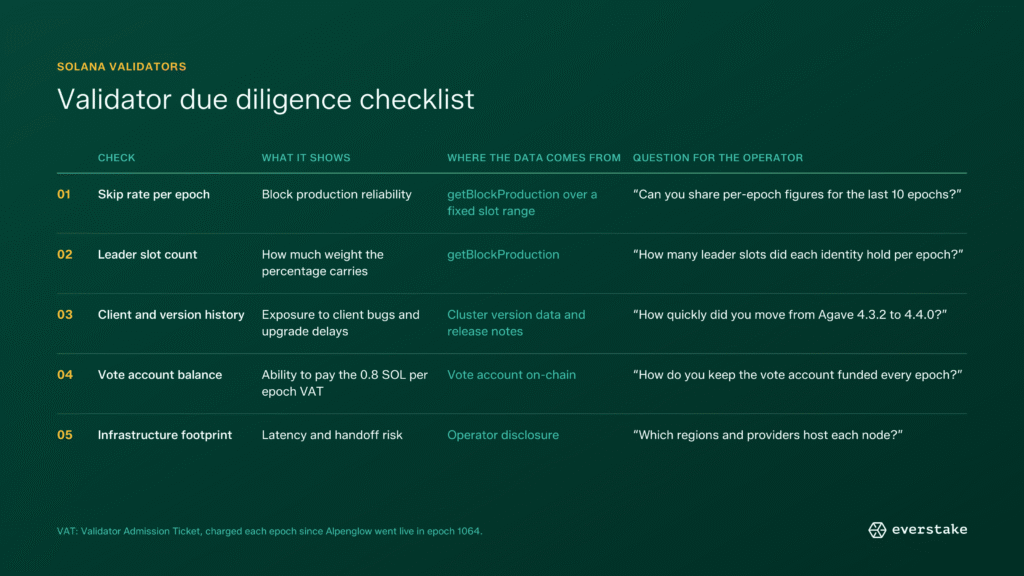
The vote account balance has carried more weight since Alpenglow. If the VAT fee goes unpaid, the validator does not vote or produce blocks in the next epoch, which removes it from consensus and block production for that period.
Institutional reports should state the epoch range, the identity keys and the data source used. That way, a compliance or audit team can reproduce every figure later without relying on a third-party dashboard.
How Everstake Monitors and Reduces Skip Rate
Everstake treats skip rate as an operating metric for its Solana validators and watches it alongside voting and infrastructure health. The company has operated as a non-custodial validator and staking provider since 2018 with 99.98% observed uptime.
Everstake‘s published high-availability setup for Solana validators includes these practices:
- A dedicated operations team monitors infrastructure and services 24/7/365, backed by a separate DevOps team that manages the blockchain services.
- Each validator pairs a primary node with a standby node, so the validator identity can move to healthy hardware when the primary falls behind.
- Failover procedures make sure the previous node has stopped before the standby takes over, which protects against duplicate blocks.
Those same steps shorten the time a validator would spend offline during its leader window. Fewer offline minutes mean fewer skipped slots.
How to Check a Solana Validator’s Skip Rate
Anyone can check a validator’s skip rate with its identity key, a slot range and one RPC call. The process has 5 steps:
- Find the validator’s identity public key, which differs from its vote account address.
- Query getBlockProduction with that identity and a slot range, or open a block explorer that lists leader slots and produced blocks.
- Use the same epoch range for every validator you compare.
- Compare each result against the network skip rate for that range.
- Review the trend across 10 or more epochs before you decide.
Delegators who want to put these checks into practice can stake SOL with Everstake and track the validator’s figures over time. Teams with larger mandates can review Everstake institutional staking.
FAQ
What is a skipped slot on Solana?
A skipped slot is a slot in the leader schedule that ends without a block in the canonical chain, so the next leader builds on the last accepted block.
How do you calculate Solana skip rate?
Subtract blocks produced from leader slots, divide the result by leader slots and multiply by 100%, using getBlockProduction data for a fixed slot range.
Does skip rate affect staking rewards?
Yes, a skipped window costs the validator the fees and MEV tips its block would have carried, and part of that revenue may otherwise have reached delegators depending on commission settings.
What is a good skip rate for a Solana validator?
A good skip rate is at or below the network-wide figure for the same epoch range.
Is a skipped slot the same as validator downtime?
No, a validator can keep voting while it misses leader slots, so skip rate and voting uptime describe different parts of its work.
Did Alpenglow change how skip rate works?
The formula stayed the same, and since October 21, 2026 a slot counts as skipped once a skip certificate reaches 60% of stake.
Where can I check a validator’s skip rate?
You can query getBlockProduction with the validator’s identity key or use a block explorer that lists leader slots and produced blocks.
Share with your network