Institutional
Polygon
Tokenized Fund Growth on Polygon: Institutional Traction
Polygon is gaining institutional traction as a home for tokenized money market and Treasury funds from issuers like BlackRock and Franklin Templeton, backed by low fees, upgrades that ended chain reorganizations, Apex Group’s $100B T-REX Ledger commitment and the Coinme payments acquisition.
OCT 20, 2026
Last updated OCT 20, 2026 · V1
TL;DR
- Polygon’s new positioning states it is a payments company powered by blockchain.
- Polygon ranks 9th of 39 networks by distributed RWA value on RWA.xyz
- Its 4 largest tokenized funds hold about $138.6M.
- Short-term fund data is mixed: BUIDL rose 90.1% over 90 days, while Spiko‘s EUTBL fell 45.4%.
- Fund issuers on Polygon, including BlackRock and Franklin Templeton, focus on money market and short-term government debt funds.
- Polygon PoS fits frequent public transfers at about $0.0001 each, while Polygon CDK serves issuers that need permissioned chains.
- Apex Group committed $100B in tokenized assets by June 2027 to T-REX Ledger, a Polygon CDK chain targeting mainnet in Q4 2026.
- The Coinme acquisition and $2.83B in stablecoins add regulated U.S. payment access for funds.
- The top 5 validators hold 42.6% of staked POL
- Everstake offers 0% commission and 99.98% observed uptime.
What milestones has Polygon reached in 2026?
Last 6 months were filled with exciting news for Polygon’s institutional onboarding. It reached 7 network and institutional milestones between March and October 2026, led by the Apex Group commitment and the Coinme acquisition.
Polygon is an EVM-compatible blockchain network, and its main chain, Polygon PoS, processes payments and tokenized assets at fees near $0.0001.
Polygon Labs, the network’s core development company, has directed Polygon toward payments and real-world assets since 2025. Its 2025 annual review framed the year around payments usage on the network.
The Rio upgrade in October 2025 introduced a block producer model that removed chain reorganizations. A chain reorganization (reorg) happens when the network replaces recently confirmed blocks with a competing version, reversing the transactions in them.
Final settlement without reorgs is a baseline requirement for payment and fund operators.
Tokenized funds reached Polygon PoS before 2026, with Franklin Templeton‘s BENJI and AlloyX‘s RYT among the products on the network.
Polygon also offers Polygon CDK, a toolkit for launching separate chains, and Agglayer, which connects those chains to each other.
Polygon‘s 2026 progress covered 3 areas:
- Network upgrades for throughput and fee predictability
- Regulated securities infrastructure through T-REX Ledger
- Regulated U.S. payments through the Coinme acquisition and Open Money Stack
| Date | Milestone | Status |
| March 19, 2026 | Apex Group commits $100B in tokenized assets to T-REX Ledger, a Polygon CDK chain | Target date June 2027 |
| April 8, 2026 | Giugliano upgrade adds onchain fee parameters under PIP-83 | Live |
| June 2026 | Gas limit rises to 160M, lifting throughput to about 5,000 payments per second | Live |
| July 14, 2026 | T-REX Ledger case study confirms testnet | Mainnet planned for Q4 2026 |
| September 2, 2026 | Open Money Stack completes a SOC 2 Type I examination | Completed |
| September 2026 | $97.9B in monthly stablecoin transfer volume | Reported |
| October 14, 2026 | Coinme acquisition makes OMS a U.S.-regulated payments platform | Completed |
What does recent data show about tokenized funds on Polygon?
Polygon holds about $138.6M across its 4 largest listed tokenized funds. Token Terminal data from October 19, 2026 shows each fund above $14M on Polygon. BUIDL from BlackRock and Securitize posted the largest 90-day increase at 90.1%, reaching $14.2M on Polygon. The fund still remains 33.3% below its level 180 days earlier.
Spiko funds led the declines, with USTBL down 55.2% and EUTBL down 45.4% over 90 days. Polygon network figures on October 19, 2026 (RWA.xyz networks):
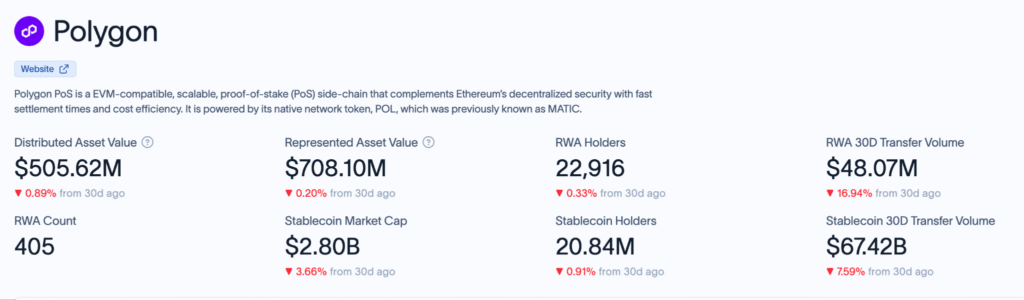
- Distributed RWA value: $509.1M
- Represented RWA value: $728.5M
- Network rank: 9th of 39
- Share of global distributed value: 1.3% of $39.29B
- RWA holders: 22,871
- Stablecoin market cap: $2.83B
- Stablecoin holders: 20.9M
Tokenized funds across all chains reached about $35B in market cap, per Token Terminal data reported on October 8, 2026. The Polygon figure includes its 4 largest listed funds only, so total fund value on the network is actually higher.
Which institutions issue tokenized funds on Polygon?
Polygon PoS hosts fund tokens from at least 5 issuers, with a strong focus on money market or short-term government debt funds.
| Issuer | Fund token | Underlying assets | Named service providers | Polygon detail |
| BlackRock / Securitize | BUIDL | U.S. T-bills, repos, cash | Securitize platform | Live on 9 networks, including Polygon |
| Franklin Templeton | BENJI | U.S. government money fund | Benji platform | Launched on Stellar in 2021, later expanded to Polygon |
| Spiko | EUTBL, USTBL | Eurozone and U.S. T-bills | EU money market fund framework | EUTBL holds T-bills with under 6 months to maturity |
| Fasanara Capital | FAST | Money market fund | Apex Group (administrator), Tokeny (transfer agency) | Launched on January 21, 2025 |
| AlloyX | RYT | U.S. Treasurys, commercial paper | Standard Chartered (custodian, Hong Kong) | Launched exclusively on Polygon in October 2025 |
AlloyX runs RYT on daily cycles with T+1 settlement and publishes selected fund data onchain (Polygon blog).
Fasanara Capital manages over $4B and launched FAST on Polygon PoS with Fireblocks and Chainlink as technology partners (Apex Group).
Spiko‘s EUTBL operates as a licensed EUR money market fund under the EU regulatory framework (Polygonscan).
The Everstake overview of tokenized money market and index funds in 2026 lists BUIDL on 9 networks and BENJI on 6 or more networks.
How do Polygon’s architecture and costs suit tokenized fund use cases?
Polygon PoS suits funds that need frequent, low-cost public transfers. Polygon CDK suits issuers that need a permissioned chain with their own access controls.
Polygon PoS network specifications relevant to fund operations:
- Transaction cost: about $0.0001 per transaction
- Finality: 2 to 5 seconds after the Heimdall v2 upgrade
- Throughput: about 5,000 payments per second after the 160M gas upgrade in June 2026
- Fee predictability: onchain fee parameters under PIP-83, shipped in the Giugliano upgrade
- Reorg risk: removed by the Rio upgrade’s block producer model, live since October 2025
- Reported network uptime: 99.999%
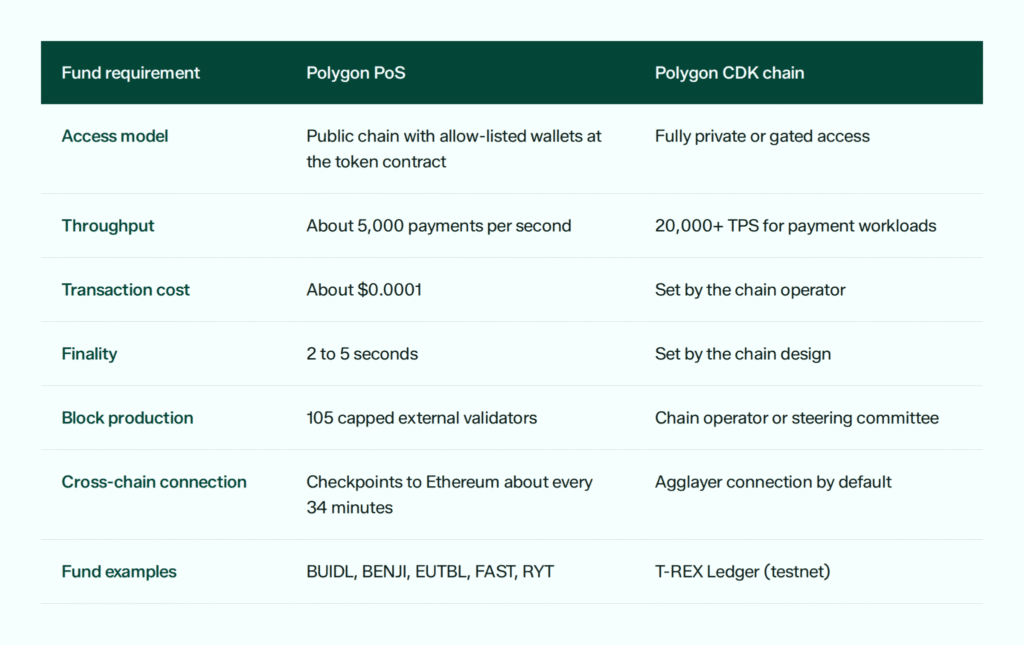
Sources: Polygon CDK docs and Everstake Polygon validator guide.
Fund operations where low fees and fast finality apply on Polygon:
- Daily subscription and redemption cycles, such as RYT‘s T+1 settlement.
- Transfers between allow-listed wallets in different jurisdictions, such as Spiko funds under the EU framework.
- Stablecoin cash legs, supported by $2.83B in stablecoins on Polygon.
- Collateral transfers in onchain markets, where 2 to 5 second finality shortens settlement windows.
Token contracts on Polygon PoS show balances and transfers on Polygonscan to any viewer, so issuers control access through allow-lists at the contract level.
Which institutional infrastructure supports tokenized funds on Polygon?
3 institutional developments support tokenized funds on Polygon:
- T-REX Ledger, a compliance chain for tokenized securities
- Regulated U.S. payment access through the Coinme acquisition
- Stablecoin settlement on Polygon PoS
How does T-REX Ledger extend Polygon to regulated securities?
The largest commitment comes from Apex Group, which targets $100B in tokenized assets by June 2027. Apex Group announced its T-REX Ledger commitment on March 19, 2026, naming the chain its default multichain infrastructure for tokenized funds. T-REX Ledger gives Polygon a regulated-securities use case for its CDK toolkit, connecting Apex Group’s tokenized assets to the Polygon ecosystem through Agglayer.
T-REX Ledger is a compliance chain built with Polygon CDK and connected through Agglayer. The chain runs the ERC-3643 standard.
Apex Group services $3.5T in assets and will act as the first onchain transfer agent on T-REX Ledger. The ERC-3643 standard has been used to tokenize over $32B in assets across 140+ institutions. Named users include:
- DTCC
- Deloitte
- ABN AMRO
- Fireblocks
As of October 20, 2026, T-REX Ledger is still on testnet, with mainnet planned for Q4 2026.
The chain’s token standard, ERC-3643, is open-source code maintained by the ERC-3643 Association and available to any issuer. A steering committee sets the rules for T-REX Ledger itself.
Onchain issuance on T-REX Ledger becomes measurable after the mainnet launch planned for Q4 2026.
What does the Coinme acquisition add to Polygon’s payment tech?
The Coinme acquisition makes Polygon Open Money Stack (OMS) a U.S.-regulated payments platform that connects onchain money to bank accounts and cash. Polygon Labs completed the deal on October 14, 2026, as Polygon Labs executive Marc Boiron announced on X.
The acquired payments business covers 48 U.S. states through 37 state money transmitter licenses and 11 applicable exemptions.
The business is registered with FinCEN as a money services business (MSB), and each license applies within its own scope.
OMS capabilities listed in the announcement:
- Bank transfers into and out of stablecoins over 5 networks, including FedNow and SWIFT
- Debit card transfers into and out of stablecoins
- Named virtual accounts for U.S. and non-U.S. businesses and individuals
- Physical cash deposits and withdrawals of stablecoins at retail locations
- Custodial and non-custodial wallets
- KYC and KYB checks with sanctions screening
- Cross-chain and cross-asset routing
OMS bank connections can serve the fiat side of tokenized fund subscriptions and redemptions on Polygon.
How much stablecoin activity runs on Polygon?
Polygon reported over $3T in cumulative stablecoin transfer volume, with $97.9B recorded in September 2026.
Stablecoins on Polygon reached $2.83B in market cap, which gives fund issuers enough flexibility.
What does tokenized fund activity mean for Polygon staking and validator competition?
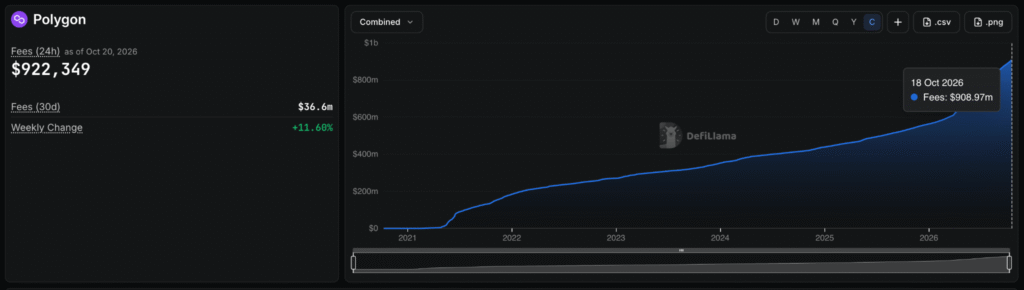
Tokenized fund transfers pay fees in POL. The Rio upgrade distributes fees between the block producer and other validators. Cumulative fees on Polygon exceeded $908M as of October 20, 2026.
Polygon PoS staking figures on October 19, 2026 (Polygon validator dashboard):
- Active validators: 105 of 105
- Total staked: 3.57B POL
- Delegators: 28,532
- Checkpoint interval to Ethereum: about 34 minutes
- Slashing: inactive as of mid-2026
The top 5 validators hold 42.6% of staked POL, and 3 of them are exchange-run operators. Fund issuers can treat that concentration as a network risk input, because those validators produce the blocks that settle fund transfers.
Operator competition on Polygon PoS works through 5 factors:
- Slots: the active set is capped at 105, so new operators enter only when a slot opens.
- Removal: PIP-4 allows validators with sustained poor performance to be off-boarded from the active set.
- Commission: validators typically charge between 0% and 10% commission.
- Performance: delegators check checkpoint signing rates, with 99% to 100% as the common target (Everstake guide to choosing a Polygon validator).
- Concentration: delegating outside the top 5 reduces the 42.6% share held by 5 operators.
Institutions holding POL beyond their transaction fee needs can delegate it through Polygon staking contracts on Ethereum mainnet.
Delegation on Polygon is non-custodial: the delegator keeps sole control of the private keys. Everstake operates a non-custodial validator on Polygon PoS with 0% commission and no minimum stake.
Everstake has run validators since 2018, with 99.98% observed uptime on geographically redundant bare-metal infrastructure. The validator infrastructure provider has supported 130+ networks to date, building operational experience across different consensus designs and network upgrade cycles, suitable for institutional workload.
FAQ
Where does Polygon rank for tokenized assets?
Polygon ranks 9th of 39 networks by distributed RWA value on RWA.xyz, with a 1.3% share.
Which tokenized funds are issued on Polygon?
Polygon hosts money market fund tokens such as Spiko‘s EUTBL and Franklin Templeton‘s BENJI.
How much does a transaction cost on Polygon?
A Polygon PoS transaction costs about $0.0001, according to Polygon documentation. Finality takes 2 to 5 seconds after the Heimdall v2 upgrade.
What is T-REX Ledger on Polygon CDK?
T-REX Ledger is a compliance chain for tokenized securities built with Polygon CDK and the ERC-3643 standard.
How many validators secure Polygon PoS?
Polygon PoS has 105 active validators, which is the current cap.
Does tokenized fund activity affect Polygon staking?
Yes, indirectly, because fund transfers pay fees in POL that the Rio upgrade distributes among validators.
How can an institution stake POL on Polygon with Everstake?
An institution can delegate POL to the Everstake validator through the dedicated Polygon staking page or via contact us form, if you’re looking to talk to a staking professional.
Is Apex Group’s $100B already tokenized on Polygon?
No, the $100B figure is a target for T-REX Ledger through June 2027. T-REX Ledger runs as its own Polygon CDK chain, so its assets are counted apart from Polygon PoS.
What does the Coinme acquisition mean for Polygon?
Polygon Labs completed the Coinme acquisition on October 14, 2026, making Polygon Open Money Stack a U.S.-regulated payments platform. The acquired business holds 37 state money transmitter licenses and 11 exemptions, covering 48 states.
Share with your network