Aptos
Institutional
Aptos Token Unlock Schedule and What Follows It
Aptos placed investors and core contributors on a four-year unlock schedule at launch, and that cycle concludes in October 2026. After it ends, scheduled supply increases fall sharply and the remaining new supply comes from staking rewards rather than vesting.
SEP 30, 2026
Last updated SEP 30, 2026 · V1
TL;DR
- Aptos core contributor and early backer vesting had its last release on September 12, 2026, with the formal end on October 12, 2026.
- Monthly releases fall from 11.31M APT to 4.54M APT, a 60% drop, all to Community and Aptos Foundation pools.
- About 63% of all APT is staked, and staked tokens take up to 14 days to withdraw.
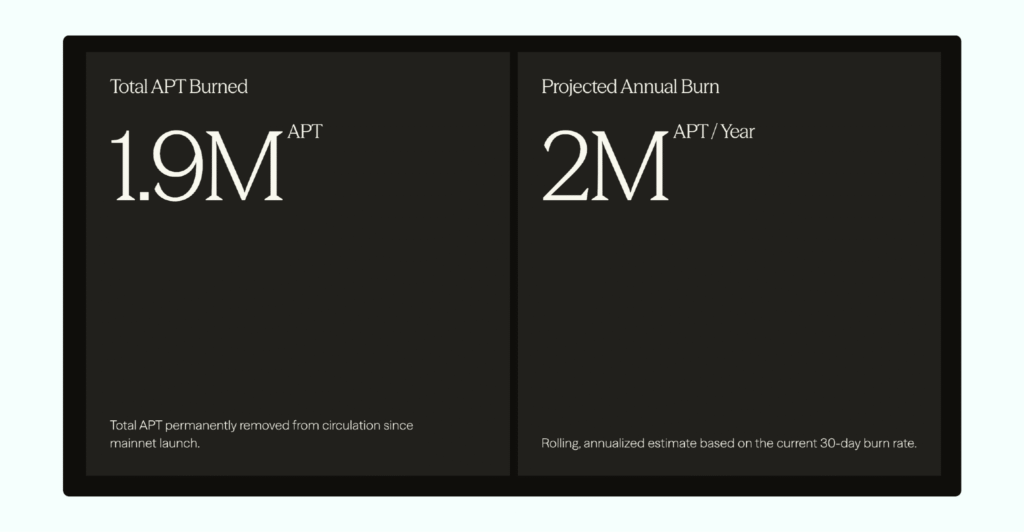
- Staking rewards drive new supply: about 20.9M APT per year against 1.9M APT burned since launch.
- A 2.1B APT hard cap and a reward rate cut from 5.19% to 2.6% issuance.
- Aptos staking rewards depend on the network rate, the staked amount, and how reliably the validator proposes and votes on blocks.
A token unlock is a scheduled release of tokens that were locked at launch, a process called vesting. Aptos locked the APT of its core contributors and early venture capital (VC) backers for 4 years after the network went live.
That 4-year cycle concludes in October 2026. The last monthly release reached these groups on September 12, 2026. The Aptos Foundation marks October 12, 2026, the fourth anniversary, as the formal end.
After the cycle closes, scheduled monthly releases drop by about 60%, and staking rewards become the main source of new APT. The key supply figure becomes the share of APT that is staked, since staked tokens take up to 14 days to withdraw.
Everstake has operated as an Aptos node operator since the network launched in October 2022. Network changes from this year appear in the Aptos news roundup for 2026.
The APT Unlock Schedule
The APT unlock schedule releases the genesis supply, the 1B APT created at launch, between October 2022 and October 2032. Core contributors and early backers finished vesting in 2026, and the Community and Aptos Foundation pools keep releasing monthly until 2032.
| Category | Initial allocation | Share of genesis supply | Vesting terms |
| Community | 510.22M APT | 51.02% | 125M APT at launch, then 1/120 of the rest monthly |
| Core contributors | 190M APT | 19.00% | 12-month cliff, then monthly releases to month 48 |
| Aptos Foundation | 165M APT | 16.50% | 5M APT at launch, then 1/120 of the rest monthly |
| Early backers | 134.78M APT | 13.48% | 12-month cliff, then monthly releases to month 48 |
A cliff is a waiting period during which none of a group’s tokens are released. The fraction 1/120 means each pool releases one equal share per month for 120 months, or 10 years.
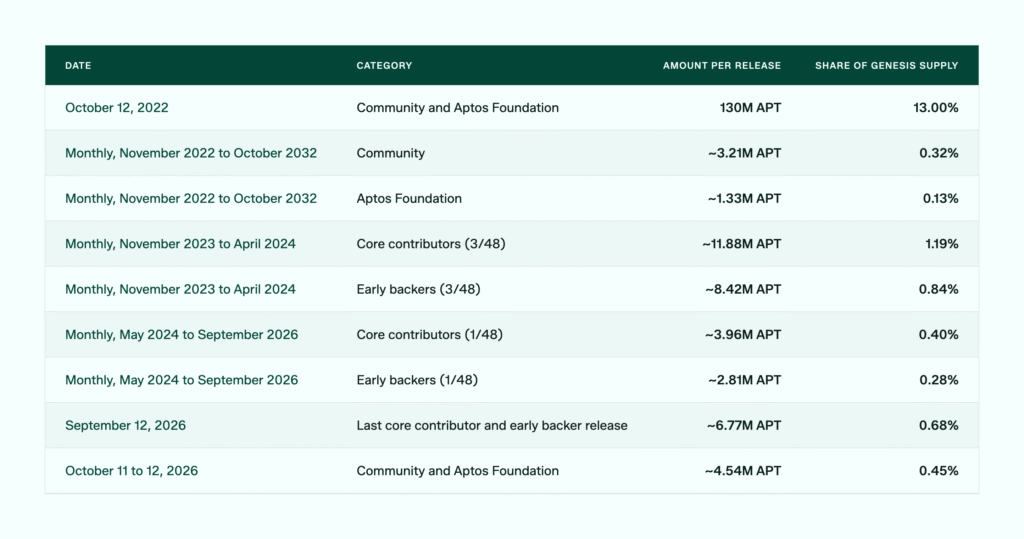
Amounts are rounded from the fractions in the Aptos Foundation tokenomics overview, with releases around the 12th of each month.
Tracker data from DropsTab shows 331.69M APT of the genesis supply still locked in vesting.
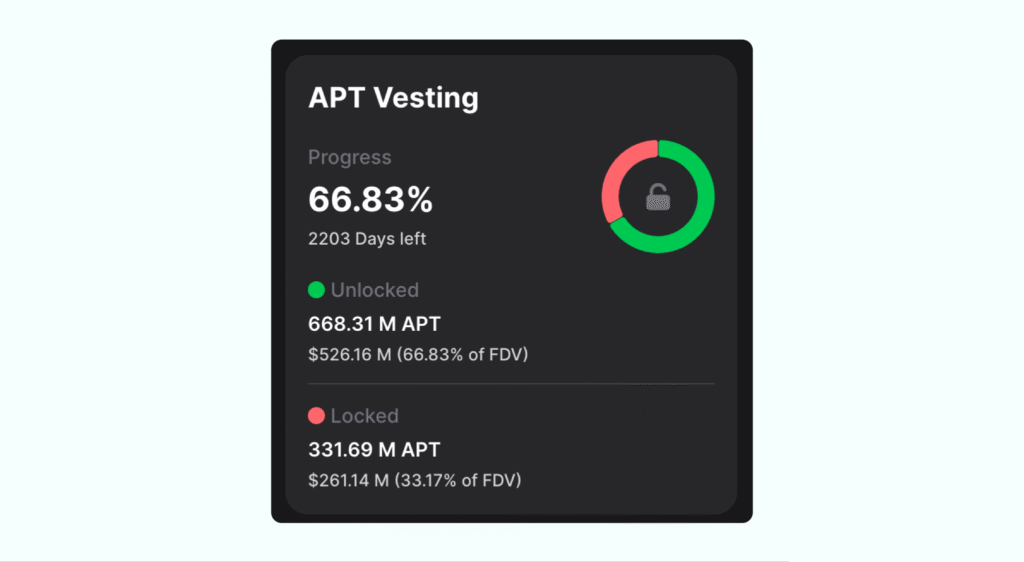
All of it belongs to the Community and Aptos Foundation pools.
What Ends for Aptos in October 2026
The 4-year vesting period for core contributors and early backers ends in October 2026. Together, these two groups held 324.78M APT, or 32.48% of the genesis supply.
Their tokens were released in three phases:
- No tokens were released during the first 12 months after launch.
- From month 13 through month 18, each group received 3/48 of its allocation per month.
- From month 19 to the 4-year mark, each group received 1/48 per month.
The Aptos Foundation schedule counts the 4-year anniversary, October 12, 2026, as the end date.
The 11.31M APT monthly release combined 6.77M APT for these two groups and 4.54M APT for the Community and Aptos Foundation pools. Once the 6.77M APT share stops, only the 4.54M APT portion continues.
Annual scheduled releases fall from roughly 135.7M APT to 54.5M APT, the 60% cut the Aptos Foundation tokenomics update estimated.
Circulating Supply vs Free Float
Circulating supply counts APT that has left vesting. Free float is the part of circulating supply that holders can dispose of as they wish.
Circulating Supply vs Total Supply
Total supply counts every APT in existence, locked or unlocked. It grows when staking rewards create new tokens and shrinks when transaction fees are burned, or permanently destroyed.
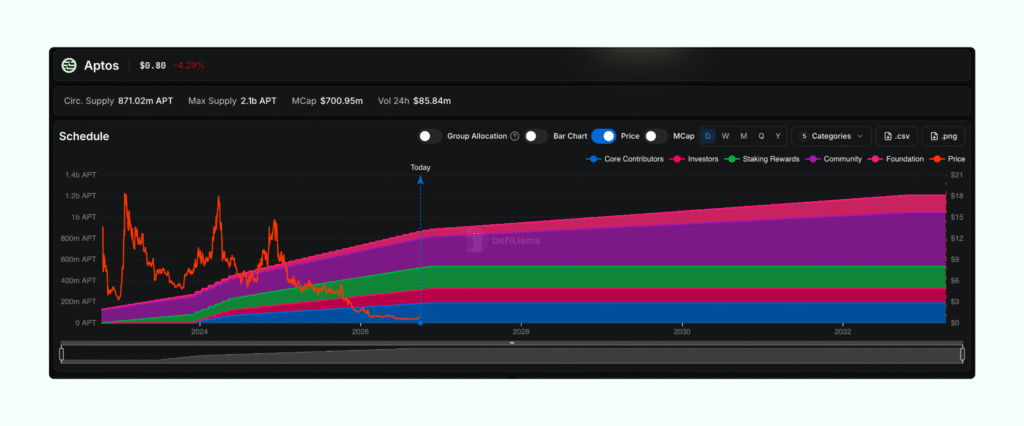
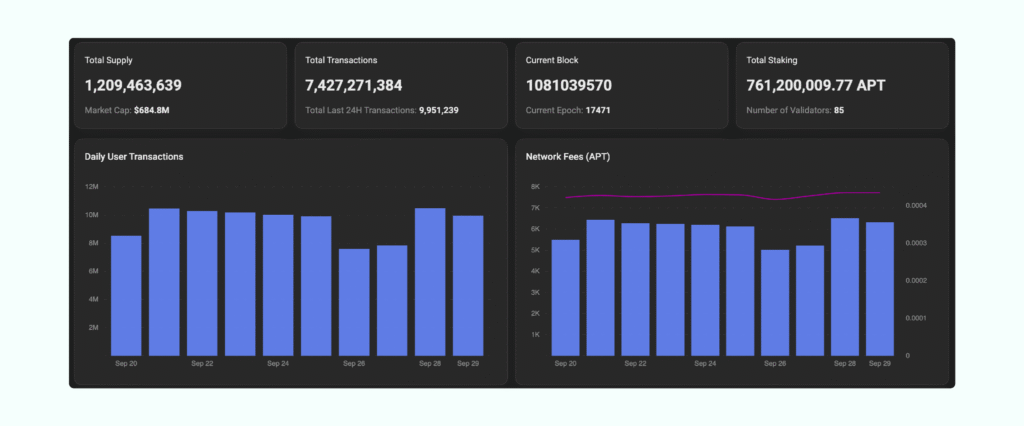
Aptos circulating supply (per DefiLlama) is 871.02M APT on Sep 30. The difference from total supply of about 1.2B APT roughly equals the 331.69M APT still in vesting.
| Metric | What it counts | Latest reported figure | Source |
| Max supply | Hard cap approved by governance | 2.1B APT | Aptos Proposal #183 |
| Total supply | All existing APT, locked and unlocked | ~1.2B APT (Q1 2026) | Aptos Foundation |
| Circulating supply | Tokens released from vesting | 871M APT(as of Sept 2026) | DefiLlama |
| Staked supply | Tokens delegated to validators | ~763M APT (as of Sept 2026) | Aptoscan |
Free Float Crypto Definition
In crypto, free float counts tokens that holders can transfer and sell today. For APT, four categories fall outside it:
- tokens still vesting in the Community or Aptos Foundation pools,
- staked tokens, which need up to 14 days to withdraw,
- the 210M APT the Aptos Foundation committed to stake permanently and never sell,
- treasury holdings reserved for grants.
Vesting tokens can also be staked, so the staked and vesting categories overlap. Roughly 763M APT staked against about 1.2B APT total supply puts about 63% of all APT with validators.
What Replaces Vesting as a Supply Driver
Staking rewards become the main source of new APT once core contributor and early backer vesting ends. Fee burns remove APT, and the hard cap stops issuance at 2.1B APT.
| Supply driver | Effect on supply | Current parameter |
| Staking rewards | Adds new APT | Annual rate cut from 5.19% to 2.6% |
| Community and Aptos Foundation vesting | Adds circulating APT | ~4.54M APT per month until 2032 |
| Transaction fee burns | Removes APT | 100% of fees burned, fees raised 10x |
| Aptos Foundation permanent stake | Removes APT from free float | 210M APT |
| Hard cap | Limits total supply | 2.1B APT |
APT holders approved the hard cap in an on-chain governance vote, Proposal #183. It passed with 335.2M APT in favor and about 1,500 APT against, per The Defiant.
The original design started the staking reward rate at 7% per year, per Everstake‘s analysis of whether Aptos is inflationary. The 2026 reforms cut the rate from 5.19% to 2.6%.
At 2.6% on roughly 802M APT staked, rewards create about 19.8M APT per year. Burns totaled about 1.9M APT from launch to mid-September 2026, according to Aptos reported metrics.
What Changes for Delegators
A delegator is a holder who assigns APT to a validator, the operator that runs network nodes, while keeping ownership of the tokens. Delegation works the same after the final unlock, while the network reward rate is cut from 5.19% to 2.6%.
Core Aptos staking parameters:
- Minimum delegation: 10 APT at protocol level, with 11 APT used by Everstake and other interfaces.
- Lockup: a recurring 14-day cycle that renews automatically unless unstaking starts.
- Withdrawal time: 0 to 14 days, depending on where the cycle stands.
- Reward frequency: every epoch, a network period of about 2 hours, with rewards added to the stake automatically.
- Partial unstake rule: at least 10.01 APT must remain staked.
Aptos staking rewards depend on the network rate, the staked amount, and how reliably the validator proposes and votes on blocks. The validator then keeps a commission, and Everstake charges 10%.
Uptime, commission, and lockup settings are the main criteria in choosing an Aptos validator.
Delegation activates within about 2 hours through the Everstake dashboard for APT, where holders can stake APT with Everstake.
What the End of Vesting Means for Institutions
Institutions holding APT after the last release might face a staking decision, so the validator operator’s controls become part of due diligence.
The Aptos Foundation reports that BlackRock, Franklin Templeton, and Apollo have deployed capital on Aptos.
Everstake provides non-custodial institutional staking, so the institution keeps its tokens and keys in its own custody. Its institutional staking infrastructure integrates with custody platforms such as:
- Fireblocks,
- BitGo,
- Anchorage Digital,
- Copper.
Everstake holds SOC 2 Type II and ISO/IEC 27001:2022 certifications, alongside NIST CSF, GDPR, and CCPA alignment. Everstake has operated across 130+ networks to date, with more than $7B in total staked assets and 99.98% observed uptime since 2018.
Due diligence items for institutional delegators on Aptos:
- Validator uptime and block proposal history.
- Commission rate and change notice, which operators must file at least 7.5 days before a lockup cycle ends.
- Custody integration and key control.
FAQ
When is the next Aptos unlock?
The next scheduled Aptos unlock falls on October 11 to 12, 2026. Trackers list about 4.54M APT, released to the Community and Aptos Foundation pools.
How many APT are locked?
About 331.69M APT of the 1B APT genesis supply remains locked in vesting, per DropsTab. Staking is a separate lock: around 763M APT is staked with validators, including Everstake.
What is the APT vesting schedule?
Core contributors and early backers vested over 4 years after a 12-month cliff, with the last release on September 12, 2026. Community and Aptos Foundation pools release 1/120 of their remaining balance monthly until 2032.
What happens when VC unlocks end?
Scheduled monthly releases fall by about 60%, from 11.31M APT to 4.54M APT. New supply then comes mainly from staking rewards, which delegators receive every epoch of about 2 hours.
Is Aptos inflationary after the unlocks end?
Yes, total supply keeps growing while staking rewards exceed fee burns. Rewards create about 19.8M APT per year (Aptoscan staked total × 2.6%) against 1.9M APT burned since launch, learn more in Everstake‘s Aptos inflation analysis.
Share with your network