Aptos
ethereum
solana
Tempo
The ABCs of Crypto
Where Do Blockchain Transaction Fees Go?
A transaction fee is the payment a user attaches so the network processes a transaction. Who receives that payment depends on the network and on which part of the fee is in question.
SEP 28, 2026
Last updated SEP 28, 2026 · V1
TL;DR
- A transaction fee could include up to four charges, and each charge might be routed to a different recipient/burned.
- Ethereum burns the base fee and blob fees, removing that ETH from supply permanently.
- Ethereum proposers receive priority fees and builder payments, and about 90% of blocks come from outside builders through MEV-Boost.
- Solana burns 50% of the base fee and pays the other 50%, plus 100% of priority fees, to the validator producing the block.
- Aptos burns all execution gas, so its validators receive newly issued APT.
- On most rollups, the sequencer operator keeps user fees after paying Ethereum for data.
- On Tempo, a built-in pool converts the user’s stablecoin into the validator’s chosen stablecoin, and the validator receives 99.7% on a direct swap, about 99.4% on a two-hop route, and 100% when no conversion is needed.
- Validators on the same network can receive different fee amounts, depending on how each operator runs its infrastructure.
- For institutions, issuance can be estimated from protocol parameters, while fee-based rewards move with network activity.
A transaction fee is the payment a user attaches so the network processes a transaction. Who receives that payment depends on the network and on which part of the fee is in question.
Depending on the network, fees end up in one of three places:
- A burn, which destroys the tokens and reduces total supply.
- The validator that includes the transaction in a block.
- The company or DAO that operates a rollup sequencer.
The Anatomy of a Transaction Fee
A transaction fee is made of separate charges with different prices and recipients. Networks measure computing work in gas units, and most charges are priced per unit of gas.
A typical fee contains four charges:
| Charge | What it is | Typical recipient |
| Base fee | Protocol-set price per gas unit that moves with demand | Burned on Ethereum and Aptos; 50% burned on Solana |
| Priority fee | Optional tip for faster inclusion | Block producer |
| MEV payment | Value from transaction order, paid by block builders | Proposer, after builder and searcher margins |
| Data fee | Charge rollups pay to record their data on Ethereum | Burned on Ethereum |
MEV stands for maximal extractable value. Rollups are networks that process transactions separately and record their data on Ethereum.
Every node applies the same recipient rules, so a fee settles when its block becomes final. That property lets consensus act as a settlement primitive for payments.
Ethereum: Burn, Proposer, Builder
On Ethereum, one validator is selected as block proposer for each 12-second slot. Each part of the fee then goes to a different destination:
- The base fee is burned and removed from ETH supply.
- In locally built blocks, the priority fee goes to the proposer’s fee recipient. In MEV-Boost blocks, the builder collects priority fees and pays the proposer a single bid that includes them.
- Blob fees paid by rollups are burned in a separate fee market.
- MEV value reaches the proposer as a payment from the winning block builder.
The burn began with EIP-1559, where the base fee rises when blocks are more than half full and falls when they are less, by up to 12.5% per block.
Priority Fees and Validator Rewards
Priority fees are the part of a fee that goes directly to validators. They rise during congestion, when users bid against each other for a place in the next block.
Validator rewards on Ethereum combine newly issued ETH, paid for voting on and proposing blocks, with priority fees and builder payments.
Roughly 90% of Ethereum blocks are built through MEV-Boost, software that lets proposers accept complete blocks from outside builders. Builders compete for proposer slots and timing, and the share of each builder payment reaching delegators varies by operator in institutional staking.
Rollups post their data to Ethereum in blobs, temporary data packages introduced in the Dencun upgrade on March 13, 2024. Blob fees are burned, and since December 2025, EIP-7918 sets a minimum blob price tied to regular gas costs.
Solana and Aptos: Different Fee Divisions, Different Incentives
Solana sends most fee value to the validator producing each block, while Aptos burns its execution gas in full.
Solana
On Solana, a validator called the leader produces blocks during its scheduled slots. Each transaction pays a base fee of 5,000 lamports per signature, and 1 SOL equals 1 billion lamports.
50% of the base fee is burned, and the other 50% goes to the leader.
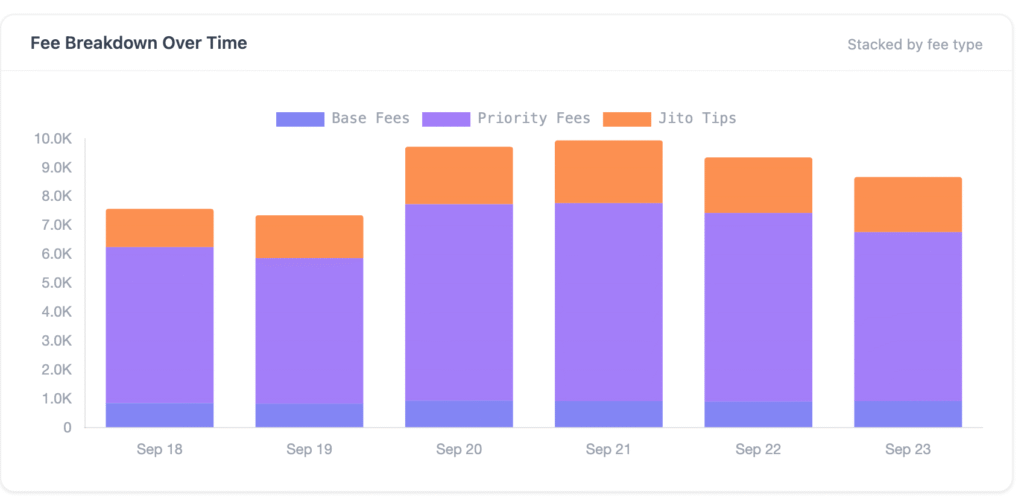
Under SIMD-0096, approved with 77% validator support in May 2024, 100% of priority fees go to the leader. Jito tips are separate payments that validators receive for transaction ordering through the Jito block engine. As of mid-2026, priority fees and Jito tips made up the majority of Solana daily network revenue, per Solana Compass.
Aptos
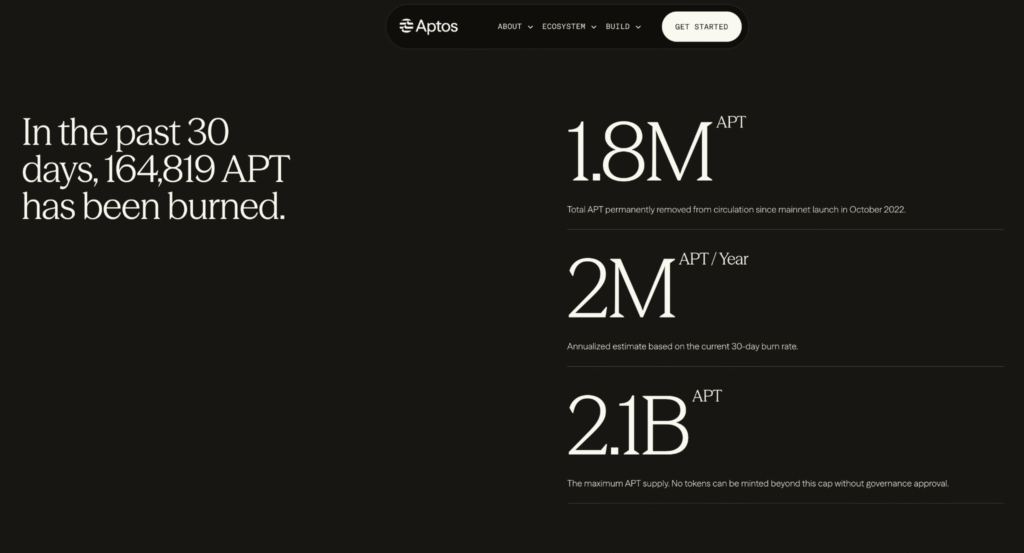
Aptos burns the execution and IO portion of every transaction’s gas in full, where IO covers reading and writing stored data. Validator rewards on Aptos come from staking issuance, meaning newly created APT.
Sequencers: When the Fee Is Revenue for One Company
A sequencer is the server that orders transactions on a rollup, and most rollups run one. The sequencer collects all user fees, and its operator keeps what remains after data costs.
The sequencer revenue cycle runs in four steps:
- Users pay L2 execution fees to the sequencer.
- The sequencer batches transactions and posts the data to Ethereum, the L1, as blobs or calldata.
- Ethereum burns the blob base fee paid for that data.
- The sequencer operator keeps the difference between user fees and L1 costs.
Arbitrum
On Arbitrum One, sequencer fees go to the treasury of the Arbitrum DAO, a governance body run by ARB token holders.
Arbitrum added Timeboost in April 2025, an auction where the winner gets a short time advantage for transaction inclusion. It collected about $2 million in its first 3 months, with proceeds controlled by the DAO and Arbitrum Developer Guild. However, the Timeboost was replaced by priority gas auctions and fast feed in late September 2026.
Base and the Superchain
The Superchain is a group of rollups built on Optimism‘s OP Stack software. Members pay the Optimism Collective the greater of 2.5% of sequencer revenue or 15% of revenue after data costs.
Base, the rollup operated by Coinbase, sent about 3,765 ETH to the Optimism Collective in 2025, over 70% of all contributions.
On February 18, 2026, Base announced a move to its own codebase, and the revenue share ends with that move.
The Stablecoin Conversion Problem
Stablecoin gas needs a conversion step when the user’s fee token differs from the token the validator wants. On Tempo, a built-in automated market maker (AMM), a token pool that swaps automatically, converts the fee at a fixed price.
Tempo is a payments-focused L1 incubated by Stripe and Paradigm, with mainnet live since March 2026. It uses USD-denominated stablecoins issued under its TIP-20 token standard as its only gas assets.
Fee Token Selection
Each user picks a fee token, which can be any USD stablecoin with enough liquidity in the fee AMM. Validators pick their preferred token by calling setValidatorToken on the FeeManager, a contract built into the protocol.
For a validator, the preferred token decides which asset its fee revenue settles in. An institution that reports in USD can set USDC.e (Stargate-bridged USDC) as its token and receive fees in a USD asset that redeems to native USDC when bridged out to Ethereum.
How the Fee AMM Works
A fee conversion on Tempo follows this sequence:
- The FeeManager collects the maximum possible fee from the user before execution and refunds the unused part afterwards.
- If the validator prefers a different token, the fee AMM swaps the fee within the same transaction.
- A direct swap executes at 0.9970 validator tokens per user token, so a $1.00 fee reaches the validator as $0.997.
- Fees accumulate in the FeeManager, and validators claim them on demand.
| Parameter | Tempo fee AMM value |
| Fee swap rate | 0.9970 validator token per user token, per hop |
| Liquidity provider share | 0.3% per hop |
| Validator receives | 100% with no conversion; 99.7% on a direct swap; about 99.4% on a two-hop route |
| First deposit | 1,000 liquidity units burned to protect pool reserves |
| Insufficient liquidity | Direct pool first, then one two-hop fallback via the token’s quote token; rejected before execution only if neither route has enough liquidity |
The validator absorbs the conversion spread, since the user pays the full fee. On a direct swap, the spread is 0.3% and goes to the liquidity providers who supply the validator’s preferred token. On a two-hop route, the spread is about 0.6%, split between the liquidity providers of both pools. When the user pays in the validator’s token, there is no spread.
Because the rate is fixed, traders cannot move the price around a fee swap, which removes sandwich attacks and backrunning on fee swaps. Pool rebalancing still creates a single race at the top of the next block.
Tempo accounts also set receive policies that control which tokens they accept. Other networks offer stablecoin gas through gas abstraction, where a third party pays the native fee.
Validator Fee Distribution by Network
As of September 2026, validator fee distribution differs by network and by fee component:
| Network | Base fee | Priority fee | Ordering payments | Fee asset |
| Ethereum | Burned | Proposer in local blocks; builder in MEV-Boost blocks | Builder payment to proposer | ETH |
| Solana | 50% burned, 50% leader | 100% leader | Jito tips to validators | SOL |
| Aptos | Burned | Burned | None in protocol | APT |
| Arbitrum One | DAO treasury | Ignored; ordering follows arrival time | Timeboost bids to DAO | ETH |
| Tempo | Validator | Validator | Unconfirmed | Validator’s chosen USD stablecoin |
How Fee Composition Affects Validator Rewards
Two validators on the same network can receive different reward amounts, because fee revenue depends on how each operator runs its setup.
These operator factors change the fee share a validator receives:
- Relay connections: relays pass builder blocks to proposers, and each added relay gives access to more bids.
- Uptime: a validator offline during its slot receives no fees from that block.
- Latency: a faster setup can accept a later, higher builder bid.
- Commission and fee-sharing policies: these decide the share of fees that reaches delegators.
For institutions modelling staking rewards, issuance can be estimated from protocol parameters, while fee-based rewards move with network activity.
Institutional reporting typically separates staking rewards into these lines:
- Protocol issuance.
- Priority fees.
- Builder or MEV payments.
- Operator commission.
Everstake has run validators since 2018 and has historically operated 130+ networks. With over $7B in total staked value to date and 99.98% observed infrastructure uptime, Everstake is one of the largest non-custodial staking operators in the industry.
Everstake holds SOC 2 Type II and ISO 27001 certifications and runs non-custodial staking, meaning clients keep control of their keys and assets. Everstake institutional staking includes managed validator operations and audit-ready reporting.
FAQ
Where do gas fees go?
Gas fee destinations depend on the network and fee component. On Ethereum, 100% of the base fee is burned, and the proposer receives the priority fee.
Do validators get all the gas fees?
No, both Ethereum and Solana burn part of every fee. On Solana, validators receive 50% of base fees and 100% of priority fees, while Ethereum burns the full base fee.
What is the base fee vs priority fee?
The base fee is a protocol-set price per gas unit, and the priority fee is an optional user tip. On Ethereum, the base fee moves by up to 12.5% per block and is burned.
Does Ethereum burn gas fees?
Yes, Ethereum burns the base fee and the blob base fee. The burn started with EIP-1559 on August 5, 2021.
Who gets MEV?
On Ethereum, the block proposer receives MEV as the winning builder’s payment, after builders and searchers keep their margin. About 90% of blocks are built through MEV-Boost.
How are transaction fees split?
Protocol rules divide transaction fees, and those rules differ on each network. Solana burns 50% of the base fee and pays the rest to the leader, while Ethereum burns 100% of it.
Do sequencers keep the fees?
Yes, the sequencer operator keeps user fees after paying Ethereum for data. Superchain members share at least 2.5% of sequencer revenue with the Optimism Collective, and Arbitrum One fees go to the Arbitrum DAO.
Share with your network