Institutional
web3 infrastructure
B2B Stablecoin Payments vs Card and Wire Transfers: Where the Costs Move
B2B stablecoin payments remove some payment costs and hand others to the paying company and its providers. A line-by-line look at which costs stablecoins remove and which they simply relocate.
OCT 05, 2026
Last updated OCT 05, 2026 · V1
TL;DR
- Stablecoin settlement removes card interchange and 120-day chargeback exposure.
- B2B stablecoin payments become final in seconds to minutes, compared with 1 to 3 business days for card settlement.
- However, off-ramps charge 0.1% to 3%, which can cancel the savings on some corridors.
- Finance teams also take over compliance checks and invoice reconciliation that card processors handled.
- Stablecoins fit large cross-border supplier payments and contractor payroll. Cards keep the advantage in consumer checkout and small domestic payments.
- Settlement reliability depends on the blockchain’s validators, which institutions review alongside issuer regulation and custody.
B2B stablecoin payments remove some payment costs and hand others to the paying company and its providers. Compared with card and wire transfers, stablecoin settlement removes:
- interchange fees,
- multi-day settlement float,
- chargeback exposure,
- part of the FX (foreign exchange) spread on selected corridors.
A corridor is a payment route between two countries.
However, B2B stablecoin payments add:
- on-ramp and off-ramp spread,
- treasury operations,
- compliance tooling,
- reconciliation work that card networks automated decades ago.
The net result depends mostly on payment size and corridor. Stablecoins tend to cost less for a $50,000 cross-border supplier invoice and more for a $40 consumer checkout.
How Card, Wire and Stablecoin Payments Are Built
A card payment passes through 4 stages and 3 institutions before the seller receives funds. A stablecoin transfer also has 4 steps, all recorded on a shared blockchain.
The card payment path:
- Authorization: the issuer, meaning the bank that issued the buyer’s card, approves the charge within seconds.
- Clearing: the acquirer, meaning the seller’s bank or payment processor, sends transaction data through Visa or Mastercard to the issuer.
- Settlement: the acquirer pays the seller, typically 1 to 3 business days later, according to Stripe.
- Reconciliation: the seller matches each deposit, minus fees, against its invoices.
A cross-border wire travels as a Swift message through correspondent banks. These intermediary banks hold accounts with each other to move funds between countries.
Swift reports that 90% of its cross-border payments reach the recipient’s bank within an hour. Only 43% reach the recipient’s account in that time, because the receiving bank adds its own checks and batch processing.
The stablecoin payment path:
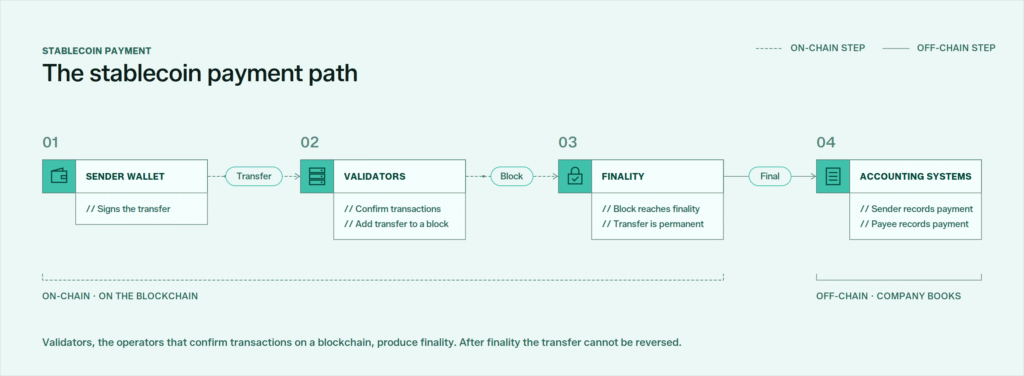
- The sender’s wallet signs a transfer.
- Validators, the operators that confirm transactions on a blockchain, add the transfer to a block.
- The block reaches finality, the point after which the transfer is permanent.
- Both companies record the payment in their own accounting systems.
Banks and card networks now connect to stablecoin settlement directly, as Everstake’s analysis of bank and payment network stablecoin integration details.
B2B Stablecoin Payments Cost Line by Line
Stablecoin settlement removes interchange and chargeback costs and cuts settlement float from days to minutes. Other costs move to conversion providers and finance teams.
Settlement float is money that has left the payer but has not yet reached the payee, so neither side can use it.
| Cost line | Card payments | International wire | Stablecoin transfer |
| Interchange fees | 1.00% to 2.00% on Mastercard B2B programs; 3.05% + $0.10 on Discover commercial cards | None | None |
| Card payment processing fees | Network fee plus acquirer markup, on top of interchange | None | Provider fee, if a payment provider is used |
| Transfer fees | Included in processing fees | $25 to $50 sender fee plus $10 to $30 per intermediary bank | Blockchain network fee, often under $1 |
| FX cost | Cross-border and currency conversion fees | 1.5% to 4.5% spread on a $10,000 transfer | Off-ramp spread of 0.5% to 3%, depending on corridor |
| Settlement float | 1 to 3 business days | Under 1 hour to 5 business days, depending on the receiving bank | Seconds to minutes, plus bank time when converting to cash |
| Chargebacks | Buyer can dispute for up to 120 days; fees around $20 per dispute | Recall requests, which the receiving bank can refuse | Irreversible once final |
| Fraud controls | Included in network and issuer pricing | Bank screening | Wallet screening tools, paid separately |
| Compliance | Handled by issuer and acquirer | Handled by banks | KYC and AML checks, paid by the company or its provider |
| Reconciliation | Automated through processor reports | Invoice data carried in ISO 20022 messages | Manual unless invoice data is attached on-chain |
What Costs Are Cut with Stablecoin Settlement
3 card costs are removed when a payment settles on a blockchain.
Interchange
Interchange is the fee a buyer’s card-issuing bank collects on every card payment, charged to the seller. A stablecoin transfer moves wallet to wallet, so no issuing bank takes a fee.
For example, on $100,000 of monthly card payments at 2.00%, interchange alone would cost the seller $2,000 a month.
Payment Settlement Time
A stablecoin transfer becomes final in about 13 seconds on Solana and about 13 minutes on Ethereum.
Faster finality reduces the cash a company must pre-fund to cover payments over weekends and bank holidays. On-chain payments settle at T+0, meaning on the transaction day itself.
Card networks are testing the same model, as Everstake‘s coverage of Mastercard‘s always-on stablecoin settlement shows.
Chargeback Exposure
A chargeback is a card payment reversal that the buyer’s bank forces after a dispute. Final on-chain transfers are irreversible, which removes the 120-day dispute window of card payments. Refunds would require a new, separate transfer from the payee.
What Moves to a New Line Item
4 costs move from the card network to the company or its providers after a switch to stablecoins.
On-Ramp and Off-Ramp Spread
An on-ramp converts bank money into stablecoins, and an off-ramp converts stablecoins back into bank money. Each conversion carries a spread, the difference between the quoted rate and the market rate.
Off-ramp spreads range from about 0.1% on corridors at institutional volume to around 2.5% on corridors with few local providers. On-ramp spreads at institutional volume typically fall under 0.5%.
Treasury Operations
Treasury teams take on new tasks:
- custody of wallet keys,
- approval policies for outgoing transfers,
- liquidity planning across blockchains and banking partners.
Compliance
Card issuers and acquirers handle most customer screening in card payments. On stablecoin payments, the company or its provider pays for KYC (Know Your Customer) and AML (Anti-Money Laundering) checks.
Some jurisdictions also apply the Travel Rule, which requires sender and recipient details to accompany transfers above set thresholds.
Reconciliation
A card processor sends settlement reports with fees already matched to orders.
An on-chain transfer records an amount and 2 wallet addresses under a transaction ID. Finance teams must attach invoice references themselves, for example through on-chain payment metadata.
Cross-Border Payments on Blockchain: Where Stablecoins Win
Stablecoins win on large, repeated cross-border payments to suppliers that can hold dollars or convert them cheaply. The savings shrink as payments get smaller or local conversion options get fewer.
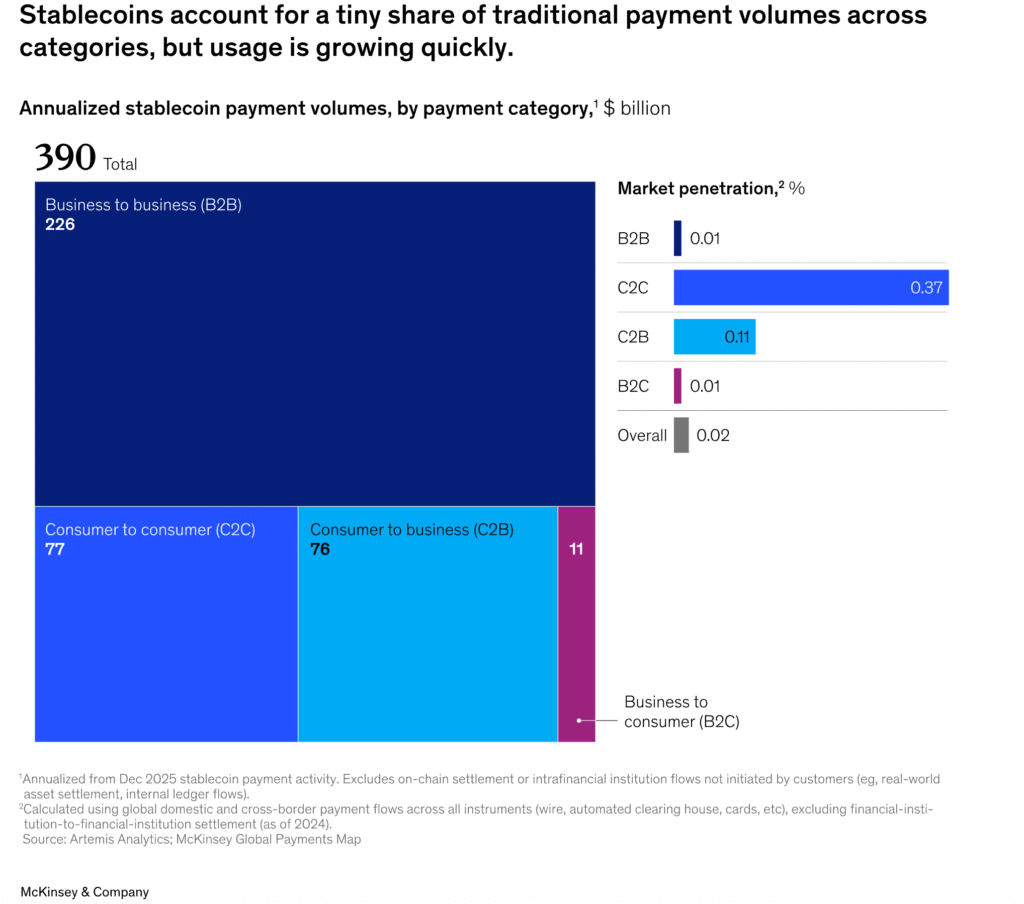
McKinsey and Artemis put B2B stablecoin payments at about $226 billion a year, up 733% year over year (February 2026). That equals roughly 60% of stablecoin payments, excluding trading and internal transfers.
Stablecoin Payroll for International Contractors
Stablecoin payroll could suit contractors who keep savings in dollars or have cheap local off-ramps.
For small transfers, the World Bank puts the global average cost of sending $200 across borders at 6.36% (Sep 2025 report).
For example a US company could be paying a contractor in Argentina directly in USDC, which removes the bank intermediary and FX markup. The contractor could then hold digital dollars or convert them to local currency.
Stablecoin payroll still triggers local tax and employment duties. Legal review is required before launching it in a new jurisdiction.
Enterprise Stablecoin Payments: What Institutions Check First
Institutions review regulation and custody before they compare fees, typically through 5 checks:
- Issuer regulation: the GENIUS Act, a US federal law signed July 18, 2025, sets reserve and licensing rules for stablecoin issuers. In the EU, MiCA (the Markets in Crypto-Assets Regulation) governs issuers.
- Custody model: who holds the wallet keys that control funds, and whether that custodian is licensed locally.
- Chain selection: how fast the blockchain reaches finality and how stable its fees stay during busy periods.
- Accounting treatment: how stablecoin balances are classified under local accounting standards.
- Audit trail: whether every transfer links to an invoice that an auditor can trace.
Where Card and Wire Transfers Offer Advantages
Cards and wires keep the advantage in 3 areas:
- Consumer checkout: buyers expect card rewards and 120-day dispute rights, and few hold stablecoin balances.
- Purchases with delivery risk: these need escrow or reversal options, which are absent from plain stablecoin transfers.
- Small domestic payments: FedNow in the US and SEPA Instant in the EU move bank money in seconds. Conversion minimum fees also make small stablecoin payments costly.
What Settlement Finality Rests On
Validators produce stablecoin finality by confirming blocks on the blockchain that carries the stablecoin. A stablecoin payment is therefore only as reliable as that blockchain’s validators.
If validators go offline, confirmations slow down. If a few operators control most of the staked tokens, they could delay or exclude transactions.
Finance teams evaluating a blockchain should check how widely its validators are distributed, alongside the issuer’s reserves.
Everstake is a global institutional validator operator that has historically operated 130+ networks since 2018 with 99.98% observed uptime and zero material slashing events.
Its controls are certified under SOC 2 Type II and ISO 27001. Everstake also offers white-label validators on payment-focused blockchains such as Tempo.
FAQ
How much does it cost to accept stablecoin payments?
Accepting stablecoins costs a blockchain network fee plus any payment-provider and conversion charges. Network fees on low-cost blockchains often run under $1, while converting to local currency typically costs 0.5% to 3%.
Is a stablecoin transfer cheaper than a wire transfer?
Usually yes, for large cross-border payments. A $10,000 bank wire can cost $150 to $450 including fees and FX spread, while the on-chain transfer often costs under $1.
How long does B2B crypto payment settlement take?
Settlement takes seconds to minutes once the blockchain confirms the transfer as final. Solana reaches finality in about 13 seconds and Ethereum in about 13 minutes.
Are there chargebacks with stablecoins?
No. Final on-chain transfers are irreversible, while card networks give most cardholders 120 days to dispute a charge.
Can a company pay international contractors in USDC?
Yes, where local law permits it and the contractor can hold USDC or convert it locally.
What is the FX cost of stablecoins compared with a bank?
Stablecoins remove the FX markup a bank builds into its exchange rate but add an off-ramp spread. Banks typically build 1% to 3% into the rate, while off-ramps charge 0.5% to 3% by corridor.
Share with your network