Institutional
Tempo
web3 infrastructure
Crypto Payment Reconciliation: Metadata, Memos and ERP
Stablecoin transfers settle in seconds but carry no invoice number, so finance teams rely on off-chain matching or on-chain memos to reconcile them. ERP integration then needs rules for classification, period cut-offs and decimal precision, and stablecoin payroll remains the hardest case.
OCT 02, 2026
Last updated OCT 02, 2026 · V1
TL;DR
- Settlement finality and crypto payment reconciliation are different problems. A Tempo transfer is final within 0.5s and can still be unmatched at month end.
- A standard blockchain transfer records the parties and the amount. It carries no invoice number and no customer ID.
- Off-chain matching by unique address or exact amount works at low volume. Partial payments and batched invoices break it.
- On-chain memos store the reference inside the transfer, and Tempo TIP-20 memos hold 32 bytes. Memos are public, so sensitive data stays off-chain.
- ERP integration needs rules for accounting classification and period cut-offs. FASB proposed stablecoin cash-equivalent examples on August 18, 2026.
- Stablecoin payroll is the hardest case. Withholding runs in the payroll engine first, and each transfer carries an employee ID memo.
- Payment reconciliation automation depends on nodes that keep memo events queryable. Everstake offers institutions a white-label Tempo validator.
A bank payment reaching accounts receivable usually carries remittance data: an invoice number, a customer reference, sometimes a PO number. The AR team uses that data to close the open invoice.
A plain token transfer, such as an ERC-20 transfer(to, value), records only who sent it, who received it, how much, and when. So a finance team sees “10,000 USDC arrived from 0xAb3…” and still has to work out which customer that wallet belongs to and which invoice or invoices the payment covers. This is the reconciliation problem.
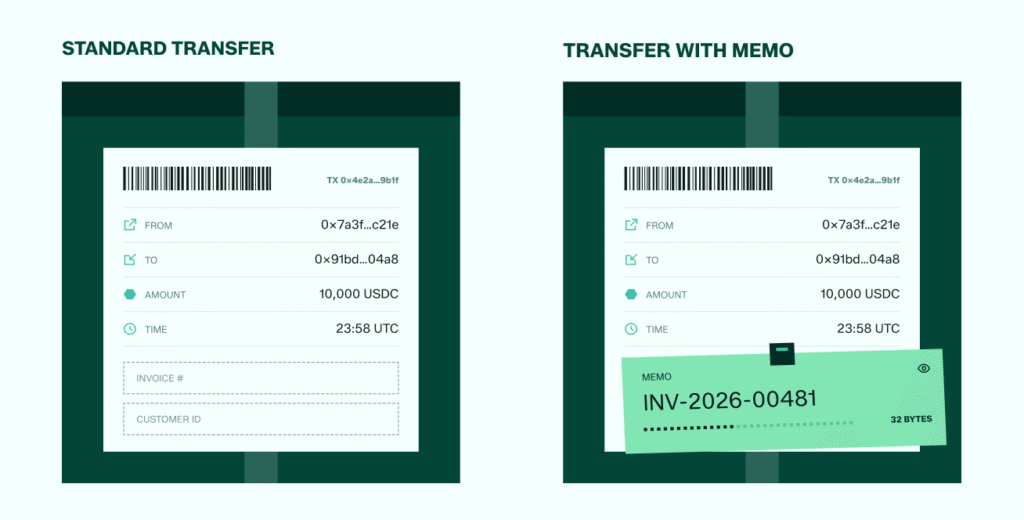
Settlement finality is responsible for making sure money moves irreversibly, and reconciliation helps to figure out what this money pays for. Even though an on-chain transfer can be final in seconds, it can still be unmatched at month end.
Off-chain methods link addresses or amounts to customers, and they degrade at scale and under partial payments. On-chain methods place memo fields and structured payment metadata inside the transfer, and newer payment networks support them natively.
Settlement and reconciliation are growing in importance due to the stablecoin boom. According to DefiLlama, stablecoin supply reached about $322.9 billion in May 2026, and has been drifting over $300B ever since. As banks and payment networks integrate stablecoins, more of that supply reaches corporate receivables.
Why Are Settlement Finality and Blockchain Reconciliation Separate Problems?
Settlement finality confirms that value moved and cannot be reversed. Blockchain reconciliation confirms which obligation that value paid, and it happens in the accounting system.
Tempo reaches deterministic finality in about 0.5 seconds. Atomic settlement and T+0 shorten the time until funds are final.
After finality, a finance team still needs to know:
- Which customer sent the payment?
- Which invoice or invoices does it cover?
- Does the amount cover the invoice in full?
- Which entity and ledger account receive the entry?
Faster settlement can add reconciliation work. Transfers arrive 24/7, while the close calendar and ERP batch jobs follow business days.
What Data Does a Blockchain Transaction Carry?
A token transfer records the parties and the amount. Any business reference must come from another source unless the network supports metadata.
The ERC-20 standard defines its transfer function with 2 parameters: a recipient and an amount.
| Field | Recorded on-chain by default | Reconciliation use |
| Sender address | Yes | Identifies a wallet, which may belong to an exchange |
| Recipient address | Yes | Identifies the receiving account |
| Amount | Yes | Matches invoices only when amounts are unique |
| Block time | Yes | Sets the accounting period |
| Transaction hash | Yes | Serves as proof in the audit trail |
| Invoice or PO number | Network-dependent | Primary matching key |
| Customer ID | Network-dependent | Links the payment to the AR record |
| Cost centre or tax data | No | Needed for payroll and multi-entity books |
When a customer pays from an exchange account, the sender address belongs to the exchange and is shared across its users.
Cons of the Off-Chain Approaches
Off-chain methods identify a payment using data held in the company’s own systems. Each method works at low volume and breaks under specific conditions:
- Unique address per invoice. The company generates a new deposit address for every invoice. It breaks when customers reuse old addresses or the address count reaches thousands.
- One address per customer. Each customer receives a stable deposit address, a model Circle supports through sub-wallets. It breaks when 1 transfer covers 3 invoices, since the address names the payer only.
- Amount matching. The system matches exact amounts, sometimes adding unique cents to each invoice. It breaks when exchanges deduct withdrawal fees or 2 invoices share an amount.
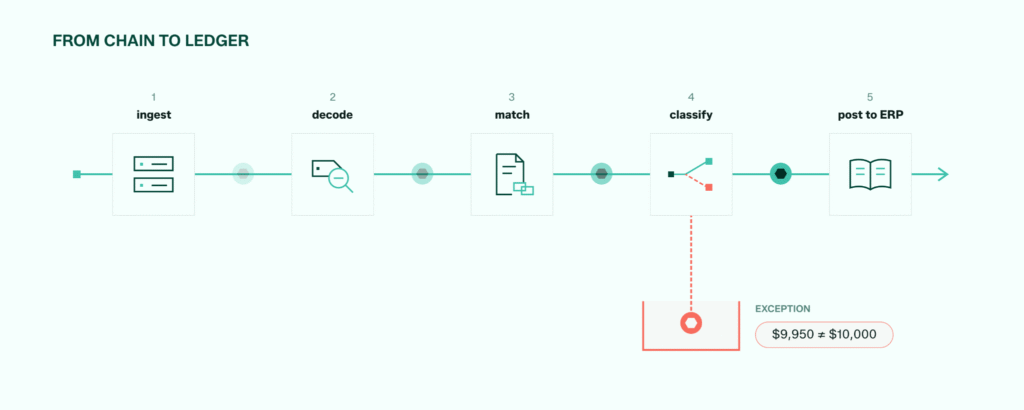
Partial payments break all 3 methods. A $9,950 transfer against a $10,000 invoice needs a classification rule for short payments and fee deductions.
Transaction Metadata on the Blockchain: On-Chain Approaches
On-chain approaches write a payment reference into the transaction. Any system that indexes the chain can read it.
| Network | Mechanism | Capacity |
| Stellar | Transaction memo | Text up to 28 bytes, a 64-bit ID, or a 32-byte hash |
| XRP Ledger | Destination tag | 32-bit integer, 0 to 4,294,967,295 |
| Solana | Memo program instruction | UTF-8 text written to transaction logs |
| Tempo | TIP-20 transferWithMemo | 32 bytes, indexed in the event |
| Ethereum (ERC-20) | None in the token standard | Requires off-chain matching |
Tempo emits the memo as an indexed parameter of the TransferWithMemo event. A team can filter logs by memo value to retrieve every transfer carrying INV-12345.
A 32-byte field fits an invoice number such as INV-2026-00481. It can also hold a hash of a longer remittance record stored off-chain.
Memos are public. Solana Pay documentation advises against placing private or sensitive data in them, so customer names and bank details belong off-chain.
Tempo receive policies add account-level controls that govern which incoming transfers an account accepts.
ISO 20022 and Blockchain Payment Data
ISO 20022 is the messaging standard banks use for structured payment data. Swift ended the MT and ISO 20022 coexistence period for cross-border instructions on November 22, 2025.
ISO 20022 remittance data exceeds what a 32-byte memo can hold. Tempo documentation describes TIP-20 memos as a link between stablecoin transfers and payment engines that use Swift messaging, typically through a shared reference.
ERP and Blockchain Integration: Getting Payments Into the Books
ERP integration turns a matched transfer into a journal entry with the correct account and posting date.
A typical pipeline runs in 5 steps:
- Ingest transfers from a node or indexer through an RPC or streaming API.
- Decode the memo and match it to an open invoice.
- Classify the result, for example as a partial payment or an unidentified transfer.
- Post the cash receipt to the ERP through a crypto subledger.
- Reconcile wallet balances to the general ledger at period end.
Crypto subledgers post matched transfers into existing ERP systems. Bitwave integrates with NetSuite, and Modern Treasury reconciles stablecoin and fiat payments in one ledger.
A treasury management system (TMS) with crypto support gives treasury one cash position across bank accounts and wallets. The TMS balance is accurate only when incoming transfers are already matched.
| Issue | Decision required | Example |
| Classification | Cash equivalent, financial asset or intangible | FASB proposal of August 18, 2026 |
| FX | Rate source for non-USD entities | A EUR entity receives USDC |
| Timing | Which timestamp sets the period | Block time of 23:58 UTC on month end |
| Precision | Rounding between token and ledger decimals | USDC uses 6 decimals, most ERP fields use 2 |
| Audit trail | Evidence linking entry to chain | Transaction hash stored on the journal line |
ASU 2023-08 introduced fair-value accounting for crypto assets and left most fiat-backed stablecoins outside its scope. The FASB proposal adds examples of when certain stablecoins meet the existing cash-equivalent definition, with comments due November 19, 2026.
Classification choices require review with auditors and legal counsel. The proposal amends presentation and disclosure requirements under ASC 230.
Stablecoin Payroll: The Hard Case for Recurring Payments
Stablecoin payroll is the hardest reconciliation case because every transfer in a run must match on one fixed date. A run can include hundreds of recipients, each with its own tax withholding.
Deel launched stablecoin salary payouts for full-time employees on May 20, 2026, starting in the US and Eurozone. Employees choose a stablecoin allocation from net salary after taxes and deductions.
A reconcilable payroll run needs:
- withholding calculated in the payroll engine before any on-chain transfer,
- one memo per transfer, such as an employee ID plus the pay period,
- batched transfers that post as one approved set,
- a process for wrong wallet addresses, since confirmed transfers cannot be recalled,
- local tax reporting that treats stablecoin salary as wages.
Tempo documentation shows batch transfers with an employee ID in each memo. The payroll journal then ties each net pay line to a transaction hash.
The ERP entry needs 2 parts: the gross payroll journal and the on-chain disbursement of net pay. Vendor payments raise the same issues at lower frequency.
What Infrastructure Providers Need to Expose
Reconciliation software can only match what the underlying node provides. Infrastructure providers must keep memo events and historical logs queryable, in addition to meeting non-custodial on-chain settlement infrastructure requirements.
Chainstack notes that production payment processors typically need dedicated RPC access to keep memo data available. Public endpoints may rate-limit or prune the history a close process depends on.
Finance and engineering teams can check providers against 5 requirements:
- Full log history, since memo events are stored in logs.
- Low-latency event streams for near-real-time matching.
- Filtering by memo value, so queries retrieve one invoice reference.
- Versioned APIs with published uptime commitments.
- Audit evidence, such as SOC 2 Type II reports.
Everstake has historically operated 130+ networks since 2018, with 99.98% observed uptime. The company holds SOC 2 Type II and ISO 27001 certifications, which institutional procurement teams typically request from infrastructure vendors.
For institutions building payment operations on Tempo, Everstake is ready to offer a white-label validator solution with multi-region active-passive failover. Institutions participate in validation under their own brand, and Everstake runs the nodes, incident response and infrastructure maintenance.
FAQ
How do you match a crypto payment to an invoice?
Match it through a reference in the transfer or through data your systems attach to the sender address. A 32-byte TIP-20 memo on Tempo can hold the invoice number directly.
What is a payment memo field?
A memo field is optional data attached to a blockchain transfer to identify it. Stellar text memos hold up to 28 bytes, and XRP Ledger destination tags hold a 32-bit integer. Node operators keep the infrastructure that stores this data online.
Can you add an invoice number to a blockchain transaction?
Yes, on networks with a memo or reference field. Tempo supports 32-byte memos, while plain ERC-20 transfers on Ethereum take 2 parameters and need off-chain matching.
How do you reconcile USDC payments in NetSuite?
Most teams connect a crypto subledger to NetSuite. Bitwave, for example, syncs matched USDC transfers into NetSuite journal entries, where USDC uses 6 decimals. The subledger relies on node data from infrastructure operators.
What is crypto accounts receivable?
Crypto accounts receivable (AR) covers invoicing customers and recording their digital asset payments. Each incoming transfer needs 1 matched invoice or a documented exception. Operators run the nodes that record each incoming transfer.
How do you know who sent a stablecoin payment?
The sender address identifies a wallet, and a memo identifies the customer. Tempo documentation shows exchanges crediting accounts from a memo such as CUST-12345.
Share with your network