ethereum
Institutional
How Staking ETFs Stay Liquid: Liquidity Sleeves and Redemption Buffers
Why is the ETF staking rate typically below the network rate? The answer is the liquidity sleeve, an unstaked slice of a staking ETF kept ready to pay redemptions without waiting out the network exit queue.
SEP 18, 2026
Last updated SEP 18, 2026 · V1
TL;DR
- ETF shares redeem on any business day, but staked ETH is locked behind an unbonding queue that can run for days, so the two timelines do not line up.
- The liquidity sleeve is the unstaked slice of the fund held ready to pay out, so redemptions clear without waiting for the network exit period.
- Redemptions draw the sleeve down first while the staked core keeps producing rewards, and issuers add credit lines, repo agreements, and staking vault transfers for larger outflows.
- Sizing varies by issuer with no single standard: BlackRock’s ETHB stakes 70% to 95% of its ETH and keeps 5% to 30% unstaked, while Grayscale stakes up to 100% where practicable.
- The sleeve produces no rewards, so a fund holding 15% unstaked at a 3% network rate blends down to about 2.55%, and sponsor fees plus the reward split lower it further.
- For institutions, the sleeve and fees open a difference between the headline network rate and the rate shareholders receive, so the net-of-fee figure is the one to model.
What a Liquidity Sleeve Is
An ETF, or exchange-traded fund, holds an asset and issues shares that trade like a stock. When a fund stakes, it locks part of its crypto into a network like Ethereum to help secure it and collect rewards.
ETF shares can be redeemed on any business day. Staked assets cannot, because protocols enforce an unbonding queue, a waiting line for unlocking staked tokens that can run for days.
Issuers do not remove this mismatch but manage it by keeping a slice of the fund unstaked and ready to pay out, and that slice is called the liquidity sleeve.
A liquidity sleeve is the part of a staking fund kept unstaked and freely transferable. Redemption is the process where large traders hand shares back to the fund and receive the underlying asset, so the fund needs assets on hand to settle those requests.
The sleeve exists so the fund can meet redemptions without touching the unbonding queue. Freely transferable means the asset can move on-chain right away, with no waiting line.
Since the unstaked asset in the sleeve is freely transferable, there is no timing mismatch between share redemption and the on-chain transfer.
Without a sleeve, a wave of redemptions could force a fund to wait out the network exit period. That delay would block the payouts to shareholders. The sleeve is a design choice written into the fund’s staking policy. It converts an on-chain constraint into a manageable operational schedule.
Why the Mismatch Exists
Ethereum limits how fast validators can leave through a rate-limited exit queue. The wait time depends largely on network conditions. The exit queue cleared to roughly zero in mid-2026, so withdrawals processed in minutes during calm periods.
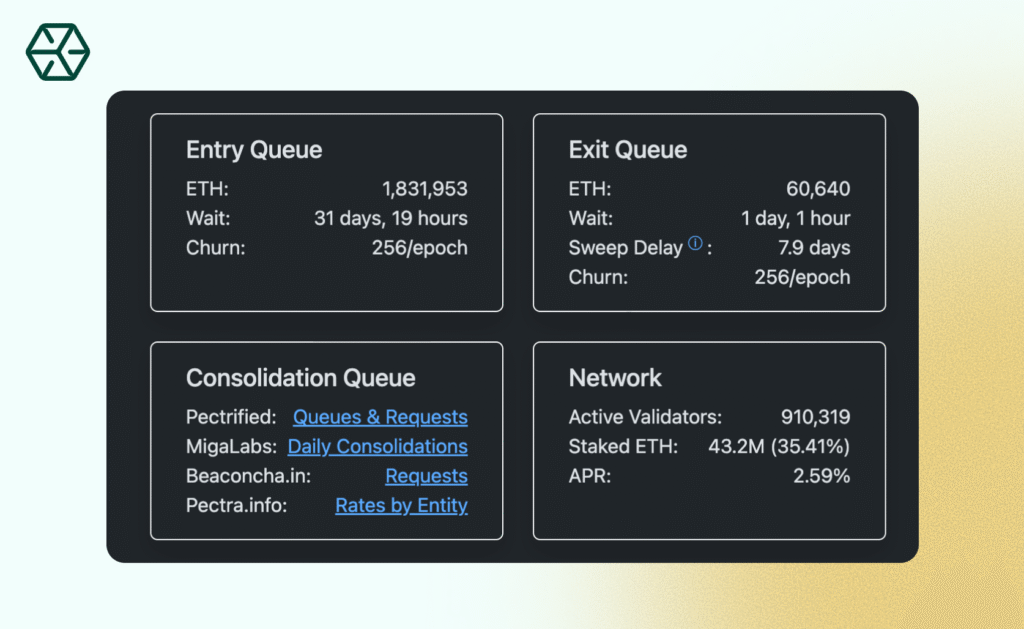
During stress the picture could change fast, like in January 2024, a mass unstaking event pushed the exit wait past 5 days. By September 2025 the exit queue pushed to a record 2.5 million ETH ($12 billion), with average wait times of 43-45 days as the most enormous validator exit wave in history.
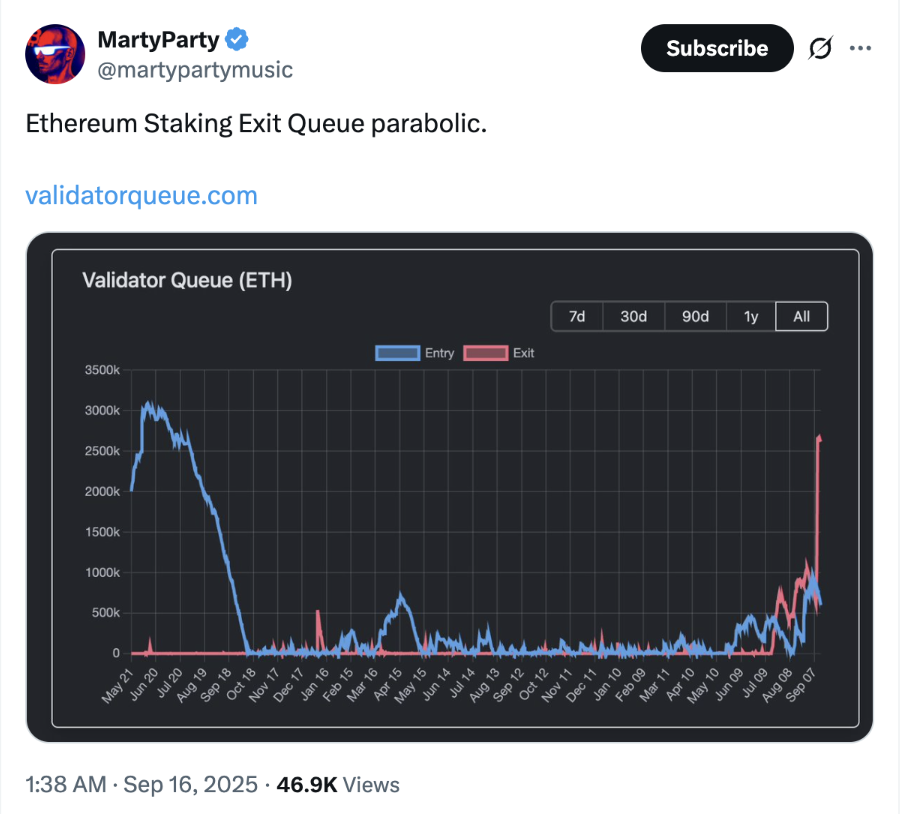
A fund cannot promise same-day redemptions while its assets are stuck in a queue like that, so the sleeve gives some room for adjustment and provides needed flexibility.
How It Works in Practice
When shareholders redeem, the fund draws from the unstaked sleeve first. The staked core keeps producing rewards while the sleeve absorbs the outflow.
Coinbase Institutional explains that managers use the sleeve first and draw down staked balances only for prolonged or outsized outflows.
Issuers size the sleeve against expected redemption patterns, then top it back up over time. The percentage is dynamic and adjusts with primary and secondary market activity.
For deeper outflows, issuers typically add tools on top of the sleeve:
- staking vault transfers, which move live validator positions for immediate liquidity,
- credit lines drawn against fund assets,
- repo agreements that raise cash without unstaking,
- insurance products for stress scenarios.
These tools back the sleeve as a second reserve. The sleeve covers routine days, and the extra tools cover severe redemption spikes.
Real-World Sizing
BlackRock’s iShares Staked Ethereum Trust (ETHB) launched on March 12, 2026 targets a staking ratio of 70% to 95%, leaving 5% to 30% unstaked as the sleeve.
Grayscale takes a different stance across its staking products. Its filings say the sponsor seeks to stake as much as practicable, up to 100%, with the remainder held in the sleeve.
Grayscale’s newer filings for products like its BNB and HYPE trusts decline to name a fixed sleeve percentage. The sponsor states the size may move with liquidity needs and redemption activity.
The disclosed approaches vary widely across issuers:
| Product | Issuer | Staked target | Unstaked sleeve |
| iShares Staked Ethereum Trust (ETHB) | BlackRock | 70% to 95% | 5% to 30% |
| Ethereum Staking ETF (ETHE) | Grayscale | Up to 100% practicable | Dynamic remainder |
| Solana Staking ETF | Grayscale | Up to 100% practicable | Dynamic remainder |
| HYPE Staking Trust | Grayscale | At least 70% at launch | Undisclosed, dynamic |
Each issuer sets its sleeve against its own redemption model and the applicable strategies to the network it stakes.
To learn more about tokenized institutional staking milestones for the first part of 2026, read our piece on real-world assets and staking.
The Trade-Off: Rate Drag
The unstaked sleeve produces no staking rewards. Only the staked core produces them, so the fund’s blended rate lands below the headline network rate.
The blended rate is the average across the whole fund, staked and unstaked parts combined. It is always lower than the network rate because part of the fund is idle.
If a fund keeps 15% unstaked and stakes the other 85% at a network rate of about 3%, only that 85% produces rewards, so the fund-wide rate works out to 85% times 3%, or roughly 2.55%.
Fees then widen the difference further. BlackRock distributes 82% of gross staking rewards to shareholders and keeps the other 18%, and it also charges a 0.25% sponsor fee, waived to 0.12% for the first $2.5 billion in AUM during the first 12 months.
AUM means assets under management, the total value the fund holds.
Combine those and the shareholder rate drops well under the network figure. One Everstake analysis of Ethereum staking ETFs for institutions models a gross Ethereum rate near 3.2% landing at roughly 1.9% to 2.6% net after all fee steps.
A larger sleeve means faster redemptions and a lower blended rate, and issuers pick a point on that trade-off.
How This Compares to Other Structures
The sleeve is just one of the options that institutions rely on to fix the issue every staking structure faces. Two alternatives handle it differently:
- Prime broker structures use liquid staking tokens, which are tradable receipts that represent staked assets and can be sold without unstaking. These trade capital efficiency for a different set of counterparty risks and exposures, and liquidity comes from selling the tradable token itself.
- Direct custody offers no buffer at all. A holder staking directly cannot sell during the unbonding window and must wait out the full exit period.
The sleeve is the ETF’s specific mechanism for turning a locked asset into a daily-redeemable share.
Everstake operates as a non-custodial validator and staking provider, having historically operated 130+ networks, running the infrastructure behind staked positions for institutional allocators. Its role is operational, providing infrastructure services directly or as a white-label option while the issuer manages the sleeve and redemptions.
Why the Sleeve Shapes Institutional Allocation
The sleeve plus fees creates a difference between the headline staking rate on an ETF and the rate a shareholder receives.
A fully staked fund would show a higher rate and weaker redemption terms. A fund with a larger sleeve shows a lower rate and stronger daily liquidity.
A staking ETF solves one problem with one mechanism. The liquidity sleeve turns a locked, queue-bound asset into a share that redeems on any business day, and in 2026 it has become the default design choice across institutional staking products.
FAQ
Can a staking ETF fail a redemption?
A staking ETF can meet routine redemptions from its liquidity sleeve without touching staked assets. Grayscale filings note that arrangements may not always provide sufficient liquidity in extreme scenarios, which is why issuers add credit lines and repo agreements behind the sleeve.
Why is my ETF staking rate lower than the network rate?
The difference comes from the unstaked sleeve and fee steps. BlackRock’s ETHB keeps 5% to 30% unstaked, and that portion produces nothing, so a 3% network rate blends lower before the 0.25% sponsor fee and the 82% reward-sharing split are applied.
How large is a typical liquidity sleeve?
There is no fixed standard. BlackRock runs a 5% to 30% sleeve on ETHB, while Grayscale stakes up to 100% where practicable and adjusts the unstaked remainder dynamically with redemption activity.
How long is the Ethereum unbonding period?
The Ethereum exit wait varies with queue depth. It cleared to near zero in mid-2026, but reached about 5 days in January 2024 and roughly 9 days in July 2025 during heavy exit demand.
What happens during a large redemption wave?
The fund draws the sleeve down first, then turns to backup tools. Coinbase Institutional describes staking vault transfers, credit lines, and repo agreements as the tools that cover outsized outflows once the sleeve is exhausted.
Does the liquidity sleeve change over time?
Yes. Issuer filings state the sleeve percentage is dynamic and adjusts with primary and secondary market activity, so a fund tops the buffer back up after redemptions draw it down.
Share with your network