The ABCs of Crypto
Crypto Validators Explained in Depth: The Core of Proof-of-Stake Networks
Validators are the core operators of Proof-of-Stake blockchains. This guide explains how they work, how they differ from delegators, and why they are critical to network security.
DEC 05, 2025
Last updated NOV 06, 2026 · V1
TL;DR
- A crypto validator is a participant in a Proof-of-Stake blockchain that operates validator software and takes part in consensus: depending on the protocol, it proposes blocks, attests to them, or votes on them.
- Validators secure the network through staked collateral, where correct behavior is rewarded and violations are penalized under each protocol’s rules, which on some networks include slashing.
- Blockchain networks can’t function on trust alone; they rely on participants who verify every transaction and keep the system honest.
- This guide explains what validators do, how different networks select them, what infrastructure they run, how to measure their performance, and how to evaluate one before you delegate.
What Is a Crypto Validator?
A crypto validator is a network participant that operates validator software and participates in a Proof-of-Stake blockchain’s consensus process. Depending on the protocol, validators propose blocks, attest to blocks, vote on proposed state transitions, or perform other consensus duties.
This is where the primary difference between validators and miners becomes apparent. In Proof-of-Work systems, such as Bitcoin, miners utilize specialized hardware to solve complex mathematical puzzles, consuming vast amounts of energy. In Proof-of-Stake, validators replace that process with economic commitment: they lock up tokens as collateral, and the protocol can penalize them if they fail to perform their duties or break consensus rules.
Three terms are often used interchangeably, but they describe different things:
- Validator: the protocol-level participant, identified by a key and backed by stake, that the network assigns consensus duties to.
- Validator operator: the person or organization responsible for maintaining the validator’s infrastructure.
- Validator node: the software and hardware used to participate in the network. On Ethereum, for example, a node runs an execution client and a consensus client, and needs a validator client added to propose blocks.
It’s important for anyone delegating stake: the validator’s rewards and penalties are set by the protocol, while its reliability depends on how well the operator maintains the node.
How Do Blockchain Validators Work?
Validators check transactions against protocol rules, take turns proposing blocks, and vote on each other’s blocks until validators holding enough stake agree.
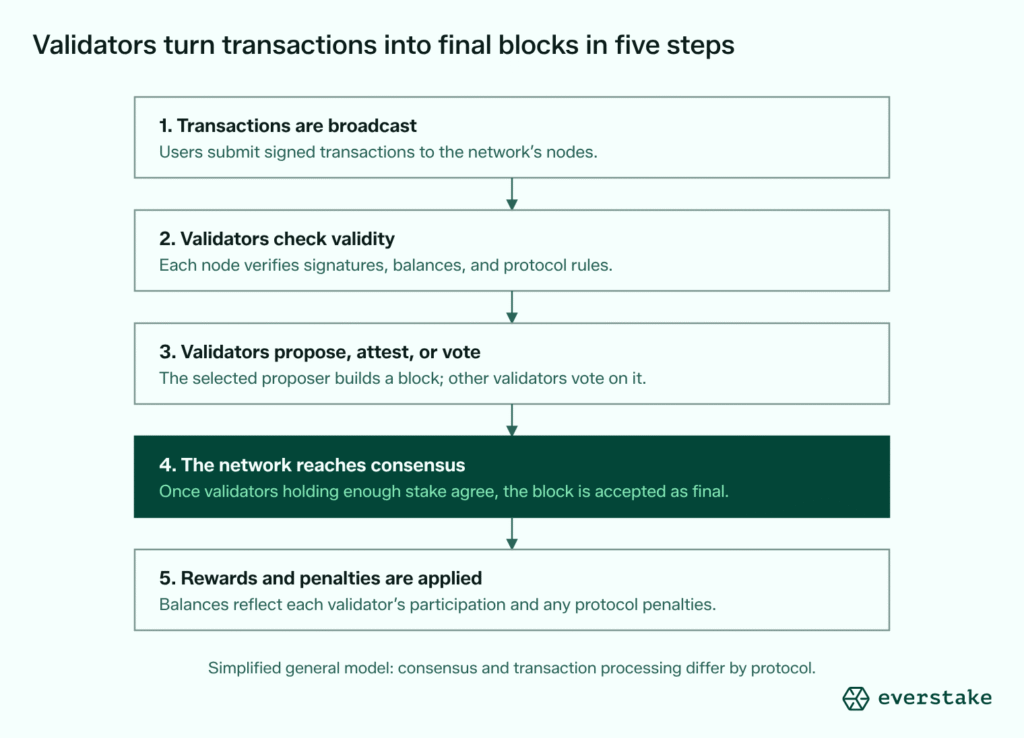
No single validator can unilaterally control consensus outcomes, because every block needs agreement from validators holding a supermajority of stake.
Why Do Validators Matter for Network Security?
Validators are the first and last line of defense in Proof-of-Stake networks: every block they confirm reinforces the network’s trust, ensuring that no one can rewrite history, double-spend tokens, or manipulate the history of transactions.
Reliable validators are rewarded, while those that go offline for too long face penalties, and on networks such as Ethereum and Cosmos Hub, signing conflicting blocks or votes is slashed. This economic alignment replaces the brute-force security of Proof-of-Work.
What Is the Difference Between a Validator, a Node, and a Delegator?
A node verifies and stores blockchain data, a validator takes part in consensus, and a delegator assigns stake to a validator without managing infrastructure. Both validators and delegators contribute to network security, but they do it in different ways.
| Role | Primary responsibility |
| Full node | Verifies blockchain data and maintains network state |
| Validator | Participates in consensus under protocol rules |
| Validator operator | Maintains the validator’s infrastructure |
| Delegator | Assigns stake to a validator where the protocol supports delegation |
Running a node does not automatically make someone a validator: on Ethereum, a consensus client without a validator only keeps up with the head of the chain and is not assigned proposal or attestation duties.
Validators operate the software and infrastructure their protocol requires, around the clock, and take part in block production and voting, so their uptime and accuracy directly affect the network’s reliability.
Delegators stake their tokens with a validator and share its rewards, minus commission, without operating hardware themselves. On stake-weighted networks, more delegated stake gives a validator more consensus weight; where delegated stake can be slashed, as on Cosmos Hub, a validator’s misbehavior also reduces its delegators’ stake.
Delegation models differ by network. Ethereum has no native delegation, so users who don’t run their own validator stake through pools or providers that operate validators for them. On Cosmos or Solana, users delegate directly from their wallets to validators like Everstake.
How Does Validator Selection Work in Different Blockchains?
Each Proof-of-Stake network decides who proposes and who votes on blocks using its own rules: some select proposers pseudo-randomly weighted by stake, some rotate through a stake-weighted schedule, and some cap the size of the active validator set. The core principle remains the same across all of them: stake gives a validator weight in consensus, and the protocol defines exactly how that weight is used.
| Network | Consensus duties | What determines participation | Entry requirement |
| Ethereum | Block proposals, attestations, sync committees | Active validator status; proposer chosen pseudo-randomly, weighted by effective balance | 32 ETH to activate; up to 2,048 ETH effective balance for validators with 0x02 (compounding) withdrawal credentials |
| Solana | Block production as scheduled leader; Alpenglow (Votor) voting | Stake-weighted leader schedule; vote weight proportional to stake | No fixed minimum stake; VAT admits only the top 2,000 validators by stake each epoch, and each pays a 0.8 SOL per-epoch fee from its vote account, separate from the rent-exempt reserve |
| Cosmos Hub | Block proposals, prevotes and precommits (CometBFT) | Voting power from bonded stake; only the top 180 validators by stake are active | No fixed minimum; must rank in the top 180 |
| Polygon PoS | Checkpoint signing on Heimdall; block production on Bor | Capped set of 105 validators; Heimdall selects Bor block producers each span based on stake | Stake POL on Ethereum; join only when a slot opens in the 105-validator set |
| Aptos | Proposing and voting in AptosBFT | Leader chosen by a deterministic formula using reputation (past performance) and stake | 1M APT minimum per validator; voting power capped at 50M APT |
Ethereum. Time is divided into 12-second slots and 32-slot epochs, and one validator is pseudo-randomly selected as block proposer in every slot using RANDAO, while a randomly chosen committee attests to the block. Selection is weighted by each validator’s effective balance. 32 ETH remains the minimum to activate a validator, but since the Pectra upgrade on May 7, 2025, a validator with 0x02 (compounding) withdrawal credentials can hold an effective balance of up to 2,048 ETH.
Solana. Validators take turns producing blocks according to a leader schedule weighted by stake, and all validators vote on the blocks leaders produce. On October 21, 2026, Solana replaced TowerBFT with Alpenglow’s Votor voting protocol: validators now send votes directly to each other instead of as onchain transactions, and a block is final after one or two voting rounds (80% of stake for the fast path, 60% thresholds for the second round). To vote and produce blocks, each validator must keep at least 0.8 SOL above rent-exempt in its vote account to pay the Validator Admission Ticket fee every epoch, and only the top 2,000 validators by stake are admitted.
Cosmos Hub. Validators are ranked by bonded stake (their own plus delegated), and only the top 180 form the active set. Within that set, a validator’s voting power equals its bonded stake; proposers rotate in proportion to voting power, and a block is committed once validators holding more than two-thirds of voting power sign it. Reputation influences which validators delegators choose, but the protocol itself ranks validators only by stake.
Polygon PoS. Validators stake POL in contracts on Ethereum and run two clients: Heimdall-v2 (built on Cosmos SDK and CometBFT) for validation and checkpoints, and Bor for block production. The system allows a maximum of 105 active validators, and new validators can join only when an active validator unbonds or is removed.
Aptos. A leader is selected by a deterministic formula based on reputation (including whether the validator voted in the past) and stake, and the minimum to join the validator set is 1M APT with a 50M APT maximum. Delegation pools let multiple holders combine stake to reach that minimum.
What Infrastructure Does a Validator Need?
A professional validator is an operational system, not a single server: it combines node clients, isolated signing keys, redundant sites, and 24/7 monitoring. Even short downtime can mean missed rewards or penalties.
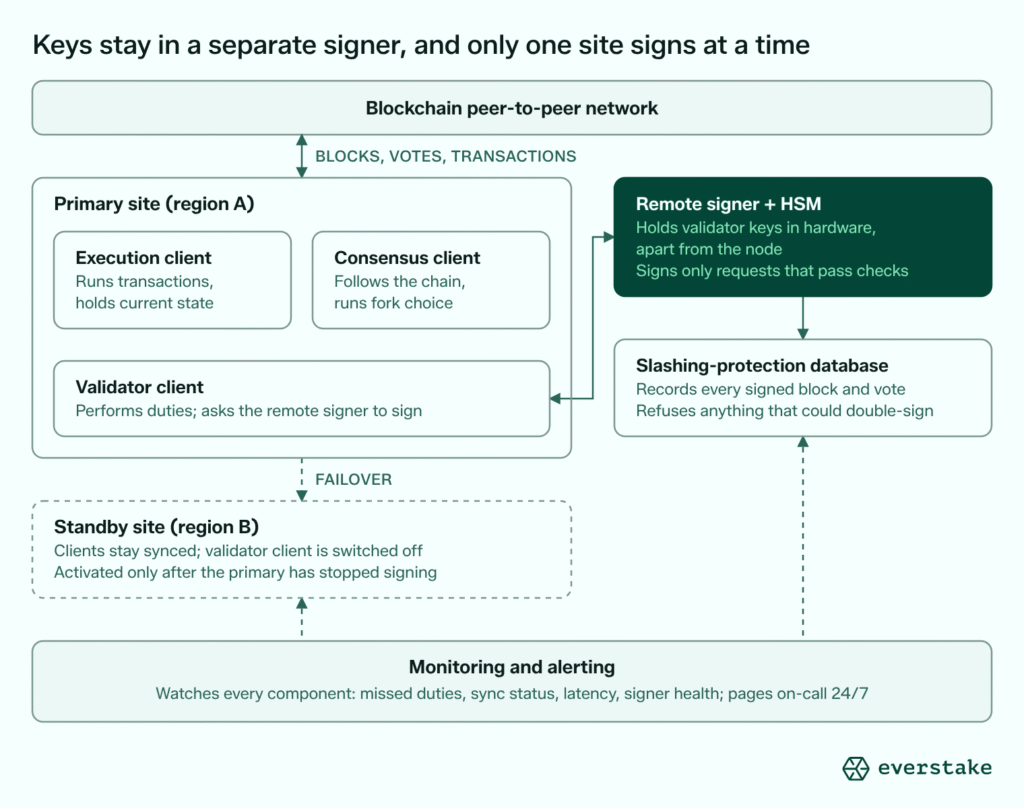
This example shows an Ethereum setup; other networks use different clients but the same pattern. The core components are:
- Node clients and hardware. On Ethereum, an execution client, a consensus client, and a validator client, on hardware sized to the network’s requirements with low-latency, well-peered connections.
- Isolated key management. Validator keys live in a remote signer backed by a Hardware Security Module (HSM), not on the node, which limits the damage from a compromised server.
- Slashing protection. A database records every signature and refuses any message that could conflict with one already signed.
- Redundancy and failover. A standby site in another region and hosting provider activates only after the primary has stopped signing, so failover cannot cause double-signing. On Ethereum, distributed validator technology (DVT) goes further by splitting signing across multiple machines and operators.
- Monitoring and incident response. Alerts for missed duties, sync issues, and signer health, with engineers on call.
- Software maintenance and client diversity. Testing and applying upgrades on time, without depending on a single client.
How Is Validator Performance Measured?
Validator performance is measured with protocol-specific metrics, together with commission and slashing history. These metrics are not directly comparable across networks: Ethereum attestation effectiveness and Solana skip rate measure different duties, so a single blended uptime figure says little about quality.
| Metric | What it measures | Where it applies |
| Uptime | Whether validator infrastructure remains online and responsive | All networks |
| Attestation effectiveness | How consistently and quickly a validator submits correct attestations | Ethereum |
| Missed blocks / missed proposals | Block production opportunities that were not fulfilled | Ethereum, Cosmos, Polygon, Aptos |
| Skip rate | Share of a validator’s leader slots in which it did not produce a confirmed block | Solana |
| Voting performance | Whether a validator votes correctly and on time in consensus rounds | Solana, Cosmos, Aptos |
| Commission | The operator’s share of applicable staking rewards | Networks with delegation |
| Slashing history | Recorded protocol-level penalties | Networks with slashing |
| Client diversity | Whether infrastructure depends on a single client implementation | All multi-client networks |
The Solana Foundation Delegation Program is a public example of performance-based evaluation: it caps a validator’s skip rate relative to the cluster average and requires timely upgrades to the latest stable release.
When reading any metric, check the time window, whether it is compared with the network average for the same period, and whether the data is onchain or self-reported.
What Are the Risks of Running a Validator?
Running a validator exposes the operator, and on some networks its delegators, to five main risks. Penalties depend on the protocol: ordinary downtime is not slashing on most networks.
- Downtime: missed duties and rewards, plus small penalties on some networks.
- Double-signing: signing conflicting blocks or votes, most often by accident when a primary and a backup node sign with the same key at the same time. It is the most common slashable offense.
- Client bugs and correlated failures: a bug in a widely used client, or an outage at a shared data center or cloud provider, can take many validators down together; on Ethereum, correlated slashing also raises penalties.
- Key compromise: an attacker with a signing key can force slashable behavior.
- Upgrade and configuration errors: missing an upgrade window or misconfiguring a parameter can remove a validator from consensus.
Penalty mechanics differ significantly by network:
| Network | Downtime | Double-signing / equivocation |
| Ethereum | Missed rewards and small penalties; heavier inactivity leak if the chain stops finalizing for more than four epochs | Slashing: an initial penalty, a correlation penalty on day 18 that grows with the share of validators slashed in the surrounding 36 days, and forced exit |
| Solana | Missed rewards; no stake is slashed. Since Alpenglow, failing to fund the 0.8 SOL admission fee also removes the validator from the next epoch | Protocol-enforced slashing is not live on mainnet; evidence logging (SIMD-0204) and penalty economics (SIMD-0212) are in development |
| Cosmos Hub | Jailed and slashed 0.01% for signing fewer than 500 of the last 10,000 blocks | Slashed 5% and permanently removed (tombstoned); delegators share the loss |
For network-by-network slashing rules and coverage options, see staking slashing risk: prevention and insurance.
How Do Validators Receive Rewards?
Validators are rewarded for performing consensus duties accurately. Reward sources vary by network, and not every validator receives every type:
- Protocol issuance: new tokens paid for consensus participation.
- Block proposal rewards: a bonus for the validator that produces a block.
- Priority fees: the share of user fees directed to the block producer (on Ethereum, the base fee is burned).
- MEV: builder payments on Ethereum and Jito tips on Solana.
- Commission: the operator’s share of rewards on delegated stake; the rest goes to delegators in proportion to their stake.
For who receives each part of a fee, see where blockchain transaction fees go. Staking rewards are never “free money”: reliable validators optimize for consistent performance and transparency rather than chasing the highest rewards.
How Do Validators Support Blockchain Decentralization?
Decentralization depends on how distributed the validators are. When block production and verification are handled by many independent participants instead of a few large entities, the network becomes more resilient, censorship-resistant, and transparent.
The number of validator identities alone does not measure decentralization. A network can have thousands of validators but still depend heavily on a small number of operators, hosting providers, or software clients. Six factors give a more accurate picture:
- Stake concentration: how much voting power the largest validators hold, and how many of them would be needed to halt or control consensus.
- Operator concentration: whether many validator keys are controlled by the same company.
- Geographic distribution: how validators are spread across countries and jurisdictions.
- Cloud and hosting concentration: whether a single data center or cloud provider outage could take a large share of stake offline.
- Client diversity: whether a bug in one client implementation could affect a majority of the network. Client mix can also change suddenly: for example, Solana’s Alpenglow migration supported only Agave-based clients, so operators on Firedancer or Frankendancer had to switch.
- Governance participation: whether validators vote on protocol changes and do so independently.
Decentralization isn’t automatic: it’s built through the choices of those who operate validators and those who delegate to them.
How to Evaluate a Blockchain Validator
To evaluate a validator, check six things: verifiable historical performance, slashing and incident history, infrastructure resilience, key management, protocol-specific expertise, and operational transparency.
| Question | What to verify |
| Is the validator consistently online? | Historical onchain performance (attestation effectiveness, skip rate, signed blocks) over months, compared with the network average |
| Has it experienced slashing? | Public protocol records and block explorers for slashing, jailing, or tombstoning events |
| Does it use redundant infrastructure? | Architecture documentation: multiple regions, providers, and failover design that cannot double-sign |
| How are signing keys protected? | Key management policies: remote signers, HSMs, access controls, slashing-protection databases |
| Does it update software promptly? | Client version history around recent network upgrades |
| Does it publish performance data? | Public dashboards, regular reporting, and incident post-mortems |
For a full institutional assessment, including legal structure, insurance, reporting, and compliance, use Everstake’s complete staking provider evaluation checklist and the guide to institutional staking risks.
How Do Institutional Validator Operations Differ from Individual Staking?
Institutional validator operations add formal controls on top of the same protocol duties: the protocol treats both alike, but institutions need the operator to prove its reliability. The main additions are:
- 24/7 monitoring and formal incident response, with on-call coverage, runbooks, and post-incident reports.
- Audited security and key controls, such as SOC 2 Type II, ISO 27001, HSM-backed signing, and role-based access.
- Service-level commitments for uptime and response times.
- Reporting for reward reconciliation, tax, and compliance.
For the risks institutions face and how to manage them, see institutional staking risks, staking for institutional treasuries, and the staking due diligence framework for private bankers.
Everstake as a Trusted Validator Example
Everstake is one of the largest global non-custodial staking providers, trusted by more than 1.6M users across 130+ Proof-of-Stake networks to date. Founded in 2018 by blockchain engineers, it has supported over $7 billion in staked assets for both institutional and retail clients.
The company operates with 99.98% uptime and has maintained zero material slashing events since inception. Its infrastructure holds SOC 2 Type II and ISO 27001:2022 certifications, along with alignment with NIST CSF 2.0 and GDPR and CCPA compliance.
Through API-first architecture, distributed node deployments, and continuous infrastructure monitoring, Everstake provides staking infrastructure for wallets, custodians, exchanges, asset managers, and protocol ecosystems globally. Individual users can explore staking through Everstake’s non-custodial staking dashboard, and institutions can explore Everstake Institutional Staking.
Conclusion
Validators are the invisible backbone of every Proof-of-Stake network: they keep transactions accurate, secure consensus, and protect the system from manipulation without the energy costs of mining. Understanding how they are selected, what infrastructure they operate, and how their performance is measured is the best way to choose one, whether it is managed by an individual or a large provider like Everstake.
FAQs
What is the difference between a validator and a node?
A node verifies and maintains blockchain data, while a validator is a protocol-level participant assigned consensus duties. Validators use dedicated software and infrastructure to perform these duties.
How many validators does a blockchain need?
It depends on the protocol: Cosmos Hub has 180 active validator slots, Polygon PoS has 105, and Solana’s VAT mechanism limits admission to 2,000 validators. Ethereum has no fixed validator-set cap.
Can anyone become a blockchain validator?
On Ethereum, anyone who meets the stake and hardware requirements can operate a validator, while Solana admits only the top 2,000 validators by stake each epoch and Polygon PoS admits new validators only when one of its 105 slots opens.
How much does it cost to run a validator?
Costs include the stake requirement (for example, 32 ETH on Ethereum or 1M APT on Aptos), hardware or hosting, bandwidth, and on some networks protocol fees such as Solana’s 0.8 SOL per-epoch admission fee.
What happens if a validator goes offline?
An offline validator misses rewards for the duties it skips, and depending on the network it may also face small penalties or, on Cosmos chains, temporary jailing.
Do validators control cryptocurrency transactions?
No, validators can order and include transactions but cannot move users’ funds or change balances, because every transaction must carry a valid signature from the account owner.
Share with your network