Institutional
What Private Bankers Need Before Recommending Staking to Clients
A diligence framework for staking for private banking: what advisors must understand, disclose, and ask before they recommend it.
SEP 18, 2026
Last updated SEP 18, 2026 · V1
TL;DR
- Staking for private banking is stalled because responsibility is undefined and the mechanics are hard to explain, while regulated infrastructure already operates at scale.
- Everstake and other enterprise-grade infrastructure providers run the validator infrastructure; what advisors lack is a sales-enablement layer they can stand behind in front of a client.
- Bank of America now lets 15,000+ advisors recommend a 1%-4% crypto allocation, effective January 5, 2026. Yet JPMorgan’s 2026 Global Family Office Report found 89% of family offices still hold none.
- Exposure and staking are separate decisions: the BofA guidance covers spot-Bitcoin–ETF exposure, while staking adds custody, slashing, and lock-up dimensions the ETF conversation never had to answer before.
- A fiduciary needs a written answer to who is accountable when something goes wrong, and it mostly remains unaddressed in provider pitches.
- As a result, the infrastructure side must now hand bankers plain-language risk explanations, a custody and key-control map, audit-grade reporting, and a defined liability chain.
The divide is not what it looks like
Bank of America moved its house view to allow proactive 1%-4% digital-asset recommendations across Merrill, Bank of America Private Bank, and Merrill Edge, effective January 5, 2026.
That decision reached more than 15,000 advisors who previously could not discuss crypto unless a client raised this topic first. Chris Hyzy, Chief Investment Officer at Bank of America Private Bank, deemed a modest allocation as potentially appropriate for clients comfortable with higher volatility.
Meanwhile, the allocator side has barely moved. JPMorgan‘s 2026 Global Family Office Report surveyed 333 single-family offices across 30 countries with an average net worth of $1.6 billion.
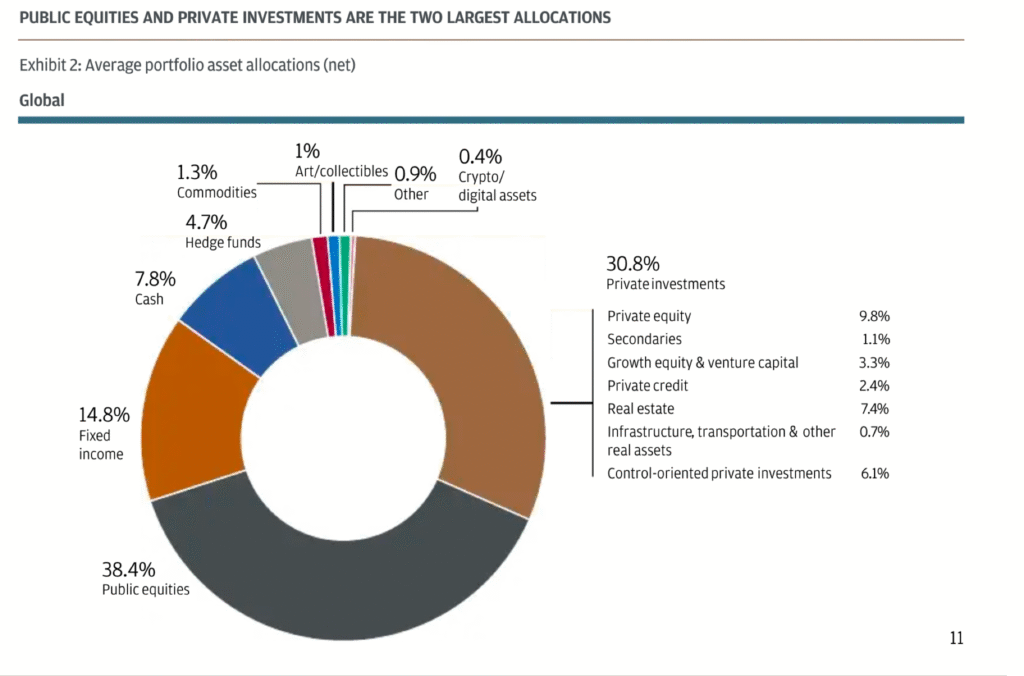
It found that 89% hold zero cryptocurrency exposure, and the average allocation across all respondents is 0.4%. Bitcoin alone averages 0.2%, and only 17% of offices treat digital assets as a key theme.
Advisors got the green light, but the money didn’t follow. The infrastructure already exists, works, and is designed to meet institutional compliance and security standards, so the blocker is not technical. The main issue for the advisors is that the responsibility is undefined and the mechanics are hard to explain.
Nobody at a family office wants to become a staking specialist. They want someone they already trust to vouch for it, which makes the missing piece a sales-enablement layer on the infrastructure side.
Reading the market signals accurately
Wealth managers are being handed permission to recommend crypto, and the house-view change is happening across at least four major firms. BlackRock has described a 1%-2% Bitcoin allocation as reasonable, Morgan Stanley issued a 2%-4% range for opportunistic portfolios in October 2025, and Fidelity has long held a 2%-5% band.
The allocator reality lags because attention is directed elsewhere. In the JPMorgan survey, 65% of family offices prioritize artificial intelligence, and private equity leads planned increases at 37% globally.
The survey masks a bimodal market. Some family offices in Asia and Hong Kong, plus crypto-native offices, are committing tens to hundreds of millions, while the broad cohort holds zero.
The house-view change is mostly about spot-Bitcoin–ETF exposure. Exposure is not staking. Staking is the next step that adds reward mechanics alongside custody, slashing, and lock-up dimensions the ETF conversation never had to deal with.
Is miscommunication a root of the problem?
Advisors are reluctant to recommend staking even when permitted because the accountability question stays unanswered in most provider pitches.
A fiduciary must be able to explain and defend a decision to beneficiaries, so access alone does not clear the bar. A retail staker who picks a weak validator might lose some reward; a fiduciary who does the same must justify the choice, which raises the standard from availability to explanation.
Staking is harder to translate than ETF exposure. It introduces reward mechanics, key control, penalties, and liquidity constraints that do not map cleanly onto traditional products.
This is a sales-enablement problem, which reframes the whole discussion. The task is equipping the trusted intermediary with answers, and that responsibility rests with the provider.
What private bankers need: the staking enablement checklist
Here is a diligence framework a banker can use before putting staking in front of anyone.
Definitions of risk in wealth-management language
Staking reward comes from the network paying for its security through issuance and fees. It carries validator and lock-up risk. The specific risks an advisor must be able to name and explain include:
- slashing (loss of principal for validator misbehavior such as double-signing, not loss of reward alone),
- downtime or missed rewards (distinct from slashing, and not to be conflated with it),
- lock-up and unbonding delays (a liquidity constraint),
- smart-contract and liquid-staking-token risk (for liquid staking or restaking),
- counterparty and operational risk,
- chain-event risk from upgrades, forks, and governance changes.
A provider that separates slashing from operational penalty from downtime is credible; one that mixes them is not.
Custody and control
Advisors need to know exactly who controls what at each step:
- the funds,
- the signing keys,
- the withdrawal credentials,
- the reward parameters,
- the exit process,
- the operational authorizations.
The label “custodial versus non-custodial” is too coarse to entail the depth of this topic. Staked assets remain client assets, so they need segregation, records, approval controls, and clear treatment before, during, and after staking.
Non-custodial models reduce custody counterparty risk. Everstake runs validator operations while asset control stays with the client organization, and it integrates with custodians including Fireblocks, BitGo, Anchorage, Zodia, and Taurus.
Non-custodial design does not remove slashing, incident, or governance risk. It determines the custody with the client, while taking on the operations and infrastructure.
A defined accountability chain
The single most important enablement item is a written answer to who is accountable when something goes wrong. That answer must cover contractual limits, coverage programs and their exclusions, incident response, and liability of the operator, custodian, and client.
Slashing-insurance and reimbursement programs exist, and their terms vary widely. Advisors must be able to read those terms, not cite the headline coverage figure alone.
Reporting and audit trails
Staking must be auditable across every system that touches it. Records of staked assets, validator activity, rewards, fees, balances, and unstaking events need to reconcile across custody, portfolio accounting, fund administration, and tax.
Poor or absent reporting is an adoption blocker. When records fail to reconcile, an advisor cannot sign off, regardless of how strong the underlying operation is.
Suitability, tax, and compliance framing
The 1%-4% guidance already raises concentration-risk scrutiny, so advisors should document suitability and concentration monitoring for each client. Tax treatment of rewards and jurisdictional rules also apply, including MiCA and ESMA consumer-protection discussion of liquid-staking tokens in the EU.
Suitability, tax, and jurisdictional decisions are the advisor’s own compliance and legal responsibility. This article does not provide them as advice.
The due-diligence questions for provider
Advisors evaluating a staking provider before a client conversation can work through a fixed list. Selection is about a provider that can sustain the service with verifiable evidence and explain its limitations, so the lowest fee is not the deciding factor.
- Who controls keys, withdrawal credentials, and exit at each step?
- What is the slashing track record, and what technical prevention and economic response exist?
- Is the model concentrated or distributed, and does staking with one operator create single-point-of-failure risk?
- What reporting is produced, and does it reconcile to the accounting and tax stack?
- What is the business model, and does the provider also run custody, exchange, or ETP lines that create a conflict surface?
- How does the architecture adapt per network, given that Ethereum slashing differs from other chains’ penalty models?
The answers could separate a provider that can stand behind the service from one that cannot. A credible operator documents each point with evidence.
What the infrastructure side owes the allocator
Adoption will not move by pushing family offices to self-educate. Staking for private banking moves when providers hand private bankers and custodians a ready-made translation: plain-language risk explanations, a custody and accountability map, audit-grade reporting, and a written liability chain.
Providers whose only business is the validator operations carry a structural neutrality advantage. Everstake operates as a non-custodial validator that has historically run 130+ networks to date, holds SOC 2 Type II, ISO 27001:2022, and NIST CSF 2.0, with the completed independent DORA controls assessment and reported 99.98% uptime.
Narrowing down and specializing might work better for current market, when a provider does not also run custody, an exchange, or an ETP against the same client. Neutrality is an incentive.
Conclusion
The 89%-versus-house-view divide is a translation failure, not a technology failure. The infrastructure is ready, while the sales-enablement layer is not.
The goal is making staking explainable and attributable through the people clients already trust. That work belongs to the provider, and it is measurable through the diligence framework above.
FAQ
Can private bankers and advisors recommend crypto now?
Yes, within limits. Bank of America cleared its 15,000+ advisors to recommend 1%-4% digital-asset allocations from January 5, 2026, and suitability rules still apply on every account.
Why do most family offices still hold no crypto?
JPMorgan found 89% of family offices hold zero crypto exposure, and the cause is a trust and translation shortfall that access alone does not close.
What are the main risks of staking?
The main staking risks are slashing, downtime, lock-ups, custody exposure, smart-contract and liquid-staking-token risk, and chain-event risk.
Is slashing a loss of reward or principal?
Slashing is a loss of principal, not reward alone, and advisors frequently get this wrong. It penalizes validator misbehavior such as double-signing, so the distinction between slashing, downtime, and operational penalty gives an advisor a proper terminology for a client conversation.
What should an advisor ask a staking provider?
An advisor should ask about key control, slashing record, coverage terms, reporting reconciliation, concentration, and conflicts of interest. Everstake documents these points for institutional diligence, including its certifications and custodian integrations.
What does staking for private banking require before an advisor recommends it?
Staking for private banking requires a clear risk translation, a custody and key-control map, a written accountability chain, reconcilable reporting, and a suitability and tax review.
Does staking through a custodian remove risk?
No, it reduces custody counterparty risk but does not remove slashing, operational, or governance risk.
Share with your network