ethereum
EIP-8198 Quick Slots: Ethereum’s Path From 12-Second to 10-Second Blocks
Ethereum protocol opens one slot every 12 seconds, where the slot can hold one block. EIP-8198, called Quick Slots, is the proposal under review to shorten that interval in the Hegotá hard fork.
OCT 15, 2026
Last updated OCT 15, 2026 · V1
TL;DR
- Ethereum block time is 12 seconds and changing it would require a hard fork.
- EIP-8198 (Quick Slots) makes slot length a fork-set parameter, then shortens it in steps gated on performance data.
- The canonical draft uses an 8-second placeholder, while Ethlabs advocates 10 seconds first, keeping 12 seconds also remains possible.
- Gas and blob limits per block scale with slot length, so Ethereum TPS capacity and the steady-state base fee stay roughly level.
- At 10 seconds, blocks arrive 20% more often and two-epoch finality falls from about 12.8 to 10.7 minutes (calculation).
- Validators face tighter deadlines, with attestations due near 2.5 seconds (calculation), and slower or distant operators carry the most risk.
- DEX prices would refresh more often, though modeled arbitrage reductions vary by trading pair and remain untested on mainnet.
- Based rollups and L1-linked interoperability inherit the faster cadence with no rollup-side changes.
- For institutional stakers, annual ETH issuance stays roughly level, while confirmation policies and timestamp-based reporting need review.
- As of October 15, 2026, EIP-8198 is being considered for the Hegotá upgrade, targeted for 2027. Its inclusion, activation date, and initial slot duration remain unconfirmed.
What is Ethereum’s block time, and why is it 12 seconds?
Ethereum’s block time is 12 seconds, fixed by the length of one consensus slot. In each slot, the protocol pseudo-randomly selects one validator to propose a block.
A slot is a fixed time window filled with a block. When the selected proposer is offline or late, the slot stays empty, called a missed slot.
32 slots form one epoch, which lasts 6.4 minutes at today’s slot length. Each validator attests once per epoch, so attestation work spreads across all 32 slots.
The 12-second slot gives a global validator set time to finish three steps in order:
- A proposer builds and broadcasts the block.
- A committee attests to the chain head by the 4-second mark, one-third of the slot.
- Aggregators combine those votes by the 8-second mark, two-thirds of the slot.
These deadlines describe mainnet before Glamsterdam, which restructures parts of the slot through ePBS (EIP-7732).
What is EIP-8198 (Quick Slots)?
EIP-8198 (Quick Slots) is a draft Ethereum Improvement Proposal that makes slot duration configurable and then shortens it. Barnabé Monnot of Ethlabs proposed Quick Slots for Hegotá on the August 6, 2026 All Core Developers call.
The EIP divides the work into three phases:
- Replace the hardcoded 12-second assumption in every client with a runtime setting.
- Benchmark consensus-client performance on devnets to locate bottlenecks.
- Cut slot duration step by step, based on those benchmark results.
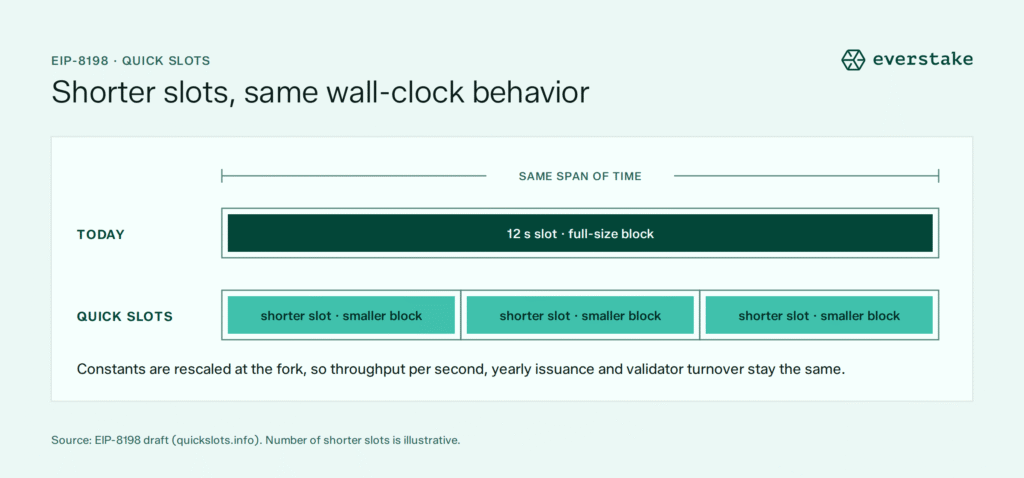
At the fork, EIP-8198 also rescales protocol constants so wall-clock behavior holds steady:
- gas and blob limits per block, scaled to the new slot length;
- the base reward factor, so annual ETH issuance stays roughly level;
- churn limits, so the validator set turns over at today’s real-time rate;
- blob retention windows, so rollups keep the same retention period in days.
Why does Quick Slots make slot time configurable first?
Quick Slots makes slot time configurable first because the 12-second assumption runs through every consensus and execution client. Removing it once lets later reductions ship as fork-activated parameter updates.
If testing favors 12 seconds, clients still end up with cleaner timing code and a measured performance profile, according to the EIP-8198 authors.
A follow-up on Ethereum Magicians proposes a slot schedule modeled on the blob-parameter-only (BPO) forks of EIP-7892. Under that design, each future cut becomes a configuration entry tied to a fork epoch.
Will Ethereum’s first step be 8 or 10 seconds?
No first-step value is decided. The canonical EIP-8198 text lists 8,000 ms as a placeholder and says the target should follow performance testing.
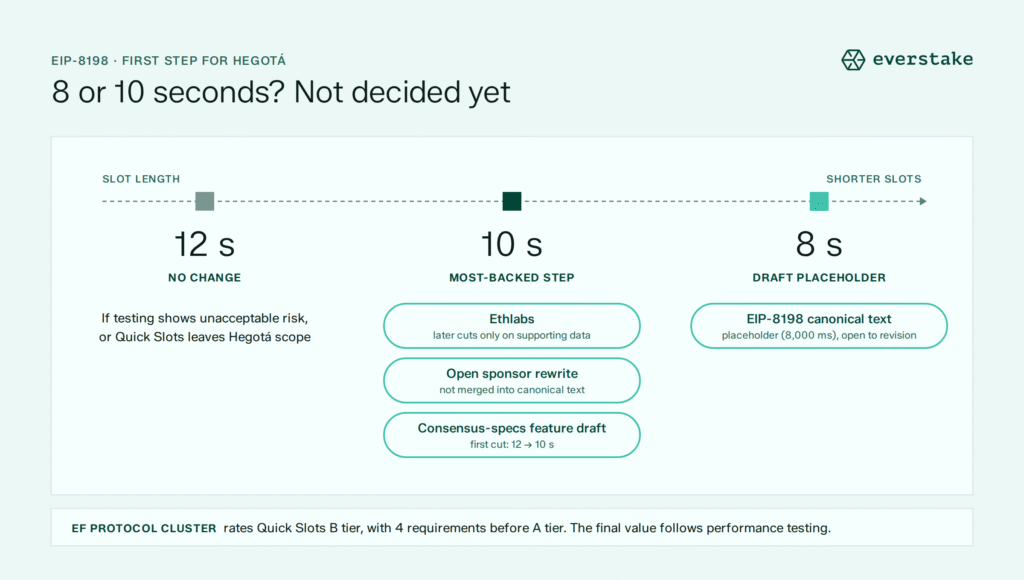
Three options remain possible for Hegotá:
- 10 seconds, the step Ethlabs and the sponsor rewrite favor;
- 8 seconds, the placeholder in the canonical draft;
- 12 seconds, if testing shows unacceptable risk or Quick Slots leaves the Hegotá scope.
Does a 10-second slot mean higher Ethereum TPS?
No. Quick Slots keeps Ethereum TPS capacity roughly constant, because each block carries proportionally less gas.
At the fork block, EIP-8198 sets the gas limit to the parent limit times the new slot length, divided by the old one. At 10 seconds, each block would carry about 83% of the prior gas limit (calculation: 10 ÷ 12).
Validators resume normal gas-limit voting from the next block, and blob limits scale the same way.
The result is smaller blocks arriving 20% more often (calculation: 12 ÷ 10 = 1.2). The EIP expects the steady-state base fee to stay unchanged, since the gas-per-second target holds.
The same principle applies on other networks, including Solana’s move to 200ms slots: cadence sets latency, while per-slot limits set capacity.
How would Quick Slots change confirmation time and finality?
Quick Slots would shorten both the wait for first inclusion and the wait for finality. Blocks arrive more often, and an epoch stays at 32 slots, so each epoch takes less wall-clock time.
Finality under Casper FFG typically takes two epochs, or 64 slots. Calculated from that slot count, finality times are:
- 12 seconds: 64 × 12 s = 768 s, about 12.8 minutes;
- 10 seconds: 64 × 10 s = 640 s, about 10.7 minutes;
- 8 seconds: 64 × 8 s = 512 s, about 8.5 minutes, matching the EIP-8198 estimate.
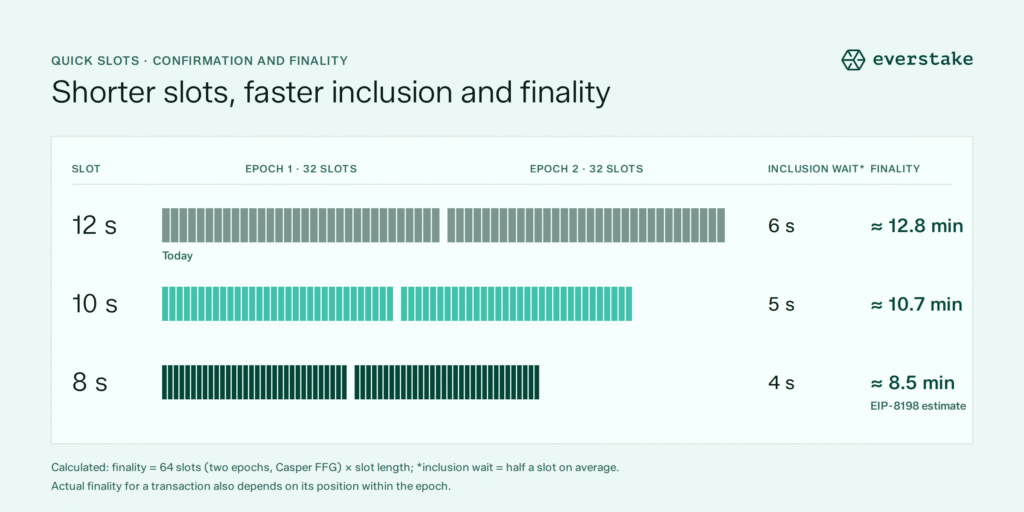
Actual finality for a given transaction also depends on its position within the epoch.
A transaction submitted at a random moment waits half a slot on average for its first inclusion chance. That is 6 seconds today and 5 seconds at 10-second slots (calculation).
What changes for validators and node operators?
Validators would face tighter deadlines and more frequent duties, since every in-slot step compresses with slot length.
EIP-8198 expresses in-slot deadlines in basis points of slot duration. If today’s proportions held at 10 seconds, attestations would be due near 2.5 seconds and aggregates near 6.7 seconds (calculation).
Main effects for node operators:
- Epochs per day rise from 225 to 270, so attestation rounds and proposals come 20% more often (calculation).
- Per-second bandwidth and compute demand rise, while peak data per block stays flat or falls, per the EIP.
- Clients, dashboards, and tooling that assume 12-second blocks need updates, per the EIP compatibility section.
- Per-duty issuance is rescaled, so annual ETH issuance stays roughly level.
The decentralization risk comes from the slowest validators, the ones that already receive blocks and attestations late. A CryptoSlate review notes that operators in slower regions or on weaker hardware would feel tighter windows first.
Post-Pectra research also linked propagation delay to reorg risk near the attestation deadline.
Operators with geo-distributed infrastructure and continuous monitoring are better placed to meet tighter deadlines. Everstake, a validator operator since 2018, runs Ethereum validators with automated failover and 24/7 monitoring.
What does Quick Slots mean for institutional ETH stakers?
For institutions, Quick Slots would mainly change settlement latency and operational timing. Annual ETH issuance stays roughly level, because the EIP rescales per-duty issuance to the new slot length.
Areas institutional teams typically review before a slot change:
- deposit and withdrawal confirmation policies that count blocks or wait for finality;
- reconciliation and reporting systems that convert block numbers into timestamps;
- tokenized-asset and ETF processes, where shorter slots narrow the delay between off-chain and on-chain prices;
- validator provider readiness for client upgrades and tighter attestation deadlines.
Institutions staking through Everstake keep ownership and custody of their assets while Everstake operates the validators. Everstake holds SOC 2 Type II, ISO 27001, and NIST CSF certifications for its validator operations.
How would Quick Slots affect MEV, DEX pricing and block building?
Shorter slots would refresh on-chain prices more often, which shrinks the window arbitrageurs exploit. EIP-8198 cites a model in which arbitrage losses scale with the square root of time between blocks.
Under that model, a cut from 12 to 8 seconds reduces those losses by roughly 18%, per the EIP. A cut from 12 to 10 seconds would reduce them by roughly 9%.
Supporters, including 20 ecosystem leaders interviewed by Ethlabs, expect four effects:
- tighter slippage settings on DEX swaps;
- lower loss-versus-rebalancing (LVR) for liquidity providers on automated market makers (AMMs);
- less MEV surplus per block across the block-building supply chain;
- less value in a builder’s option to abandon a block under ePBS when prices move, tied to fewer empty blocks.
Builders would have less time to assemble and propagate each block, which tightens deadlines across how Ethereum blocks are built.
Faster blocks address only part of on-chain trading losses. A September 21, 2026 CryptoSlate analysis notes the 18% figure is a model output, untested on a production 8-second chain.
Cited research found the effect varies by trading pair. Sudden price jumps also cause a minimum level of losses that shorter slots cannot remove.
What do shorter slots mean for L2s and based rollups?
Rollups tied to L1 timing would get faster inclusion and shorter composition windows. Based rollups inherit L1 block time as their sequencing interval, so 10-second slots would speed them up with no rollup-side changes.
L2s that use L1 for interoperability inherit slot duration too. Shorter slots cut the latency of those cross-rollup transactions, per the EIP-8198 motivation section.
Blob retention windows are rescaled to keep their length in days, which protects rollup challenge periods of about 7 days.
How does Quick Slots interact with FOCIL?
Quick Slots at 10 seconds would raise inclusion opportunities from 5 to 6 per minute (calculation). Under FOCIL in the Hegotá hard fork, each slot brings fresh inclusion lists, giving censored transactions more frequent chances to be included.
Could Ethereum go to 8 or 6 seconds?
Further cuts are possible under Quick Slots, with each step gated on new performance data. The configurable design exists so later reductions ship as parameter updates at future forks.
EIP-7782, titled Reduce Block Latency, proposes 6-second slots. It was debated for Glamsterdam, which chose ePBS as its consensus headliner. EIP-7782 remains a draft.
An EF analysis of August 2025 data put 95th-percentile relay block propagation near 800 ms. It also found some attestations too late for a 6-second design.
How is Quick Slots different from single-slot finality?
Quick Slots shortens slot duration, while single-slot finality (SSF) changes how finality is reached. Both reduce time to finality, and they run on separate research tracks.
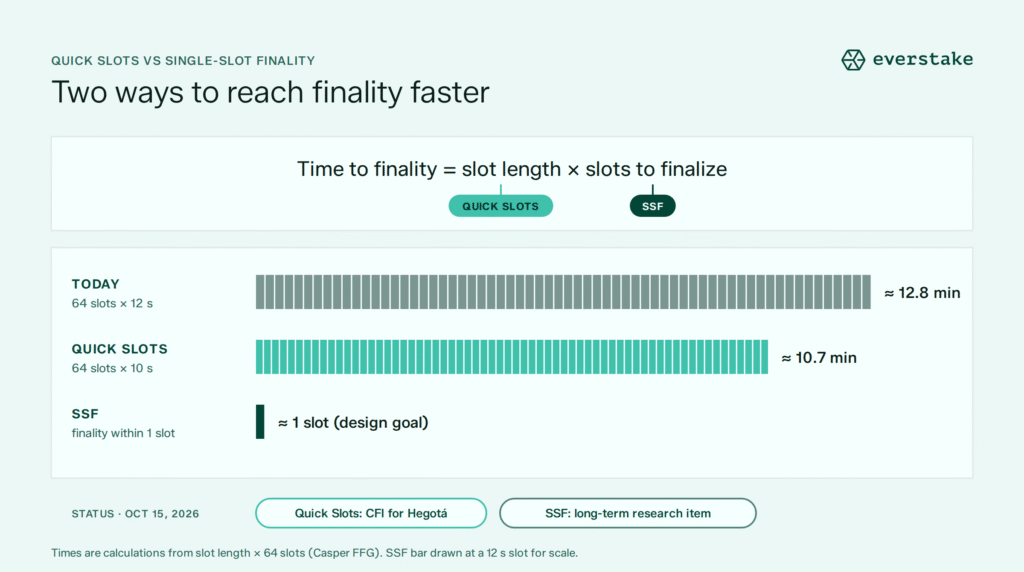
| Aspect | Quick Slots (EIP-8198) | Single-slot finality (SSF) |
| What changes | Slot duration | Finality mechanism |
| Finality path | Casper FFG over 64 slots | Finality within 1 slot |
| Time to finality | ~10.7 min at 10 s (calculation) | About 1 slot (design goal) |
| Status on October 15, 2026 | CFI for Hegotá | Long-term research item |
| Client work | Timing refactor and parameter rescaling | Consensus redesign |
What are the risks and limits of shorter Ethereum slots?
The main risks involve validators that cannot keep up with tighter deadlines. The EF Protocol cluster placed Quick Slots in its B tier on September 7, 2026, splitting the difference between strong R&D support and D grades from delivery-focused engineering teams, who cited the retuning cascade behind any slot-time change.
- Missed slots: shorter windows raise the chance that distant or slower proposers miss their slot.
- Reorg risk: post-Pectra research links propagation delay to reorgs near the attestation deadline.
- Client diversity: every consensus client must refactor timing code, and EF delivery teams rated the proposal D for that cascade.
- Centralization pressure: if timing tails worsen, well-provisioned operators in central regions could hold a timing advantage.
- Tooling breakage: applications that hardcode 12-second block times need updates.
FAQ
What is Ethereum’s block time?
Ethereum’s block time is 12 seconds, one block per slot. 32 slots form a 6.4-minute epoch run on this schedule today.
What is Ethereum’s TPS?
Ethereum TPS depends on the block gas limit and the gas each transaction consumes. Quick Slots at 10 seconds keeps gas per second constant.
How long does an Ethereum transaction take to confirm?
Inclusion happens in the next slot that picks up the transaction, and slots arrive every 12 seconds. At 10-second slots, the average wait would fall from about 6 to 5 seconds.
How long does Ethereum finality take?
Ethereum finality typically takes about 12.8 minutes, or two epochs of 64 slots. At 10-second slots, that would fall to about 10.7 minutes.
Is Quick Slots confirmed for Hegotá?
No. As of October, 2026, EIP-8198 is Considered for Inclusion, one stage before Scheduled for Inclusion.
Will 10-second blocks lower Ethereum gas fees?
No. EIP-8198 keeps gas per second constant and expects the steady-state base fee to stay unchanged.
Priority fees and the burned base fee would follow the same rules for all validators.
Does Quick Slots change ETH staking rewards?
EIP-8198 is designed to keep annual ETH issuance roughly level. Under the 8-second draft, integer rounding would under-issue by about 1.6%, per the EIP text.
Share with your network