Aptos
ethereum
solana
sui
web3 infrastructure
Validator Node Cost by Network: Hardware and Stake
Reviewing the 4 components of the validator cost for different networks.
OCT 16, 2026
Last updated OCT 16, 2026 · V1
TL;DR
- A validator budget has 4 cost lines: locked assets, infrastructure, protocol operating costs and risk.
- On Ethereum, the 32 ETH activation minimum, about $79,000, is the largest capital requirement. Running costs are $3,000 to $4,800 a year in hosting, plus rewards forgone during queue waits.
- On Solana, vote fees of up to 2.2 SOL per day, about 720–790 SOL a year, are the largest running cost. From October 21, 2026, Alpenglow replaces them with a burned 0.8 SOL per-epoch ticket, about 292 SOL a year.
- On Aptos and Sui, hardware is moderate, and the main barrier is attracting enough delegated stake.
- Network choice could be more impactful than hardware expenses.
- For most stake sizes, a provider such as Everstake costs less than an in-house validator team.
The cost to run a validator node depends on 4 components: locked assets, infrastructure, protocol-level operating costs and risk. Most cost estimates stop at hardware while it is often the smallest line.
The Four Cost Components of a Validator
Every validator budget covers assets, infrastructure, protocol costs and risk. Validator economics cannot be compared on server prices alone, since every parameter varies depending on network design and behavior.
- Assets. Tokens bonded as stake. The stake is returned on exit, so the cost is the rewards forgone during entry and exit queues, plus any slashing loss.
- Infrastructure. Servers, bandwidth, storage, standby nodes and monitoring.
- Protocol costs. Fees the network charges validators, such as Solana vote fees.
- Risk. Expected losses from slashing, downtime and missed rewards.
Validator Hardware Requirements by Network
| Network | CPU | RAM | Storage | Network | Minimum stake |
| Ethereum | 8+ cores | 64 GB | 4 TB NVMe | 25+ Mbit/s upload | 32 ETH |
| Solana | 12 cores / 24 threads, 2.8 GHz | 256 GB or more | 3 NVMe drives: accounts 1 TB+, ledger 1 TB+, snapshots 500 GB | 2 Gbps minimum, 10 Gbps recommended | None (vote account rent 0.027 SOL) |
| Aptos | 32 cores, 2.8 GHz | 64 GB | 3 TB SSD, 60K IOPS | 1 Gbps | 1,000,000 APT |
| Sui | 24 physical cores | 128 GB | 4 TB NVMe | 1 Gbps | 3 voting power (0.03% of total stake) |
Specs are sourced from the Ethereum node guide, Agave validator requirements, Aptos node requirements and Sui validator requirements, accessed October, 2026. Aptos specs apply to the validator and its validator fullnode.
Ethereum Validator Requirements and Costs
An Ethereum validator needs 32 ETH to activate, worth about $78,000 in October, 2026. Dedicated server hosting runs about $250 to $400 a month, per Cherry Servers node pricing.
EIP-7870 recommends 8+ cores, 64 GB of RAM, a 4 TB NVMe drive and 25+ Mbit/s upload for validating nodes. One machine runs both an execution client and a consensus client.
EIP-7251, activated with the Pectra upgrade on May 7, 2025, raised the maximum effective balance from 32 ETH to 2,048 ETH. An institution staking 2,048 ETH now manages 1 validator key instead of 64.
The entry queue adds an extra cost: on October 16, 2026, about 1.29 million ETH waited about 22 days to activate. Exits also queue, with about 1.01 million ETH waiting about 17 days, plus a 7.2-day withdrawal sweep.
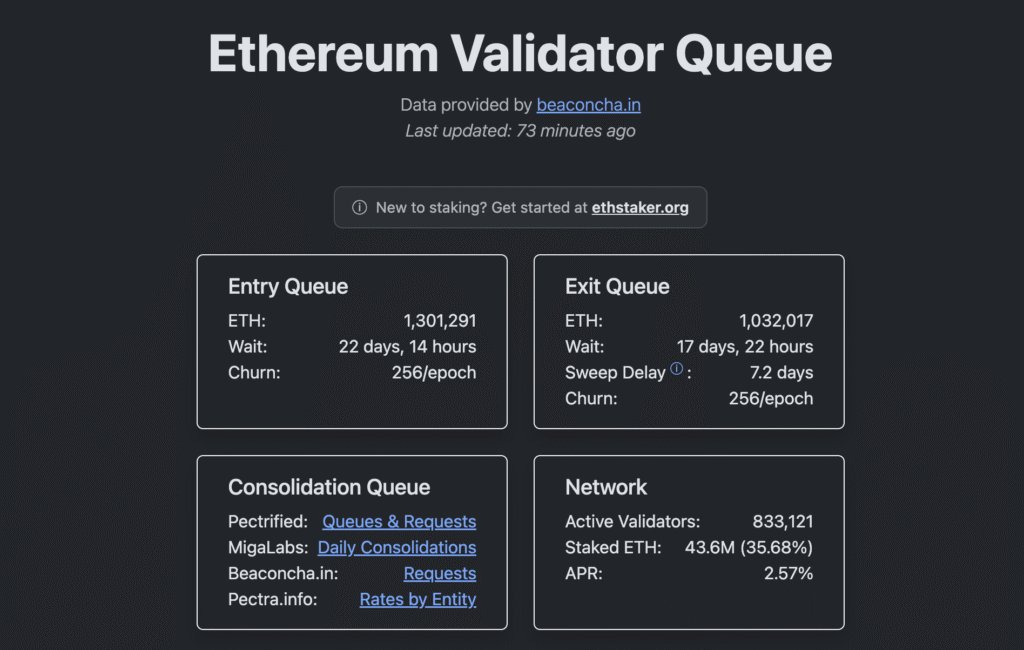
Queued stake receives no rewards. At a 2.58% reward rate, a 22-day wait costs about 0.05 ETH per 32 ETH, or about 3.3 ETH on a 2,048 ETH position.
The 2.58% protocol rate was recorded across 833,821 active validators in October 2026, per ValidatorQueue data.
Note: these are projected numbers derived from open sources and hypothetical calculations.
Solana Validator Requirements and Costs
Solana sets no minimum stake, and vote fees make it the costliest network here to operate. Validators send one vote transaction per slot. Since slot times fell from 400 ms to 200 ms on October 9, 2026, that adds up to about 2.2 SOL per day, or about 790 SOL a year.
At $117 per SOL, vote fees reach about $92,000 a year (subject to change). Bare metal hosting adds $800 to $1,200 a month.
Vote fees are fixed in SOL, so covering them takes the same stake at any token price. Hosting is billed in USD, so a lower SOL price raises the stake needed to cover it.
The active validator count fell from about 2,560 in early 2023 to 699 on August 13, 2026. Small operators exited as vote fees and 0% commission competition outpaced their rewards. The Solana Foundation also pruned inactive nodes from April 2025.
The Alpenglow upgrade replaces vote transactions with a Validator Admission Ticket (VAT) of 0.8 SOL per epoch, burned at each epoch start. Mainnet activation is scheduled for epoch 1064, starting about October 21, 2026, with the consensus set capped at the top 2,000 validators by stake.
At 200 ms slots, epochs last about 1 day, so the ticket totals 270 to 290 SOL a year, below current vote fees. Validators without a registered BLS key were excluded from consensus on July 22, 2026.
Alpenglow also changes where the fee goes. Today, half of each vote fee goes to the block producer, so large validators recover part of their own voting cost. The 0.8 SOL ticket is fully burned.
Break-even stake equals annual cost in SOL divided by (protocol reward rate × commission). After Alpenglow, annual costs are about 374–415 SOL, which covers the ticket plus hosting at $117 per SOL. At a 5.35% reward rate and 10% commission, that comes to about 70,000–78,000 SOL of delegated stake, before block rewards, MEV and staff.
Delegators can compare Everstake terms on the Solana staking page.
Aptos, Sui and Newer Networks
Newer networks demand moderate hardware and set higher stake barriers. The main cost is winning enough delegation to enter and stay in the active set.
Aptos requires 1,000,000 APT to join the validator set, and operators run 2 isolated machines per validator.
Sui is moving to a voting-power threshold under SIP-39. Candidates need 3 voting power to join and are removed below 2 and get a seven-epoch grace period before removal.
Neither network charges vote fees, so staffing and redundancy become the largest recurring lines.
Often Overlooked Costs
Operational overhead often exceeds the server bill once a validator runs in production. Vendor price lists rarely include:
- On-call rotation. 24/7 paging coverage needs enough engineers to handle incidents at any hour.
- Client upgrades. Ethereum shipped Pectra on May 7, 2025 and Fusaka on December 3, 2025.
- Protocol migrations. Solana operators handled BLS key registration, VAT funding and Alpenglow preparation in 2026.
- Key ceremonies. Generating, backing up and rotating signing keys requires dual control and audit records.
- Failover. A standby node doubles hardware spend and needs slashing protection against double signing.
- Monitoring. Alerting on missed votes, attestations and disk health, tracked against validator uptime targets.
- Insurance and audits. Slashing coverage, plus SOC 2 and ISO 27001 audits that institutional clients request.
Hosting concentration adds exposure: on August 12, 2026, a TeraSwitch routing incident took 28.83% of staked SOL offline for 33 minutes.
Slashing Risk and Downtime
Slashing risk is best budgeted as expected loss: event probability multiplied by penalty size. Worst-case framing overstates the cost for well-run operators.
On Ethereum, the initial slashing penalty after Pectra is 1/4096 of effective balance, about 0.0078 ETH on 32 ETH. A correlation penalty grows with the share of stake slashed in the same period, and exit follows about 36 days later.
Since the Beacon Chain launched, 594 validator keys have been slashed, and slashed ETH equals about 0.001% of ETH staked, according to Rated Network in October 2026.
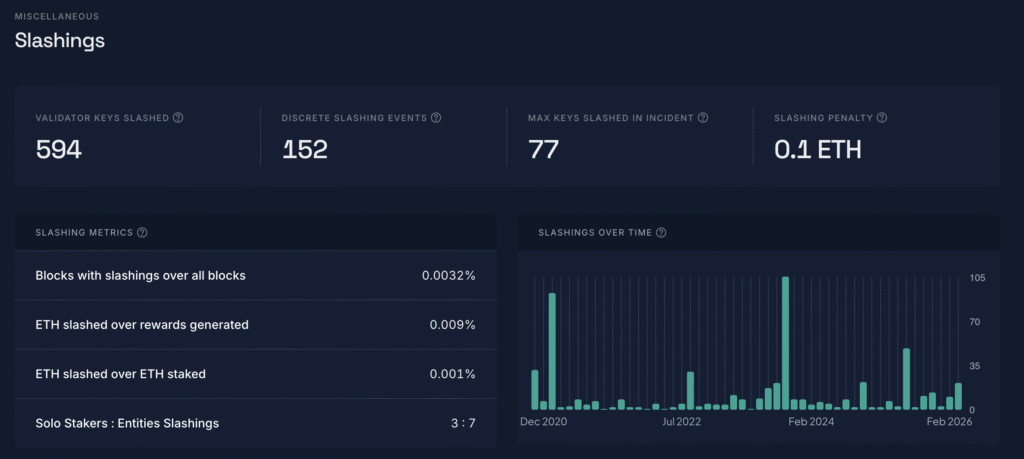
Downtime occurs more often than slashing. An offline Ethereum validator forgoes about 0.14 ETH a day in rewards and pays about 0.09 ETH in penalties, roughly 0.23 ETH a day at 2,048 ETH.
Solana mainnet applies no automated stake slashing as of October 2026. Downtime there costs vote credits and, over time, delegated stake.
Strong controls keep that expected loss close to zero. Everstake has had zero material slashing events on major networks since 2018 and maintains 99.98% observed uptime.
When Delegation or VaaS Is Cheaper Than Operating
In-house operation costs less when annual fixed costs fall below the fee a provider would take on the same stake. The threshold formula is annual in-house cost divided by provider fee times reward rate.
The threshold formula is annual in-house cost divided by (provider fee × reward rate). At an illustrative 10% fee and 2.58% rate, each $100,000 of in-house cost breaks even at about $38.8M of stake, or roughly 15,600 ETH at $2,480 per ETH.
On Solana, delegating avoids about $44,000 to $49,000 a year in admission-ticket fees and hosting after Alpenglow, before any staff cost.
On Solana, delegating avoids about $45,000 a year in admission-ticket fees and hosting after Alpenglow, before any staff cost.
In-house operation fits institutions that meet 3 conditions:
- Stake large enough to clear the threshold formula.
- An existing 24/7 infrastructure team.
- A mandate to control signing infrastructure directly.
Everstake Validator-as-a-Service deploys dedicated validators in 72 hours while the institution keeps custody. Integrations include Fireblocks, BitGo, Anchorage Digital, Copper and Zodia Custody.
Everstake has historically operated 130+ networks since 2018, with $7B+ in total staked value and 99.98% observed uptime as of Q4 2026. Everstake holds a SOC 2 Type II attestation and ISO 27001 certification, as of October 2026, with controls aligned to NIST CSF and GDPR, and has completed an independent assessment of its ICT controls against selected DORA requirements.
FAQ
How much does it cost to run a validator node?
A dedicated Ethereum hosting could cost at about $3,000 to $4,800 a year, and Ethereum requires 32 ETH, about $79,000 in October 2026, as activation capital. On Solana, running costs are about $44,000 to $49,000 a year once Alpenglow activates on October 21, 2026, and about $94,000 to $107,000 a year before it. Staff costs come on top of these figures.
How much does a Solana validator cost?
After Alpenglow, a Solana validator could cost about $44,000 to $49,000 a year before staff. That covers the 0.8 SOL per-epoch admission ticket, about 292 SOL or $34,000 at $117 per SOL, and $9,600 to $14,400 in hosting. Before Alpenglow, vote fees push the total to about $94,000 to $107,000.
What is the minimum stake to run a validator?
There is no minimum on Solana. Ethereum requires 32 ETH, and Aptos requires 1,000,000 APT. Sui is moving to a minimum of 3 voting power (about 0.03% of total stake) under SIP-39. Holders below these floors can delegate to an existing validator instead.
What hardware do I need for a validator?
It depends on the network:
- Ethereum: 8 cores, 64 GB RAM and 4 TB NVMe.
- Solana: 12+ cores and 256 GB+ RAM.
- Sui: 24 cores, 128 GB RAM and 4 TB NVMe.
- Aptos: 32 cores, 64 GB RAM and 3 TB SSD, on each of 2 machines.
What is the Solana vote cost?
At 200 ms slots, vote fees run about 2 SOL a day (up to 2.2), or about 720 to 790 SOL a year. From epoch 1064 (October 21, 2026), Alpenglow replaces them with a flat 0.8 SOL per-epoch admission ticket, which is burned. That comes to about 270 to 290 SOL a year.
Is cloud or bare metal cheaper for a validator?
Bare metal is usually cheaper for Solana mainnet validators, because cloud egress alone can add about $900 to $1,200 a month.
Disclaimer:
All figures are illustrative estimates based on public sources as of October 2026. Prices and protocol parameters change frequently, so actual costs may differ. Actual costs depend on each operator’s setup, location, stake size and staffing. This is not financial or investment advice.
Share with your network