ethereum
The ABCs of Crypto
Can You Pay Gas Fees in Stablecoins? Gas Abstraction Explained
Why blockchains charge gas in volatile native tokens, how stablecoin gas and paymasters work, and what changes operationally when fees are denominated in USD.
SEP 25, 2026
Last updated SEP 25, 2026 · V1
TL;DR
- As of September 2026, at least 7 networks let users pay gas fees in stablecoins or USD-priced units.
- Networks charge gas in their native token by default, because that token pays validators and funds network security.
- For businesses, native-token gas means holding a second, volatile asset, which complicates treasury and accounting work.
- Mechanisms move native-token price risk to another party, so institutions are choosing which counterparty carries it.
- The service has a price. Circle Paymaster adds 10% to USDC-paid gas on Arbitrum and Base, and Alchemy charges sponsors 8%.
- When validators receive fees in stablecoins, fee revenue becomes USD-denominated, while staking rewards may stay in a volatile token.
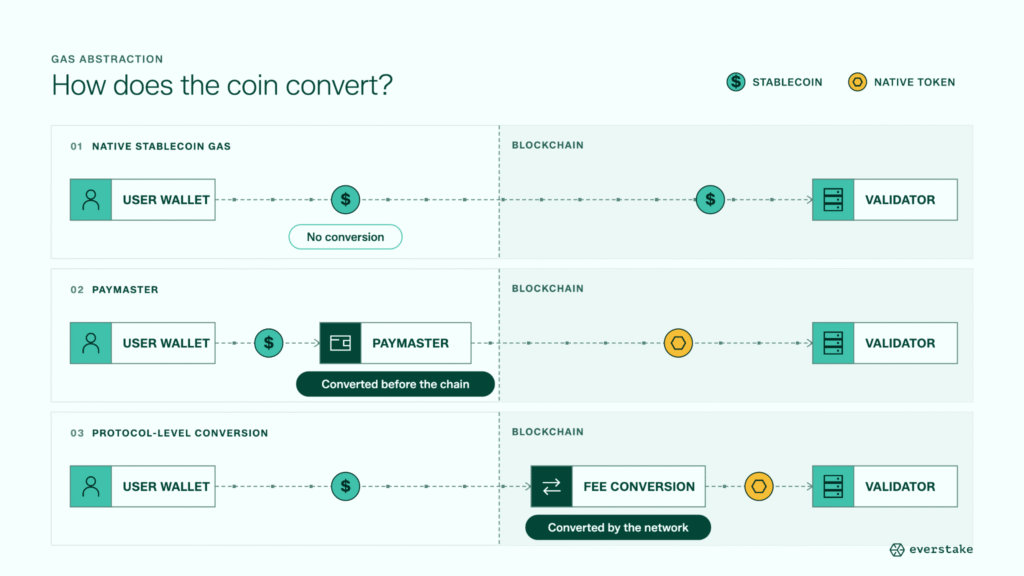
Currently, users can pay gas fees in stablecoins on a growing set of networks. 3 mechanisms make it possible:
- Native stablecoin gas: the network charges and collects fees in a stablecoin directly.
- Paymasters: a third party pays the fee in the native token and bills the user another way.
- Protocol-level fee conversion: the network swaps the user’s payment into the asset validators accept.
Key terms for gas abstraction
Gas abstraction relies on 6 core terms.
| Term | Plain-language meaning |
| Gas | The fee a blockchain charges to process a transaction. |
| Native token | The network’s own coin, such as ETH on Ethereum, used by default to pay gas. |
| Stablecoin | A token designed to hold a fixed value, usually $1, such as USDC or USDT. |
| Validator | A node operator that checks transactions and builds blocks in exchange for fees and rewards. |
| Smart account | A wallet controlled by programmable code, which can let another party pay its gas. |
| Bundler | A service that submits smart-account transaction requests to the blockchain. |
Why are gas fees paid in native tokens?
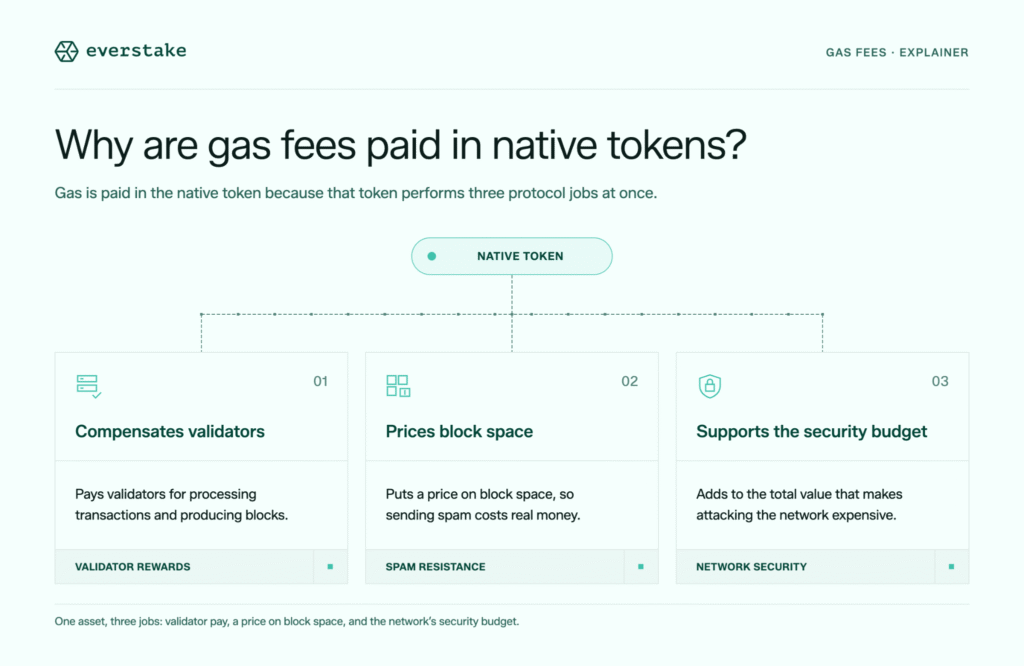
Gas is paid in the native token because that token performs 3 protocol jobs at the same time:
- compensates validators for processing transactions and producing blocks.
- puts a price on block space, so sending spam costs real money.
- supports the security budget, the total value that makes attacking the network expensive.
On proof-of-stake networks, validators lock the native token as collateral, called stake. Fees paid in that same token add to the asset that secures the network.
On Ethereum, each fee has 2 parts: a base fee and an optional priority fee, also called a tip. Since the London hard fork on August 5, 2021, the base fee is burned, meaning permanently destroyed.
The block proposer, the validator that builds the block, receives the tip in ETH. One fee asset also lets nodes check fees without an external price feed, called an oracle.
Why USDC gas fees are an operational problem for businesses
USDC gas fees create a second asset exposure. To move a dollar-pegged token on most chains, a business must also hold the network’s native token, whose price changes daily.
Circle, the issuer of USDC, notes that holding native tokens can create regulatory uncertainty and accounting challenges for institutions.
| Function | Operational impact of native-token gas |
| Treasury | Teams pre-fund wallets with ETH, SOL, or other native tokens on every chain they use. |
| Accounting | Under FASB ASU 2023-08, US companies report in-scope crypto at fair value, so price moves appear in each period’s results. |
| Fee forecasting | A USD fee budget changes with both network congestion and native-token price. |
| Reconciliation | Each payment creates entries in 2 assets: the stablecoin transfer and the native-token fee. |
| Payment operations | A wallet holding USDC with zero native token cannot send the USDC, which stalls payouts. |
For a payments team, the native-token balance becomes a separate working-capital line item.
How gas abstraction works: three ways to pay fees in stablecoins
Gas abstraction lets a user pay transaction fees in a token they already hold, such as USDC. The 3 methods differ in where the stablecoin is converted into the asset validators receive.
Native stablecoin gas
With native stablecoin gas, the network is designed to charge fees in a stablecoin from launch. The user pays in that stablecoin, and validators receive the same stablecoin.
Fees settle in the user’s stablecoin at transaction time, with zero conversion steps.
The main risk moves to the stablecoin issuer. If the stablecoin loses its $1 peg, an event called a depeg, fee values move with it.
Paymaster ERC-4337 and account abstraction payments
A paymaster is a smart contract that pays gas on a user’s behalf. ERC-4337 is the Ethereum standard that defines how smart accounts use paymasters.
Under ERC-4337, the paymaster keeps a deposit of native tokens in a shared contract called EntryPoint.
A paymaster-backed transaction follows 4 steps:
- The user’s smart account creates a
UserOperation, a transaction request that names the paymaster. - A bundler collects the request and submits it to the
EntryPointcontract. EntryPointpays the gas from the paymaster’s native-token deposit.- The paymaster recovers the cost from the user in USDC, bills the app in fiat, or absorbs it as a sponsor.
The Pectra upgrade on May 7, 2025 added EIP-7702, which lets a standard wallet temporarily run smart-account code. EIP-7702 wallets can use Circle’s paymaster, so users keep their existing wallet address.
EIP-8141 would build paymaster support into the Ethereum protocol through native account abstraction.
EIP-8141 received Scheduled for Inclusion status for the Hegotá fork on March 26, 2026. That status means developers are evaluating it, and inclusion is still unconfirmed.
Protocol-level fee conversion
Protocol-level conversion lets users pay fees in an approved token, and the network converts it into the asset validators accept. The rule is part of the blockchain’s core software, so a standard wallet works with it.
Conversion takes 2 common forms:
- An allowlist of approved fee tokens, set by governance, where wallets add one extra field naming the fee token.
- A built-in automated market maker (AMM), a pool that swaps between stablecoins at a fixed rate inside the transaction.
The user typically pays a small conversion cost, either as extra gas or as a swap spread.
| Mechanism | Where conversion happens | Wallet requirement |
| Native stablecoin gas | Fees settle in the stablecoin | Standard wallet |
| Paymaster (ERC-4337) | Paymaster contract | Smart account or EIP-7702 wallet |
| Protocol-level conversion | Core protocol logic or built-in AMM | Standard wallet plus fee-token field |
What gas sponsorship costs the sponsor
Gas sponsorship moves the full network fee, plus a provider margin, onto the sponsor. The user sees a $0 fee, while the sponsor, usually the app or wallet provider, pays for every approved transaction.
Full sponsorship
Alchemy‘s Gas Manager bills the developer in fiat and charges 8% of gas fees covered on its pay-as-you-go tier.
Sponsors control cost with policy rules:
- Per-transaction spend caps.
- Per-user or per-campaign quotas.
- Allowlists of chains and contracts.
Pay gas with USDC: user-paid token paymasters
In a token paymaster model, the user pays gas in USDC and the operator converts it into the native token. Circle Paymaster charges a 10% surcharge on Arbitrum and Base, so a $0.01 fee becomes $0.011.
Across providers, ERC-20 token paymasters typically add a 5% to 15% markup. The markup covers oracle drift, so price moves between quote and payment, plus conversion costs.
Where the volatility goes
Gas abstraction moves native-token price risk from the user to service providers and network participants. Each design still relies on a native or staking token, so its price risk stays with whoever holds it.
| Mechanism | Who absorbs native-token volatility | Residual risk for the payer |
| Native stablecoin gas | Holders and stakers of the network’s staking token, if one exists | Stablecoin issuer and depeg risk |
| Paymaster | Paymaster operator holding native-token inventory | Surcharge changes and operator dependency |
| Protocol-level conversion | Fee-pool liquidity providers, or holders of a token that is burned and reissued | Conversion spread and allowlist governance |
Paymaster operators keep native tokens on deposit at EntryPoint and carry their price risk.
What stablecoin transaction fees mean for validators and fee
When stablecoin transaction fees reach validators directly, fees become a USD-denominated stream. Staking rewards, paid as new tokens for securing the network, may still arrive in a volatile token.
Validator revenue then has 2 components with different accounting profiles:
- Fee revenue in a stablecoin, stable in USD terms and tied to transaction volume.
- Protocol rewards in the staking token, variable in USD terms and tied to issuance.
Paymaster models leave validator fee unchanged. The paymaster converts the fee before it reaches the block, so validators receive the native token.
Burn-based designs destroy the fees users pay. Validators receive newly issued tokens as rewards, sized by their activity and uptime.
Stablecoin-native networks often launch with permissioned validator sets, where the network operator approves each validator. Institutions evaluating these networks should confirm who can run nodes and how fee revenue is distributed.
Everstake is a large, institutional validator constantly improving its services and performance and running hardware/software with the highly professional specialists onboard. We have vast validating experience in more than 130 PoS blockchains. Institutions comparing networks and fee models can work with Everstake as a validator and staking provider.
Networks that support stablecoin gas fees today
As of September 2026, at least 7 networks and ecosystems let users pay fees in stablecoins or USD-denominated units.
| Network | Mechanism | User pays in | Key detail | Status (Sep 2026) |
| Ethereum and EVM L2s (networks built on Ethereum) | Paymaster (ERC-4337, EIP-7702) | USDC via Circle Paymaster on 7 chains | Validators receive ETH or the chain’s native token | Live since March 2023 |
| Celo | Protocol fee-token allowlist | USDC, USDT, cUSD/USDm (Celo‘s dollar stablecoin) | Non-native fee tokens add about 50,000 gas per transaction | Live; L2 since March 26, 2025 |
| Tempo | Native stablecoin gas with fee AMM | USD stablecoins on the TIP-20 standard | AMM swap costs 0.30%; fees go to the block proposer | Mainnet since March 18, 2026 |
| Arc | Native USDC gas | USDC | 11 founding validators, approved by Circle | Public mainnet since September 16, 2026 |
| Canton | USD-priced fees, paid by burning Canton Coin (CC) | CC at a USD rate set by Super Validators | Participants receive newly minted CC | Live |
| Plasma | Protocol paymaster plus custom gas tokens | USDT or other approved tokens | Basic USDT transfers are free, with rate limits; XPL is the native token | Mainnet beta since September 25, 2025 |
| Solana | Fee payer service on the Kora open standard | USDT or other SPL tokens (Solana‘s token standard) | Fee payer spends SOL on the user’s behalf | Live |
To get a network-specific detail, read our materials on:
- How Canton‘s fee model removes gas volatility for institutions
- What Tempo is: Stripe and Paradigm‘s stablecoin payments blockchain
- What Arc is: Circle‘s stablecoin-native L1
FAQ
Can I pay gas in USDC?
Yes, on networks and wallets that support gas abstraction. Circle Paymaster accepts USDC for gas on 7 chains, with a 10% surcharge on Arbitrum and Base. On Ethereum, validators such as Everstake still receive rewards in ETH, because the paymaster pays the network in ETH the fee first.
Why do I need ETH to send USDC?
Ethereum charges every transaction fee in ETH, including fees for moving tokens such as USDC. USDC runs as a contract on Ethereum, so each transfer uses resources priced in ETH. Validators receive the tip portion of that fee in ETH.
How do I send USDC without ETH?
Use a smart wallet or an EIP-7702 wallet connected to a paymaster, such as Circle Paymaster. The paymaster deducts the fee from your USDC balance. The fee still reaches Ethereum validators in ETH.
What is a paymaster?
A paymaster is an ERC-4337 smart contract that pays gas on a user’s behalf from a native-token deposit. It covers the fee or recovers it in USDC, typically with a 5% to 15% markup. Validators see a standard fee paid in the native token.
Who pays the gas in a sponsored transaction?
The sponsor pays, usually the application or wallet provider. Services such as Alchemy charge the sponsor 8% of covered gas on pay-as-you-go. Validators receive the fee in the native token.
Why are gas fees paid in native tokens?
Native-token fees link the cost of block space to the asset that secures the network. On Ethereum, each validator stakes a minimum of 32 ETH and receives priority fees in ETH.
Share with your network