ethereum
Ethereum Hegota Hard Fork Explained: FOCIL, Frame Transactions and Timeline Full Overview
Hegotá is an important Ethereum network upgrade planned to follow Glamsterdam. It targets stronger censorship resistance and programmable transaction authorization.
OCT 08, 2026
Last updated OCT 08, 2026 · V1
TL;DR
Hegotá is the Ethereum network upgrade planned to follow Glamsterdam. It targets stronger censorship resistance and programmable transaction authorization.
- Timeline: mainnet is expected in Q2 2027, after Glamsterdam (targeted for December 2026) and a Sepolia fork in 2027.
- Confirmed scope: EIP-7805 (FOCIL) and EIP-8141 (Frame Transactions) are currently scheduled for inclusion. The EF has also graded 15 additional EIPs as A-tier, meaning they are expected to ship but are not yet formally scheduled.
- FOCIL: a 16-member validator committee per slot lists transactions that builders must include. Censorship then requires all 16 members to omit an eligible transaction.
- Frame Transactions: accounts define their own validation and fee rules in code. Wallets and institutions can build sponsored fees and multi-key approvals on that base.
- Supporting EIPs: three A-tier companions connect both headliners and extend enforced inclusion to private transactions.
- Post-quantum: Hegotá prepares accounts for new signature schemes, and the EF targets full L1 quantum resistance by December 2029.
- ETH holders: no action is needed, and balances and issuance stay unchanged. No gas limit increase is scheduled.
- Validators: execution and consensus clients need upgrades before the fork. Everstake handles upgrades for the validators it operates.
What Is the Hegotá Hard Fork?
Hegotá is a planned Ethereum hard fork that changes both consensus and execution rules. A hard fork is a coordinated rule change that every node must adopt at a set point on the chain.
The name Hegotá combines Heze and Bogotá. Heze is a star that names the consensus-layer upgrade, and Bogotá is a former Devcon host city that names the execution-layer upgrade.
Why Is Ethereum Introducing Hegotá?
Hegotá addresses three protocol priorities set by the EF Protocol cluster
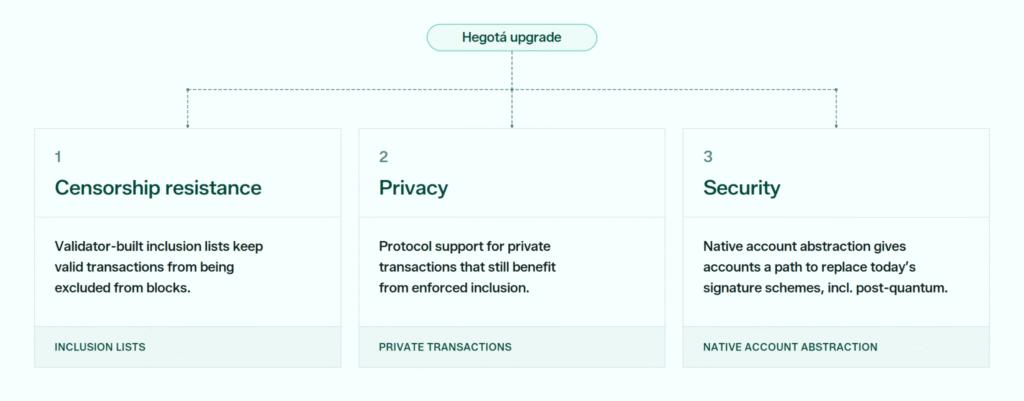
- Censorship resistance, through validator-built inclusion lists.
- Privacy, through protocol support for private transactions that can still benefit from enforced inclusion.
- Security, through native account abstraction that gives accounts a path to replace today’s signature schemes, including post-quantum ones.
The EF Protocol cluster aims for a quantum-resistant Ethereum L1 by December 2029.
When Is Ethereum Hegotá Happening?
Ethereum.org lists Hegotá as “In planning,” with mainnet expected in Q2 2027. No exact mainnet date or fork epoch has been confirmed.
| Item | Status as of October 2026 |
| Upgrade status | In planning |
| Expected mainnet | Q2 2027, date not confirmed |
| Next milestone | Sepolia fork, 2027 |
| Client implementation start | Late Q4 2026, per the EF |
| Preceding upgrade | Glamsterdam, targeted for December 2026 |
The Hegotá date depends on Glamsterdam, which has not reached mainnet yet.
Readers can track live proposal status in the Hegotá Meta EIP (EIP-8081). Fork dates are set on All Core Devs (ACD) calls and announced on the EF Blog.
Hegotá Upgrade Timeline
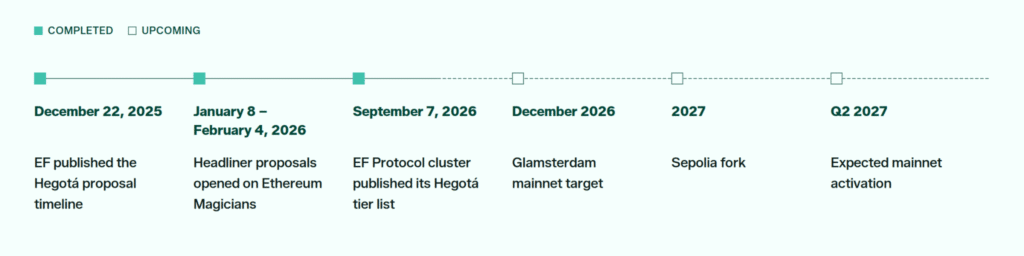
- December 22, 2025: the EF published the Hegotá proposal timeline.
- January 8 to February 4, 2026: headliner proposals opened on Ethereum Magicians.
- September 7, 2026: the EF Protocol cluster published its Hegotá tier list.
- December 2026: Glamsterdam mainnet target.
- 2027: Sepolia fork.
- Q2 2027: expected mainnet activation.
What EIPs Are Included in Hegotá?
As of October 2026, only two EIPs are formally scheduled for Hegotá: EIP-7805 FOCIL and EIP-8141 Frame Transactions. The Ethereum Foundation has additionally graded 15 proposals as A-tier, meaning they are expected to ship but are not formally scheduled yet.
| Tier | Meaning | EIPs |
| S: Must ship | Defines the fork | 2 |
| A: Expected to ship | Committed alongside S-tier | 15 |
| B: On the bubble | Admitted one at a time | 8 |
| C: Below the line | Reconsidered if time remains | 7 |
| TBD | Waiting on post-Glamsterdam mainnet data | 2 |
| DFI: Declined by EF Protocol cluster. | Not planned for Hegotá | 28 |
EIPs Scheduled for Inclusion
EIP-7805 (FOCIL) is the consensus-layer headliner, graded S by all 7 EF contributors who scored it. EIP-8141 (Frame Transactions) is the execution-layer headliner, graded S with an average of 3.89 across 9 grades.
EIPs Supporting the Hegotá Headliners
FOCIL ships with EIP-8369 (VOPS Profiles for FOCIL Eligibility). Frame Transactions ship with EIP-8250 (Keyed Nonces) and EIP-8272 (Recent Roots), all rated A-tier.
Other Proposed Hegotá EIPs
The remaining candidates could be divided into six groups:
- Execution-layer changes: EIP-5920, a PAY opcode.
- Consensus-layer changes: EIP-8015, removing unused deposit fields.
- EVM changes: EIP-7906, transaction assertions.
- Gas and metering changes: EIP-3298, removal of refunds.
- Validator and staking changes: EIP-8365, BLS withdrawal credential retirement.
- Data and state changes: EIP-8025, optional execution proofs.
The complete live list is in the Hegotá Meta EIP and the EF tier list.
Which Hegotá EIPs Are Confirmed?
As of early October 2026, only EIP-7805 and EIP-8141 are scheduled for inclusion. All other EIPs remain candidates until their status changes in EIP-8081.
What Is FOCIL?
FOCIL (Fork-Choice Enforced Inclusion Lists, EIP-7805) obliges block builders to include valid transactions selected by a validator committee. Attesters vote only for blocks that respect those lists.
What Problem Does FOCIL Solve?
Block building on Ethereum is concentrated among a small set of specialized builders. Anyone who can influence enough of them can delay a valid transaction.
How Does FOCIL Work?
FOCIL runs in parallel with block building across two slots:
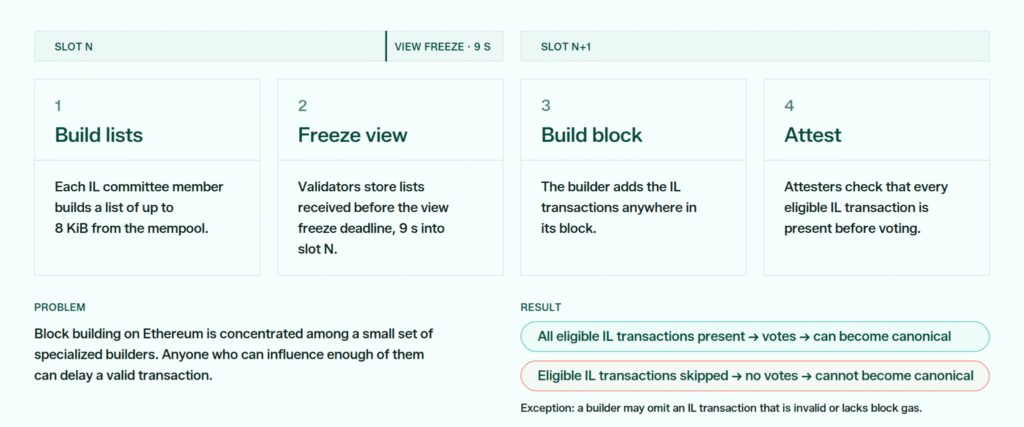
- In slot N, each inclusion list (IL) committee member builds a list of up to 8 KiB from the mempool.
- Validators store lists received before a view freeze deadline, 9 seconds into slot N.
- In slot N+1, the builder adds the IL transactions anywhere in its block.
- Attesters check that every eligible IL transaction is present before voting.
Blocks that skip eligible transactions receive no votes and cannot become canonical. A builder may still omit a list transaction if it is invalid or the block lacks gas for it.
How Does FOCIL Improve Ethereum’s Censorship Resistance?
FOCIL distributes inclusion authority from one builder to 16 committee members per slot. The protocol enforces an eligible transaction if 1 member lists it.
Censorship requires all 16 committee members to omit the transaction.
Does FOCIL Prevent Censorship Completely?
No. FOCIL enforces inclusion only for eligible transactions that at least 1 committee member lists.
Transactions outside the eligibility profiles in EIP-8369 can still appear in lists without enforcement. A full block also excuses omissions, because inclusion is conditional on available gas.
What Does FOCIL Mean for Ethereum Validators?
Validators gain a new duty: building and gossiping an inclusion list when selected for the committee. The current draft includes no explicit reward for that duty.
What Is EIP-8141 Frame Transactions?
EIP-8141 introduces Frame Transactions, a transaction type whose validity and gas payment are defined by account code.
Today, every Ethereum transaction is authorized by one ECDSA signature from one key. Smart accounts work around that limit with extra infrastructure that costs gas.
How Do Frame Transactions Work?
A Frame Transaction is a sequence of up to 64 frames, where each contract call has a defined role:
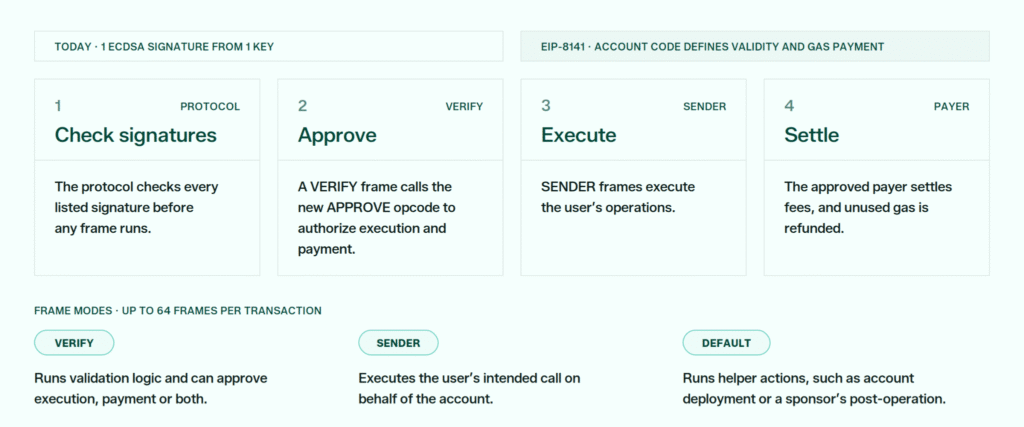
VERIFY: runs validation logic and can approve execution, payment or both.SENDER: executes the user’s intended call on behalf of the account.DEFAULT: runs helper actions, such as account deployment or a sponsor’s post-operation.
A typical Frame Transaction consists of four steps:
- The protocol checks every listed signature before any frame runs.
- A
VERIFYframe calls the newAPPROVEopcode to authorize execution and payment. SENDERframes execute the user’s operations.- The approved payer settles fees, and unused gas is refunded.
How Are Frame Transactions Different From Traditional Ethereum Transactions?
| Feature | Traditional transactions | Frame Transactions |
| Authorization | Fixed ECDSA signature | Programmable, defined by account code |
| Signature schemes | secp256k1 | secp256k1, P256 and custom schemes in the draft |
| Fee payer | Sender | Sender or an approved sponsor |
| Calls per transaction | 1 | Up to 64 frames, with atomic batches |
| Account abstraction support | External bundlers and relayers | Built into the protocol |
How Does EIP-8141 Enable Account Abstraction?
EIP-8141 makes account abstraction native to the Ethereum transaction format. Accounts define validation and fee rules in code, and the protocol enforces the outcome.
Native account abstraction supports these capabilities:
- Programmable validation and flexible authorization.
- Alternative signature schemes, including future post-quantum schemes.
- Gas sponsorship and multiple approvals.
- Spending limits, social recovery and key rotation.
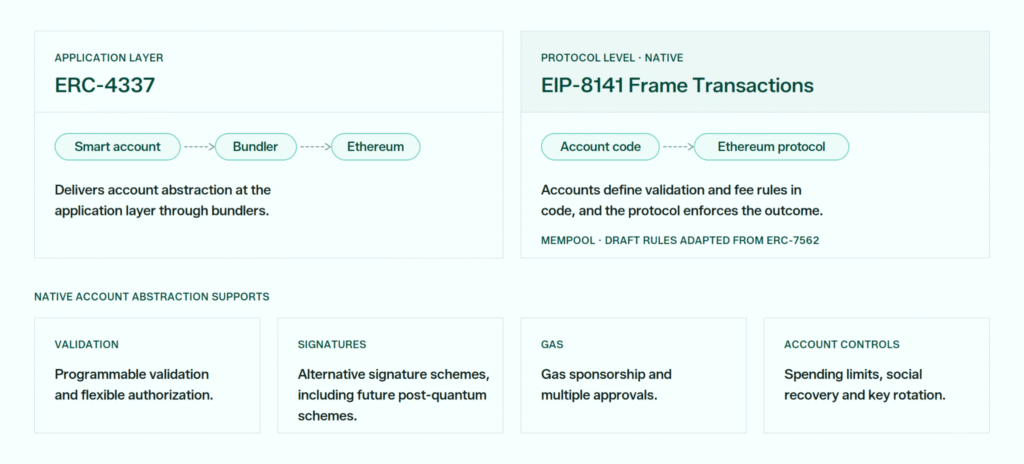
ERC-4337 delivers account abstraction at the application layer through bundlers. Frame Transactions provide a protocol-level mechanism, with draft mempool rules adapted from ERC-7562.
How Do Frame Transactions Improve Ethereum Wallets?
Frame Transactions let wallets build authorization features into accounts.
- Social recovery: designated guardians can restore access after a lost key.
- Spending limits: validation code can cap what a given key may move.
- Multiple approvals: execution can require signatures from 2 or more keys.
- Sponsored transactions: a sponsor pays fees, including in exchange for ERC-20 tokens.
- Alternative signature schemes: accounts can verify P256 signatures from passkeys.
How Does Hegotá Support Post-Quantum Security?
Hegotá prepares Ethereum accounts for post-quantum signatures, and full quantum resistance is planned for later forks. The EF calls Hegotá the fork that determines whether later post-quantum upgrades stay on schedule.
Hegotá does not make Ethereum fully quantum-resistant. Instead, Frame Transactions create a protocol-level path for accounts to adopt alternative signature schemes, including future post-quantum schemes.
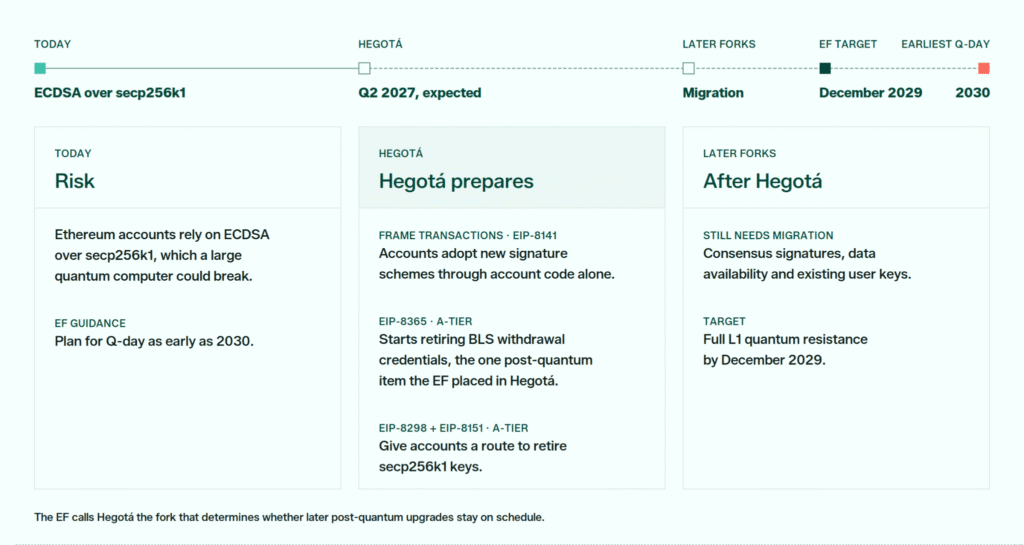
Ethereum accounts rely on ECDSA over secp256k1, which a large quantum computer could break. The EF advises planning for “Q-day” as early as 2030.
Frame Transactions let accounts adopt new signature schemes through account code alone.
Two related A-tier packages prepare existing keys for post-quantum migration:
- EIP-8365 starts retiring BLS withdrawal credentials, the one post-quantum item the EF placed in Hegotá.
- EIP-8298 and EIP-8151 give accounts a route to retire
secp256k1keys.
Consensus signatures, data availability and existing user keys still need migration after Hegotá. The EF targets full L1 quantum resistance by December 2029.
What EIPs Support Frame Transactions?
Three A-tier companion EIPs connect Frame Transactions to the rest of Hegotá. The EF pairs EIP-8250 and EIP-8272 with Frames, and EIP-8369 with FOCIL.
EIP-8250: Keyed Nonces
Traditional nonces force every transaction from an account into one strict sequence. EIP-8250 assigns nonces under separate keys, so multiple users can share one sender address and transact in parallel.
EIP-8272: Recent Roots
Recent roots are commitments to recent onchain state that private transactions use in their proofs. EIP-8272 exposes those roots in a form attesters can verify, which lets private Frame Transactions qualify for FOCIL enforcement.
EIP-8369: VOPS Profiles for FOCIL Eligibility
VOPS stands for validity-only partial statelessness, where nodes keep only the state needed to check transaction validity. EIP-8369 defines 2 VOPS profiles that decide which transactions FOCIL enforces.
- Profile 1 covers legacy, EIP-2930, EIP-1559 and EIP-7702 transactions.
- Profile 2 covers Frame Transactions whose validation reads a fixed, bounded set of account state.
How Do FOCIL and Frame Transactions Work Together?
FOCIL decides which transactions must be included, and Frame Transactions decide how transactions are authorized. The supporting EIPs let Frame Transactions qualify for FOCIL enforcement.
| Component | Role in Hegotá |
| FOCIL (EIP-7805) | Who can require transaction inclusion |
| Frame Transactions (EIP-8141) | How a transaction is authorized and paid for |
| VOPS profiles (EIP-8369) | Which Frame Transactions qualify for enforced inclusion |
| Keyed nonces and recent roots (EIP-8250, EIP-8272) | Privacy-compatible validation that attesters can check |
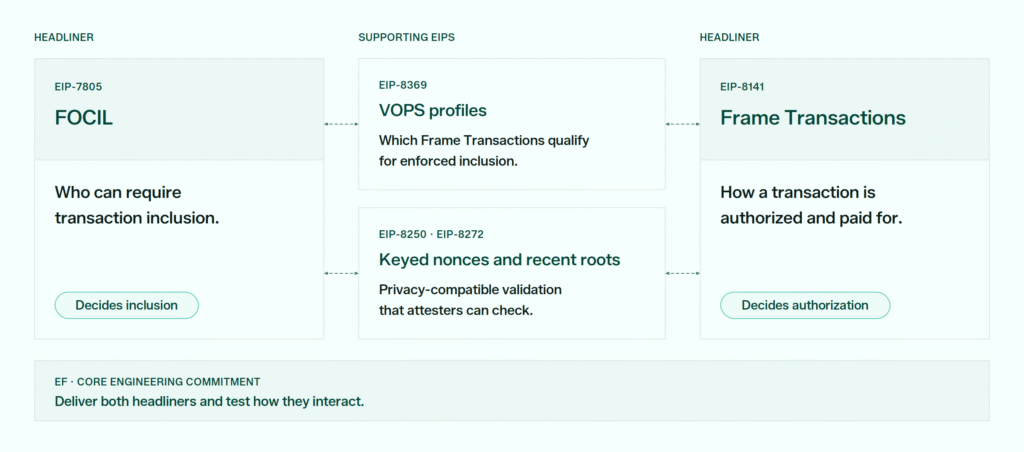
The EF names delivery of both headliners, and testing their interaction, as the core engineering commitment of Hegotá.
What Does Hegotá Change for Ethereum Users?
Hegotá changes how transactions are included and authorized, while ETH balances and supply stay the same.
For ETH Holders
ETH holders need no migration and no claim process. Hegotá creates no new token, and balances carry over at the fork.
For Regular Ethereum Users
Eligible transactions gain validator-enforced inclusion through FOCIL. Wallets may later add sponsored fees and batching.
For Smart-Wallet Users
Smart-wallet users gain protocol-level support for recovery, multiple keys and sponsored transactions. Those features currently depend on bundlers and relayers outside the protocol.
For DeFi Users
DeFi users may see atomic approve-and-swap batches, where all steps revert together.
EIP-7906, an A-tier extension, lets a transaction assert expected state changes before committing, which the EF links to fewer wallet drains.
For Privacy Applications
Keyed nonces and recent roots let private Frame Transactions qualify for FOCIL enforcement. EF contributor Toni Wahrstätter wrote that this set lets privacy apps work without intermediaries.
The EF backs the Frames-based privacy path and declined EIP-8182, an enshrined private transfer design.
For Institutions and Custodians
Institutions gain programmable authorization for policy controls, such as multi-party approvals and per-key spending limits. Those controls can run at the protocol level, which reduces dependence on external relayers.
FOCIL lets a validator committee enforce inclusion of eligible institutional transactions. Custodians and staking clients can begin integration testing once Hegotá devnets stabilize.
What Does Hegotá Mean for Ethereum Validators?
Every validator will need execution and consensus clients that support Hegotá before the mainnet fork.
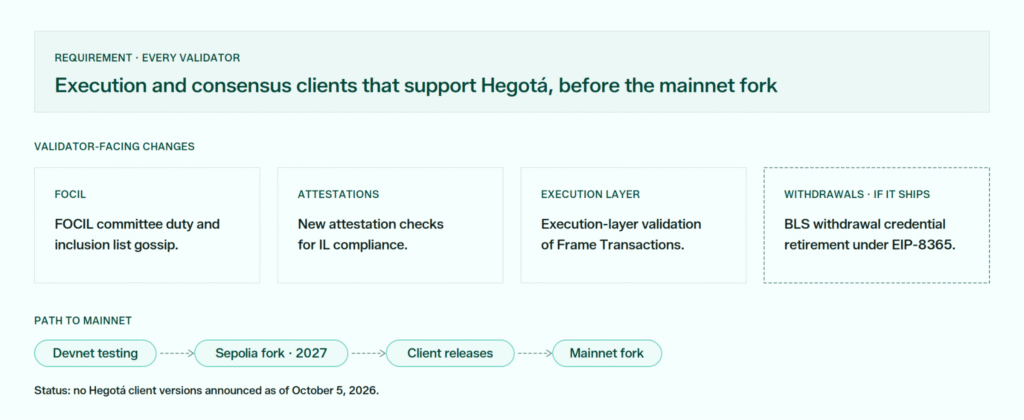
Validator-facing changes include:
- FOCIL committee duty and inclusion list gossip.
- New attestation checks for IL compliance.
- Execution-layer validation of Frame Transactions.
- BLS withdrawal credential retirement under EIP-8365, if it ships.
Client releases will follow devnet testing and the Sepolia fork in 2027. No Hegotá client versions had been announced as of October 2026.
A validator running pre-Hegotá clients will follow an incompatible chain after activation. It will miss duties on the canonical chain and accrue penalties for missed attestations.
The EF declined EIP-8148 and EIP-8205, describing them as conveniences that mainly serve large staking operations. EIP-7716, which raises penalties for correlated missed attestations, was also declined pending further research.
Everstake has maintained validators since 2018 and has operated 130+ networks to date. Everstake holds SOC 2 Type II and ISO 27001:2022 certifications covering its validator operations.
Clients using Everstake institutional staking keep custody of their assets while Everstake operates the validators. Teams that need dedicated infrastructure can use Everstake Validator-as-a-Service, where Everstake manages client upgrades.
Everstake has a dedicated team of engineers and researchers that follow all the developments and updates related to Ethereum, ensuring that our validator infrastructure is up to date.
Does Hegotá Change Ethereum’s Gas Limit?
No gas limit increase is scheduled for Hegotá as of October 2026. The gas-related candidates focus on bounding worst-case blocks and cleaning up metering.
| Term | Meaning |
| Block gas limit | Maximum gas all transactions in one block can use |
| Transaction gas limit | Per-transaction cap of 16,777,216 gas under EIP-7825 |
| State gas | Gas that meters durable state growth, defined in EIP-8037 |
| Transaction content floor | Minimum charge per byte of transaction data |
- EIP-3298 removes gas refunds (A-tier).
- EIP-8279 bounds worst-case block construction (A-tier).
- EIP-8131 sets a unified transaction content floor (A-tier).
- EIP-8368 and EIP-8372 await post-Glamsterdam data (TBD).
The EF states that spending any headroom from EIP-8279 is a separate, later decision. Validators set the block gas limit through client signaling.
What Does Hegotá Mean for Ethereum Developers?
Hegotá gives developers native account abstraction and new transaction introspection opcodes. Testing on Hegotá devnets is the main preparation task.
Wallet Developers
Wallets must produce two-dimensional, per-frame gas estimates for EIP-8141 transactions. Authorization logic moves into account code through the APPROVE opcode.
dApp Developers
dApps can offer atomic batches and sponsored onboarding. Contracts that rely on ORIGIN checks need review, because ORIGIN reports the frame caller inside Frame Transactions.
Infrastructure Providers
- Execution clients: Frame Transaction processing and new mempool rules.
- Consensus clients: FOCIL committees, gossip and fork-choice changes.
- Builders: payload construction that satisfies IL constraints.
- RPC providers: a new receipt format with payer and per-frame status fields.
Privacy Developers
Privacy designs that stay within VOPS profile 2 qualify for FOCIL enforcement.
What Hegotá Does Not Change
Hegotá keeps Ethereum‘s consensus model and ETH economics intact.
- Ethereum remains a PoS network.
- Hegotá does not make Ethereum censorship-proof.
- Hegotá does not make Ethereum fully quantum-resistant at activation.
- Block builders remain part of block production.
- Transactions do not become private by default.
- Candidate EIPs below S-tier are not confirmed.
- No gas limit increase is scheduled.
- ETH holders receive no Hegotá token.
- ETH issuance stays unchanged, and the EF declined the EIP-8363 issuance burn proposal.
Hegotá vs. Previous Ethereum Upgrades
Hegotá is the first upgrade after Glamsterdam and centers on protocol hardening. Earlier upgrades focused on staking improvements and data scaling.
| Upgrade | Mainnet date | Main focus |
| Pectra | May 7, 2025 | Account and staking improvements, including EIP-7702 and EIP-7251 |
| Fusaka | December 3, 2025 | Data availability scaling with PeerDAS |
| Glamsterdam | Targeted December 2026 | ePBS and block-level access lists |
| Hegotá | Expected Q2 2027 | Censorship resistance and programmable authorization |
Hegotá vs. Bogotá: What’s the Difference?
Hegotá is the full upgrade, and Bogotá is the name of its execution-layer half, after a past Devcon host city. Heze, a star, names the consensus-layer half.
What Do Users and Validators Need to Do Before Hegotá?
Final requirements depend on client releases and a confirmed fork epoch. Current preparation steps by role:
| Role | Pre-fork action |
| ETH holders | No action; use updated wallet software when prompted |
| Wallet users | Install wallet updates once providers announce Hegotá support |
| Validators | Upgrade execution and consensus clients before the fork epoch |
| Developers | Test applications on Hegotá devnets and the Sepolia fork |
| Infrastructure providers | Update and test client and RPC infrastructure |
| Everstake stakers | No action; Everstake upgrades the validators it operates |
Requests to “upgrade” or move ETH for Hegotá are scams. Network upgrades never require holders to send funds.
FAQ
When will Hegotá launch on Ethereum mainnet?
Hegotá is expected on mainnet in Q2 2027, with no confirmed date. A Sepolia fork is the next milestone, planned for 2027.
Are Frame Transactions replacing ERC-4337?
No Hegotá EIP deprecates ERC-4337. ERC-4337 has run at the application layer since 2023, and Frame Transactions add a protocol-level option.
Does Hegotá make Ethereum quantum resistant?
No, Hegotá is a preparatory step toward quantum resistance. The EF targets full L1 quantum resistance by December 2029.
If EIP-8365 ships, Everstake and other operators will begin retiring BLS withdrawal credentials.
Do ETH holders need to do anything before Hegotá?
No, ETH holders need no migration or claim. Hegotá creates 0 new tokens, and balances carry over at the fork. Everstake stakers also need no action, because Everstake upgrades the validators it operates.
Does Hegotá increase the Ethereum gas limit?
No gas limit increase is scheduled as of October, 2026. The 3 A-tier repricing EIPs bound worst-case block construction.
Will Hegotá change ETH supply or Ethereum staking?
No issuance change is scheduled for Hegotá.
Disclaimer:
Technical details reflect the current Hegotá/EIP drafts and may change before mainnet activation.
Share with your network