
solana
How to Run a Solana Validator Node After Alpenglow: Hardware vs. Cloud (2026)
2026 hardware benchmark for Solana validators: AMD EPYC vs Threadripper, NVMe Gen4 vs Gen5, bare metal vs cloud. Specific specs, real costs, and performance data from operators running Firedancer and Agave.
MAR 27, 2026
Last updated NOV 20, 2026 · V1
TL;DR
- A mainnet Solana validator in 2026 needs a high-clock 24+ core CPU, 384–512 GB ECC RAM, separate enterprise NVMe drives for accounts, ledger and snapshots, and 10 Gbps+ symmetric bandwidth on bare metal.
- Since Alpenglow, votes are free, but every validator pays a 0.8 SOL Validator Admission Ticket (VAT) fee per epoch and must register a BLS key.
- Cloud works for testnet, RPC and standby nodes, not for competitive mainnet validation.
Solana is the most hardware-intensive proof-of-stake chain to validate.
While other networks tolerate modest servers, Solana’s sustained throughput demands, compounded by Firedancer’s tile-based architecture, which went live on mainnet in 2025, have raised the performance bar considerably.
What Has Changed for Solana in 2026
Four upgrades between July and October 2026 changed what a validator needs:
- Alpenglow consensus. It activated in epoch 1064 on October 21, 2026. Votes stopped being onchain transactions, so vote fees ended, and each validator now pays 0.8 SOL from its vote account at the start of every epoch.
- BLS keys and the 2,000-validator cap. Validators without a registered BLS pubkey are excluded from consensus. Those with a key but ranked outside the top 2,000 by stake are excluded for that epoch.
- 200ms slots. Slot time halved from 400ms to 200ms, with the final step on October 9, 2026, so an epoch now lasts about 24 hours.
- 100M CU blocks. The block compute limit rose from 60M to 100M CUs on July 29, 2026 (SIMD-0286).
- XDP everywhere. Kernel-bypass networking is available in Agave 4.0.0+ and on by default in Firedancer, with more than 70% of stake using it.
- NVMe Gen5 drives are now price-competitive with Gen4 for new builds.
Everstake has operated validator infrastructure across 130+ networks with 99.98% uptime. The specifications in this article reflect the hardware configurations that power our Solana mainnet validators.
Solana Validator Types: What You’re Actually Running
A production Solana mainnet validator in 2026 is one of two distinct node types, and the distinction has major hardware implications.
A consensus validator votes on blocks and earns inflation rewards plus MEV revenue via Jito-Solana. Missed votes translate directly into lost rewards, and vote latency is the primary performance metric, which requires the highest-tier hardware.
An RPC node serves API requests to wallets and decentralized applications. It does not vote or earn staking rewards; revenue comes from API access fees. RPC nodes require less CPU headroom but demand massive storage (10+ TB for full archive) and high memory bandwidth for query concurrency.
Critical rule: never run RPC and validator workloads on the same machine. RPC query loads interfere with time-sensitive consensus operations.
The post-Alpenglow client landscape:
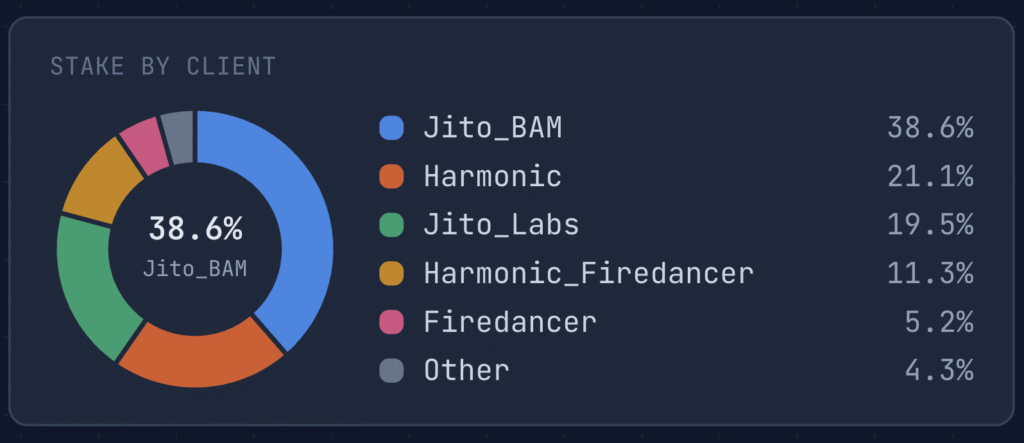
- Agave (Rust, Anza): the reference client and the most widely deployed.
- Jito-Solana (Agave-based, MEV): adds block-engine revenue.
- Harmonic Salsa (Agave-based): one of the three clients operators could run through the Alpenglow migration, alongside Agave and Jito-Solana.
- Firedancer (C, Jump Crypto): the independent high-performance client, carrying over 15% of mainnet stake. Alpenglow support arrived in the v26.10.2 mainnet release, but the Tower-to-Alpenglow migration itself was not supported. Firedancer operators should keep an Agave failover node ready for future protocol migrations.
- Frankendancer has been retired. Jump ended it when Alpenglow went live in October 2026
2026 Solana Hardware Requirements: The Full Spec Sheet
A production Solana mainnet validator in 2026 requires a minimum 24-core CPU at 3.5+ GHz, 384–512 GB ECC RAM, enterprise NVMe Gen4+ storage, and 10 Gbps symmetric networking. Each component is examined below.
CPU
The minimum viable spec is a 12-core/24-thread processor at 2.8 GHz; anything below this will struggle to meet vote deadlines. The recommended baseline for mainnet is 24+ cores at 3.5+ GHz.
AMD EPYC dominates the Solana HCL, namely, the EPYC 9354 and 9355 are the most widely deployed families. Threadripper PRO offers a competitive alternative for operators not running dual-socket configurations. Intel Xeon is viable, but AMD’s memory bandwidth and core density at comparable price points have made it the operator’s default.
Both single-thread clock speed and aggregate core count matter: high single-thread performance reduces vote latency, while Firedancer’s tile-based parallelism rewards total core count.
RAM
256 GB ECC DDR4 is the floor for consensus validators. The recommended configuration is 384–512 GB ECC DDR5. RPC nodes serving high-concurrency workloads should target 512 GB to 1 TB.
ECC (Error-Correcting Code) memory is non-negotiable. A single uncorrected memory error can corrupt the accounts database, causing missed votes or a full node restart. Mounting the accounts database as a RAMDISK delivers measurable latency improvements by eliminating NVMe seek overhead on the most frequently accessed data structure.
Storage
Consumer NVMe drives are disqualified for use as mainnet validators. The WD SN850 and Samsung 980 Pro, while excellent for desktop workloads, degrade under Solana’s sustained sequential and random write load, causing node stalls within days of deployment.
The minimum enterprise-grade spec is 2×2 TB NVMe Gen4. The recommended configuration uses 2×3.84 TB drives from the Micron 7450/7500 or Samsung PM9A3 families. Accounts and ledger must be mounted on physically separate drives. High TBW (Total Bytes Written) endurance ratings and 300K+ read IOPS are required.
For Firedancer-optimized builds, NVMe Gen5 (Micron 7500) is now cost-competitive and provides meaningful headroom for 100M CU blocks and 200ms slots.
Put snapshots on a third NVMe volume of 500 GB or more, separate from accounts and ledger
Networking
Anza requires at least 2 Gbps symmetric for a staked node and recommends 10 Gbps for stable operation. The Solana Foundation recommends 10–25 GbE symmetric connectivity. 1 Gbps is only suitable for unstaked nodes.
Dedicated public IP (no NAT) is mandatory, since Solana’s UDP-based gossip and QUIC transport layers do not tolerate NAT reliably. Solana networking is egress-heavy; cloud deployments face $900–1,200/month in egress fees alone. Low-latency peering with the Solana cluster entry points is critical for vote submission.
Firedancer validators benefit from DoubleZero, a low-latency overlay network that reduces geographic latency penalties between validators.
OS and System Tuning
Ubuntu 24.04 LTS is the standard. It is the release Anza builds and runs on. Key tuning steps include pinning threads to specific CPU cores using taskset/numactl, setting the I/O scheduler to none or mq-deadline for NVMe devices, enabling hugepages for large memory operations, and monitoring NVMe thermal throttling under sustained load.
Hardware Benchmark Table
| Component | Minimum | Recommended | Any High-Performance Client |
| CPU | 12-core/24-thread, 2.8 GHz | 24+ cores, 3.5+ GHz (EPYC 9354) | 32+ cores, 3.8+ GHz (EPYC 9355 / Threadripper PRO) |
| RAM | 256 GB ECC DDR4 | 384–512 GB ECC DDR5 | 512 GB ECC DDR5 + RAMDISK for accounts |
| Storage (accounts) | 1×2 TB NVMe Gen4 | 1×3.84 TB enterprise NVMe (Micron 7450) | 1×3.84 TB NVMe Gen5 (Micron 7500) |
| Storage (ledger) | 1×1 TB NVMe Gen4 | 1×3.84 TB enterprise NVMe | 1×3.84 TB NVMe Gen5 |
| Network | 2 Gbps symmetric | 10 Gbps symmetric | 10-25 Gbps + optional DoubleZero low-latency overlay |
| Est. bare metal cost | $400–600/mo | $800–1,200/mo | $1,200–1,800/mo |
Firedancer: What Changes for Hardware
Firedancer is not simply a faster Agave. It is a ground-up rewrite in C/C++ with a fundamentally different execution model: one that has specific and significant hardware implications.
Tile-Based Architecture
Firedancer decomposes validator operations into discrete “tiles,” each pinned to a dedicated CPU core: network I/O, transaction verification, block production, and other functions run fully in parallel with no shared-memory contention. This architecture scales nearly linearly with core count and is highly sensitive to NUMA topology, i.e., memory latency between a tile’s core and its assigned memory zone directly affects throughput.
The practical implication: Firedancer rewards investment in high-core-count CPUs (32+ recommended) and NUMA-aware memory configuration (512 GB DDR5) more directly than Agave does.
Custom XDP Networking
XDP is no longer Firedancer-only. Firedancer ships with it on by default, and Agave supports it from 4.0.0. Either way, XDP needs a 10 Gbps+ NIC with driver support, and XDP and Proof of History must run on separate physical cores. Mellanox/NVIDIA ConnectX and Intel E810 are common choices.
Performance Data (2025–2026)
Operator data from the 2025–2026 deployment period shows that Firedancer validators achieved +18–28 basis points of improvement in Skip Rate Reduction (SRR), 15% fewer missed voting credits, a vote latency of approximately 1.002 slots, and fuller blocks (averaging 47M versus 44.8M compute units under Agave). The storage requirements between Agave and Firedancer remain similar: enterprise NVMe endurance and IOPS requirements are driven by Solana’s ledger and accounts workload, which is client-agnostic.
Bare Metal vs. Cloud vs. Colocation
The VAT fee is fixed by the protocol. Infrastructure is the largest cost you control, and it directly affects skip rate and rewards.
Bare Metal (Dedicated Servers)
Bare metal is the standard choice for mainnet validators. Direct-attached NVMe eliminates virtualization overhead, there are no noisy-neighbor IOPS limits, and monthly costs run $800–1,200 for a well-specified server. The leading providers for Solana workloads include Cherry Servers, Hivelocity, Latitude, and Teraswitch, all of which explicitly permit cryptocurrency validator workloads in their ToS.
Cloud (AWS, GCP, Azure)
Cloud is convenient and appropriate for specific use cases such as testnets, RPC nodes, and temporary scaling, but is not competitive for mainnet validators. The primary problems:
- Egress fees add $900–1,200/month on top of instance costs
- Provisioned IOPS on cloud storage (even at 16K IOPS) is routinely insufficient for validator workloads
- vCPU performance is variable under noisy-neighbor conditions
The Agave documentation states explicitly that “running in the cloud requires significantly greater operational expertise to achieve stability.”
The Solana Foundation’s own guidance is that a cloud validator can be tuned to compete, but doing so gives up the elasticity, isolation and portability that justified cloud in the first place, so bare metal is strongly recommended for a top-tier XDP-enabled validator.
Colocation
Colocation offers the highest degree of hardware control: you own the physical servers, and the data center provides power, cooling, and network uplinks. Monthly rack and power costs run $300–500, but the upfront hardware investment is $20,000–50,000. This model is best suited to large-stake validators with multi-year operational commitments and in-house hardware management capability.
Provider Warning
Hetzner explicitly prohibits cryptocurrency workloads in its Terms of Service. Large-scale validator terminations have occurred without prior warning. Always audit the ToS of any hosting provider before deploying a validator, as this risk is non-trivial.
Cost Comparison Table
The numbers reflected in this table are approximate and may be time-dependent and flexible.
| Cost Dimension | Bare Metal | Cloud (AWS/GCP) | Colocation |
| Monthly server/instance | $800–1,200 | $1,500–3,000+ | $300–500 (rack + power) |
| Egress/bandwidth | Included or ~$50–100 | $900–1,200/mo | Included |
| Vote transaction fees | VAT fee: 0.8 SOL/epoch (~0.8 SOL/day, ~290 SOL/yr) | Same | Same |
| Hardware CapEx | None (rental) | None | $20,000–50,000 upfront |
| Annual TCO estimate | $69,000–85,000 | $110,000–180,000+ | $65,000–90,000 |
| Best for | Most mainnet validators | Testnets, RPC, scaling bursts | Large-stake, long-term operators |
Note: Vote fees no longer exist. The VAT fee (about 290 SOL a year at today’s 24-hour epochs) is paid by every admitted validator regardless of hosting model.
Step-by-Step: From Hardware to Live Validator
The following checklist covers the provisioning sequence for a new mainnet consensus validator. The list is merely an operational overview, so please refer to docs.solanalabs.com and docs.anza.xyz for detailed CLI commands and configuration flags.
- Provision server. Verify: CPU supports the AVX2 instruction set, NVMe drives are correctly allocated (separate accounts and ledger volumes), a 10 Gbps NIC is present, and a dedicated public IP is assigned.
- Install Ubuntu 24.04. Apply system tuning: disable swap, enable hugepages, set the NVMe scheduler, configure NUMA pinning, and enable XDP.
- Install Solana CLI.
- Choose your client: Agave for stability, Jito-Solana for MEV, Harmonic for efficiency, Firedancer for performance with an Agave failover node.
- Generate validator identity keypair. Generate identity, vote and withdraw-authority keypairs. Keep the withdraw authority off the server. Create the vote account and keep at least 0.8 SOL above its rent-exempt minimum for the next epoch’s VAT fee.
- Register a BLS pubkey with Solana CLI 4.1.0+ (
solana-keygen bls_pubkey, thensolana vote-authorize-voter-checked). Validators without one are excluded from consensus. Optionally, route block revenue to the vote account withsolana vote-update-commission-collectorso the VAT stays funded automatically. - Configure startup flags: specify the ledger path, the accounts path, known validators for snapshot sync, the expected-genesis-hash, and the RPC port settings.
- Set up monitoring: Solana CLI metrics endpoint, Grafana dashboards for skip rate and vote credits, alerts for delinquency, skip rate, and vote account balance below 2 epochs of VAT.
- Stake delegation: bootstrap with self-stake or apply to the Solana Foundation Delegation Program (SFDP) to establish initial stake weight.
Everstake – A Reliable Solana Node Validator
Everstake offers a fully managed Solana validator-as-a-service (Vaas) option for teams that want mainnet exposure without the operational overhead of bare-metal provisioning, NUMA tuning, and 24/7 skip-rate monitoring. The service runs on the same AMD EPYC, 512 GB ECC DDR5, enterprise NVMe Gen4+ infrastructure documented in this guide, with Jito-Solana and Firedancer client support, backed by SOC 2 Type II and ISO 27001 certification and Everstake’s 99.98% uptime record across its Solana mainnet operations.
For low-latency transaction landing and data feeds, see Blockspace by Everstake:
FAQs
Can I operate a Solana validator on consumer hardware?
Consumer hardware works for practice on testnet, but a mainnet validator needs at least 256 GB of ECC RAM, enterprise NVMe drives and a symmetric connection of 2 Gbps or more, which consumer desktops and home internet plans rarely provide.
What hardware and security setup does a new Solana validator need?
A stable, secure mainnet validator needs:
- a 24+ core CPU at 3.5+ GHz, such as AMD EPYC,
- 384–512 GB of ECC RAM,
- separate enterprise NVMe drives for accounts, ledger and snapshots,
- a 10 Gbps symmetric connection with a dedicated public IP,
- a withdraw authority key kept off the server on a hardware wallet,
- a registered BLS key and at least 0.8 SOL above the rent-exempt minimum in the vote account,
- firewall rules that limit SSH access to your management IP.
How do I improve block rewards with a white-label Solana validator?
Rewards per leader slot depend on how many assigned slots the validator produces and how full its blocks are, so ask your white-label validator provider for:
- an MEV-enabled client such as Jito-Solana,
- high-clock CPUs with XDP-capable 10–25 Gbps NICs,
- low-latency networking such as DoubleZero,
- a published skip rate and a failover node for each validator.
How do I add SOL staking to a wallet app without operating a validator?
Integrate the Everstake Wallet SDK, which lets users delegate SOL to Everstake validators inside your app through a TypeScript library or a REST API.
Which providers offer low-latency hosting for validators across multiple networks?
Two hosting models remove the shared-hardware limits of standard cloud:
- bare-metal providers that permit validator workloads:
- Cherry Servers
- Latitude.sh
- Hivelocity
- Teraswitch
- managed Validator-as-a-Service from Everstake, which operates the nodes on its own infrastructure.
What does a Solana validator cost to operate yourself compared with a managed service?
Operating a validator yourself costs about $800–1,200 a month for a bare-metal server, plus the 0.8 SOL per-epoch VAT fee and on-call engineering time, while a managed service typically replaces those costs with a commission on staking rewards or a contracted fee.
What costs should a business budget for when operating a Solana validator?
A commercial Solana validator budget covers:
- a primary bare-metal server and a failover node,
- 10 Gbps+ bandwidth,
- the 0.8 SOL VAT fee each epoch, roughly 290 SOL a year,
- monitoring and on-call staff,
- key management hardware and security audits.
What are the advantages of a managed Solana validator over self-operated infrastructure?
A managed validator moves these tasks to the provider:
- hardware procurement and replacement,
- 24/7 monitoring of skip rate and vote performance,
- protocol upgrades such as the Alpenglow migration on October 21, 2026,
- VAT funding and BLS key registration,
- security controls, with Everstake infrastructure aligned with SOC 2 Type II and ISO 27001.
Which hosting providers offer consistent IOPS for validator nodes?
Dedicated bare-metal servers with direct-attached enterprise NVMe drives, from providers such as Cherry Servers or Hivelocity, deliver each drive’s full rated IOPS, while cloud block storage caps IOPS at a provisioned level.
Which hosting providers offer fast sync times for validator storage at scale?
Sync speed depends on snapshot download bandwidth and NVMe write speed, so choose a bare-metal provider with 10 Gbps+ ports and enterprise NVMe Gen4 or Gen5 drives, and request volume pricing directly because rates vary by region and contract length.
What servers support high-throughput blockchain applications?
High-throughput blockchain workloads need dedicated servers with:
- high-clock AMD EPYC CPUs,
- 512 GB+ of ECC RAM,
- enterprise NVMe drives,
- XDP-capable 10–25 Gbps NICs such as NVIDIA ConnectX.
Share with your network