solana
Solana Block Time Explained: Why Slots Target 200ms
Solana’s slot time has been cut from 400ms to 200ms in four steps under SIMD-0525. The main gain is lower latency. Blocks now arrive five times per second, confirmations land sooner, and each leader controls blockspace for a shorter window.
OCT 12, 2026
Last updated OCT 12, 2026 · V1
TL;DR
Solana block time is now 200ms, down from 400ms, after the protocol proposal SIMD-0525 finished rolling out on October 9, 2026.
- The network targets five slots per second, although observed slot times remain above 200ms.
- One validator, the leader, can produce a block every 200ms, or 5 times per second, up from 2.5.
- The work allowed per block was halved, so capacity stays near 250M compute units (CU) per second, the same as at 400ms.
- Faster confirmations: confirmation rules count blocks, so finalization, the point a block becomes irreversible, now takes about 6.2 seconds nominally, down from 12.2.
- Every transaction carries a recent blockhash that now expires after 30 seconds, down from 60 seconds.
- Epochs, Solana‘s staking cycles, now last about 24 hours, so staking rewards arrive roughly once a day.
- Validators vote twice as often and have less time to absorb network delays, especially between distant regions.
- Apps and indexers that assume 400ms per slot need to read the current slot duration and handle double the blocks.
- Alpenglow, a planned consensus upgrade targeting about 150ms finality, had no mainnet date as of October 9, 2026.
Everstake, a Solana validator since network’s testnet, ran its infrastructure through every stage of the rollout.
What Is Solana Block Time?
Solana block time is how often the network produces a new block, now targeted at 200ms. Blocks are produced by validators, the computers that process transactions and secure the network.
Solana Block Time vs. Slot Time
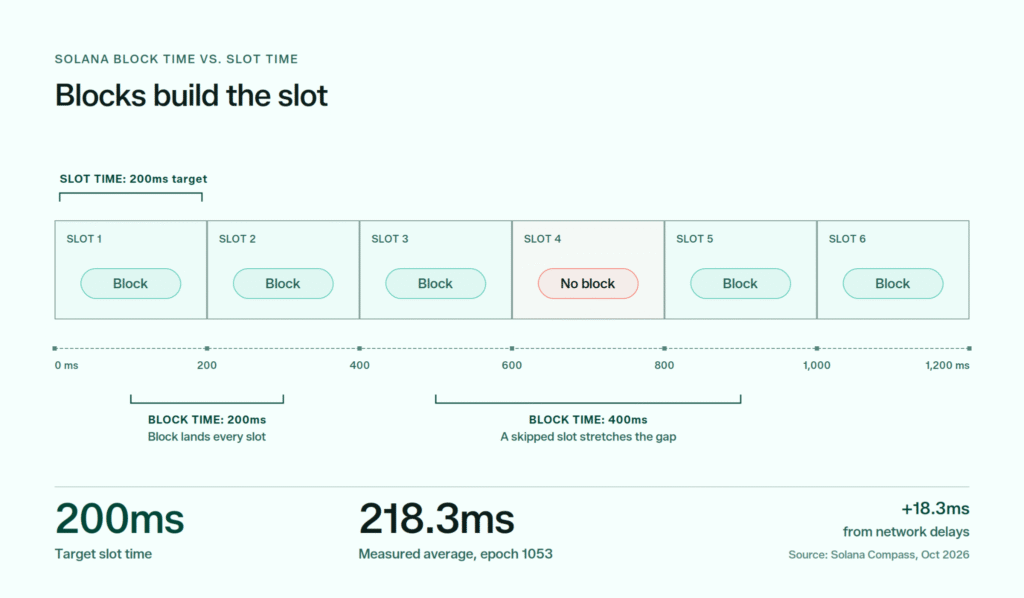
Slot time is the protocol target: the fixed window in which one validator may produce a block. Block time is the observed interval between produced blocks, which runs longer when a slot passes without a block. Measured slot times run slightly above target because of network delays.
How Solana Slots and Leader Schedules Work
A slot is a scheduled time window, and a block is the batch of transactions the leader produces in it. If the leader is offline or its block is dropped, the slot is skipped and the next leader continues.
The Solana leader schedule decides which validator leads each slot. Validators with more stake, meaning more SOL delegated to them, receive proportionally more slots.
Each leader gets 4 consecutive slots per turn. At 200ms, a turn lasts 800ms, down from 1.6 seconds.
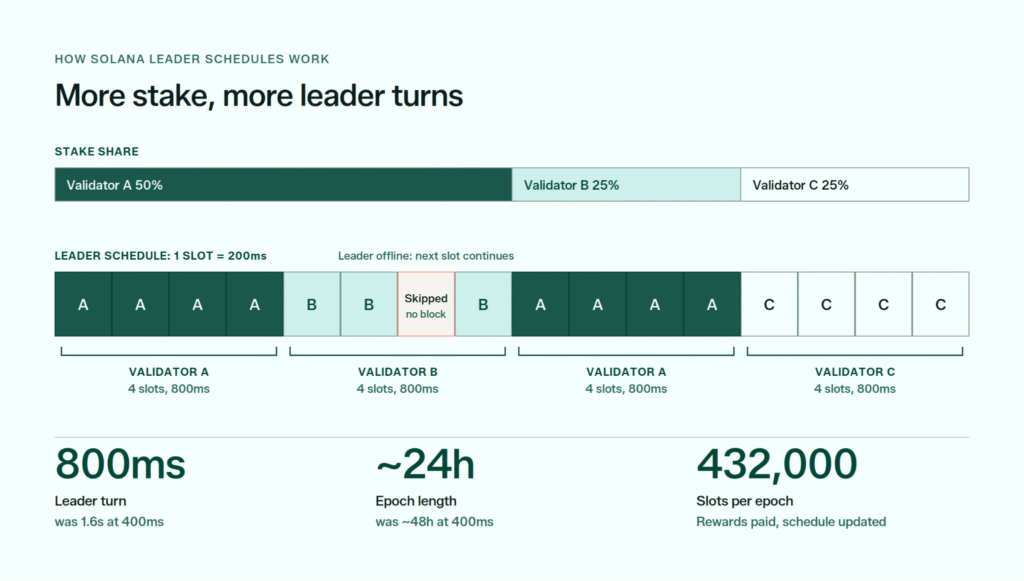
Slots are grouped into epochs of 432,000 slots, the cycle Solana uses to pay staking rewards and update the leader schedule. At the 200ms target, an epoch of 432,000 slots would take about 24 hours. The first completed epoch took 26.2 hours.
From 400ms to 200ms: How SIMD-0525 Changed Solana Slot Time
SIMD-0525 is a Solana Improvement Document, the formal proposal format for protocol changes. It cut slot time from 400ms to 200ms in 4 steps of 50ms each.
Leaders still get 4 slots per turn, and epochs still contain 432,000 slots. Only the length of each slot, and the per-block limits scaled to it, changed.
The Solana Foundation gave 2 reasons for the change:
- lower latency, since validator software now propagates and processes blocks faster,
- censorship resistance, since each leader controls block building for less time.
The Four Stages of Solana’s Slot-Time Reduction
Each step was switched on by a feature gate, a flag that activates a protocol change for all validators at an epoch boundary. The network moved to the next step only while the skip rate, the share of slots without a block, stayed low.
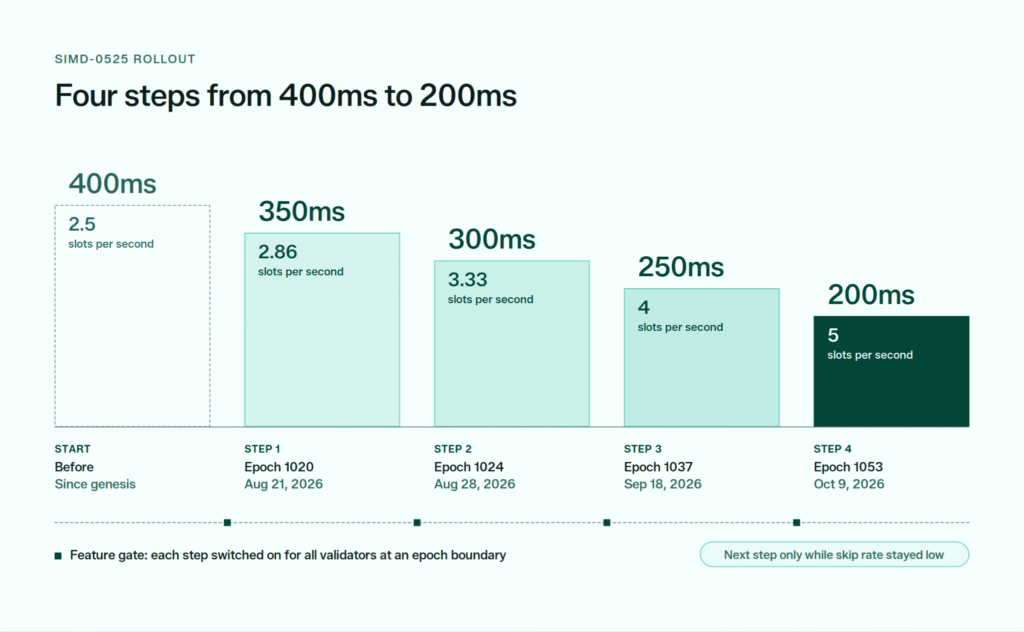
The steps were spaced 1 to 3 weeks apart, giving core developers time to review network data between activations. Solana Foundation analysis published September 28, 2026 found skip rates stable through the 250ms stage.
When Did Solana’s 200ms Slots Go Live?
The Solana 200ms slot time went live at the start of epoch 1053 on October 9, 2026, at about 14:35 UTC.
Under SIMD-0525, each new slot time took effect one epoch after its feature gate activated. The 200ms step followed this sequence:
- Epoch 1051: feature gate pending.
- Epoch 1052: feature active, slots still at 250ms.
- Epoch 1053: 200ms slots live.
Early mainnet results are stable. On October 10, 2026, Anza CEO Brennan Watt reported healthy skip rates and reasonable slot times, without publishing figures.
Does 200ms Mean Solana Has Twice the TPS?
No. Cutting Solana slot time to 200ms does not automatically double Solana TPS, because per-block compute limits decreased in the same proportion.
Every block has a compute limit, measured in compute units (CU), which caps how much processing work it can hold. SIMD-0525 cut that limit in step with slot time, so each block now holds half the work, delivered twice as often.
| Slot duration | Compute limit per block | Capacity per second |
| 400ms | 100M CU | 250M CU |
| 350ms | 87.5M CU | 250M CU |
| 300ms | 75M CU | 250M CU |
| 250ms | 62.5M CU | 250M CU |
| 200ms | 50M CU | 250M CU |
The result is a flat ceiling of about 250M CU per second at every stage. The 400ms starting point of 100M CU comes from SIMD-0286, an earlier upgrade activated on July 29, 2026.
Solana speed is measured 3 separate ways:
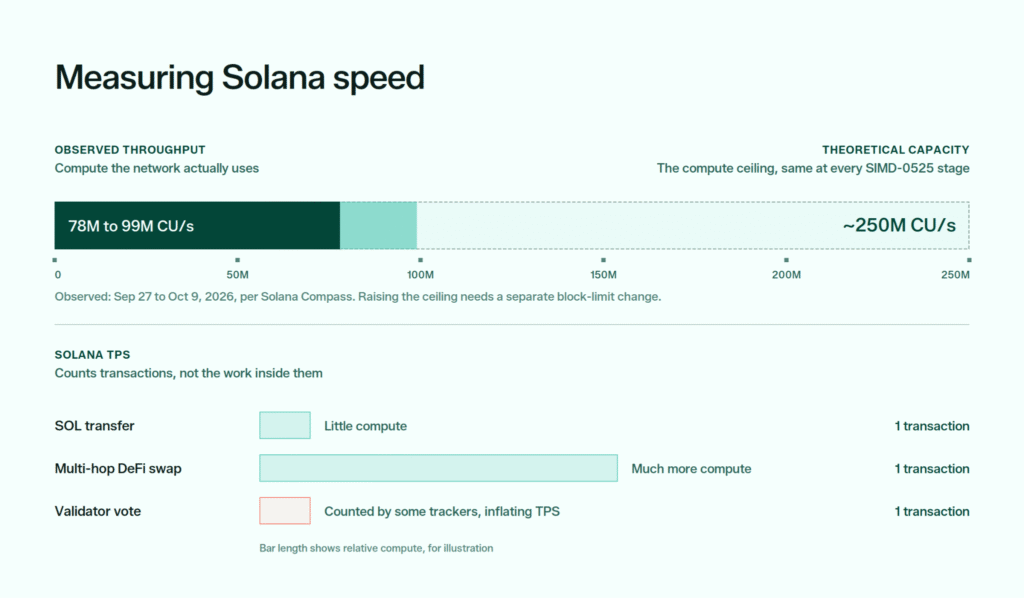
- Solana TPS: transactions per second shown on public trackers, which changes with the type of transactions sent.
- Theoretical capacity: the compute ceiling, about 250M CU per second at every stage.
- Observed throughput: compute the network uses, roughly 78M to 99M CU per second from September 27 to October 9, 2026, per Solana Compass.
TPS alone is a weak speed measure, because a SOL transfer uses less compute than a multi-hop DeFi swap. Some trackers also count the vote transactions validators send to agree on blocks, which inflates the headline figure. Raising capacity needs a separate change to the block limit.
How Do 200ms Slots Affect Solana Confirmation Time and Latency?
Solana confirmation time is shorter in wall-clock terms, because confirmation rules count blocks and blocks now arrive twice as often. Solana latency, the delay a user sees, also depends on network conditions and RPC nodes, the servers apps use to reach the network.
Processed vs. Confirmed vs. Finalized Transactions
Solana apps choose a commitment level, which sets how certain they need to be that a transaction is permanent. Anza documentation defines 3 levels:
- Processed: a node has processed the block, which can still be skipped.
- Confirmed: validators holding 66%+ of all stake have voted for the block.
- Finalized: at least 31 more confirmed blocks are built on top, making the block irreversible.
Because finalization counts blocks, it speeds up with shorter slots. 31 blocks take about 6.2 seconds at 200ms, against about 12.4 seconds at 400ms.
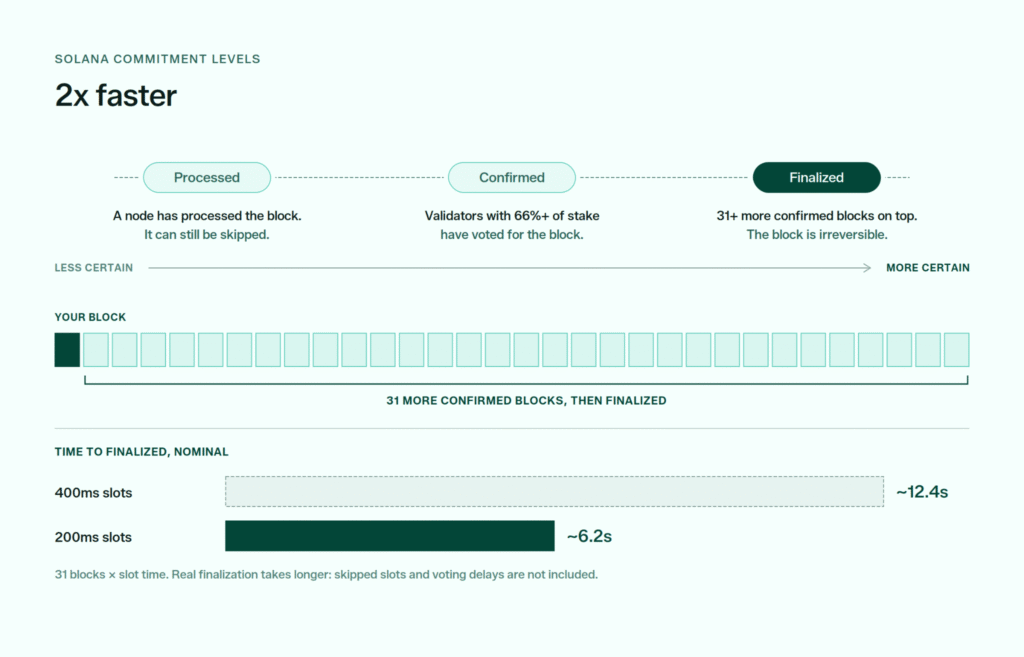
These nominal figures exclude skipped slots and voting delays, so real finalization takes longer. A block appears in about 200ms and becomes irreversible after at least 31 further blocks under the current consensus design.
The Solana Foundation reports that vote latency, the time validators’ votes take to land, rose during the rollout. The rise was largest in Asia and South America, yet the network average stayed below 2 slots and consensus remained stable.
How Shorter Slots Affect Blockhash Validity
Every Solana transaction includes a recent blockhash, a reference to a recent block that proves the transaction is fresh. The blockhash expires after 150 blocks, which now takes 30 seconds, down from 60 seconds.
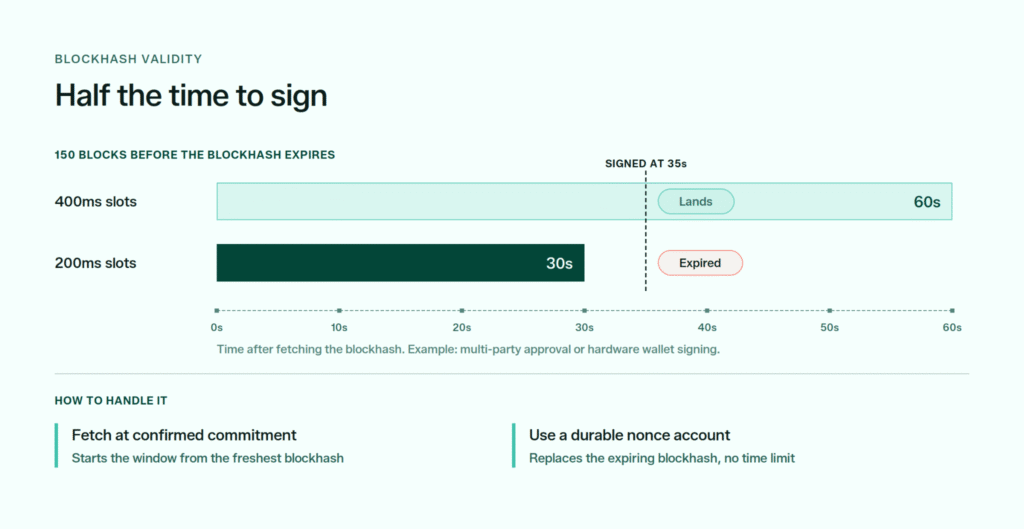
Multi-party approval and hardware wallet confirmation now have half the time to finish before a transaction goes stale. For example, a transaction signed 35 seconds after fetching its blockhash would have landed at 400ms and now expires.
Developers can fetch blockhashes at confirmed commitment to start with the freshest window. For slow signing, durable nonce accounts replace the expiring blockhash and remove the time limit.
What Do 200ms Slots Mean for Validators, Developers, and RPC Providers?
Existing Solana applications stay compatible with 200ms slots, and code that converts slots into time needs review. Validators get shorter leader turns and faster epochs, while applications get faster state updates.
Leader Windows, Epochs, and SOL Staking Rewards
Under the Solana leader schedule, each turn now lasts 800ms. A validator gets turns twice as often per hour for the same stake, which Solana Foundation modeling shows makes block rewards less variable.
Validators vote on every block, so they now vote about twice as often per second. Each vote carries a fee, and low-stake validators bear this cost most because they lead fewer blocks where vote fees are partly recovered.
Epochs now end about once a day, and epoch 1053 ran 26.2 hours. Staking rewards are paid at the end of each epoch, so delegators can track SOL staking rewards on a near-daily cadence.
The Everstake guide to Solana validator clients compares Agave and Frankendancer, two validator clients that must keep pace with 5 blocks per second.
Institutions staking SOL should review:
- custody approval steps that can exceed the 30-second blockhash window,
- reports that convert slots or epochs into dates,
- validator skip rate and vote latency at 200ms.
Everstake holds SOC 2 Type II and ISO 27001:2022 certifications for its security controls. Everstake also offers Validator-as-a-Service, a dedicated validator operated for one institution, from 50,000 SOL.
Everstake engineers have developed Blockspace: a Solana MEV infrastructure for the inbound path (the route a transaction travels before a validator includes it in a block). It addresses the points where transactions are commonly dropped, acting as a two-sided market between validators (supply) and teams that need their transactions to land (demand).
Trading, DeFi, Oracles, and Transaction Ordering
Trading systems see confirmations and price changes sooner. Solana Foundation modeling found shorter slots reduce stale-price arbitrage, meaning trades that exploit on-chain prices lagging other markets.
Oracles publish outside prices on-chain, and some protocols reject prices older than a set number of slots. A 10-slot limit now means 2 seconds, down from 4 seconds, so these limits need rechecking.
Shorter leader turns also limit how long one validator controls the order of transactions. At the 250ms stage, the longest stretches of one-leader control shortened from about 3 seconds to about 2 seconds.
Ordering risks remain, because consecutive leaders can apply the same ordering rules. The effect on sandwich attacks, where an attacker trades before and after a user, is unclear in Solana Foundation modeling.
Priority fees are extra fees users pay for faster inclusion, and settings tuned for 400ms slots may need retesting. The Everstake explainer on priority fees on Solana covers how fee bidding works.
RPC Providers, Indexers, and Application Compatibility
RPC providers run the servers apps use to read and send transactions, and indexers store chain data for search. Both now process 432,000 scheduled slots per day in the same data format, double the 400ms rate.
Code that multiplies slot counts by 400ms to estimate time now produces wrong values. Steps for developers:
- Replace hardcoded 400ms constants with the current slot duration or getBlockTime, which reports a block’s timestamp.
- Recheck retry timers and confirmation timeouts.
- Load-test data ingestion at 5 blocks per second.
- Confirm minimum client versions in Anza and SDK release notes.
What Are the Drawbacks of Solana’s 200ms Slots?
Faster slots leave less timing margin for validators and for slow operational steps. The effects vary by validator location and stake.
- More processing per second: validators handle up to 5 blocks per second plus the votes on each, raising hardware and bandwidth load. Anza merged a fix on October 9, 2026 (Agave PR #14608) that stops validators reprocessing duplicate shreds, the small packets blocks travel in.
- Less slack for delays: the same 100ms delay used a quarter of a 400ms slot and now uses half of a 200ms slot.
- Network distance: leader handoffs, when block production passes to the next validator, add delay that grows with distance. The median is about 28ms for validators under 500km apart and about 122ms beyond 8,000km.
- Congestion and skips: skipped slots still pause block production, and heavy traffic still delays transactions.
The difference between target and measured slot time has also grown as a share of each slot. It was under 5% at 350ms and about 9% at 200ms, per Solana Compass.
Solana 200ms Slots vs. Alpenglow’s 150ms Finality
Slot time sets how often blocks are produced, while finality sets when a block becomes irreversible. The 200ms upgrade changed the first and left Solana finality to the existing consensus rules.
Alpenglow replaces Solana‘s consensus protocol, the rules validators use to agree on blocks, and targets about 150ms finality. Combined with 200ms slots, it would bring block production and finality to similar timescales.
Alpenglow moved to Solana‘s test networks on September 24 (testnet) and September 25, 2026 (devnet). Mainnet was listed as upcoming, with no announced date as of October 9, 2026.
The Everstake guide to the Alpenglow consensus upgrade covers its design and status.
Current Solana Block Time: How to Check the Latest Status
The official source for Solana‘s slot-time target is the Solana Foundation reduced-slot-times tracker. Live mainnet slot times appear at solana.com/200ms
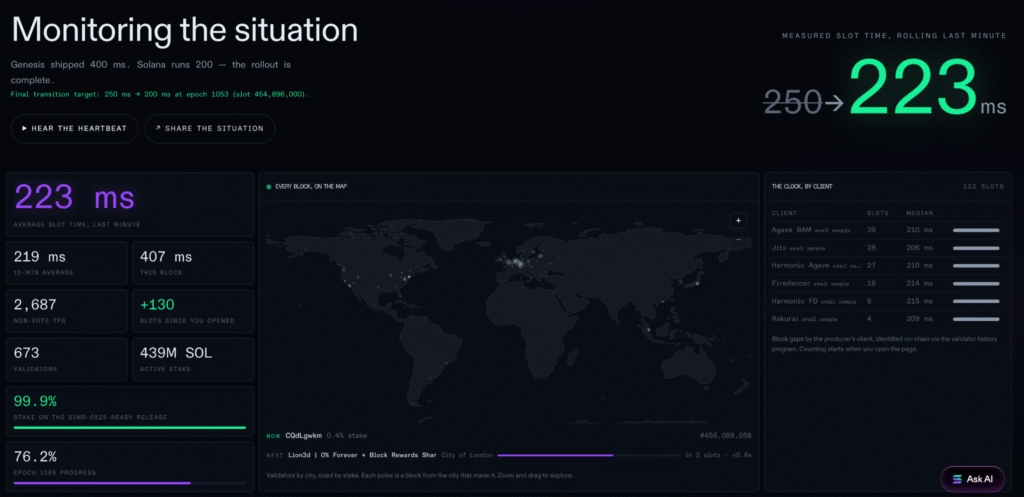
Metrics to watch after the upgrade:
- observed slot duration per epoch,
- skip rate,
- confirmation latency at each commitment level,
- non-vote TPS and compute used per second.
The RPC method getRecentPerformanceSamples and dashboards such as Solana Compass report most of these figures. Verified next steps are limited to Alpenglow mainnet migration and the 100M CU block-limit discussion, neither with a date.
FAQs
What Is Solana’s Block Time Now?
Solana‘s block time target is 200ms, live since October 9, 2026. The first full epoch averaged 218.3ms per slot.
How Fast Is Solana After the 200ms Upgrade?
Solana speed is now 5 blocks per second, double the original 2.5. Compute capacity stays near 250M CU per second.
How Many Solana Slots Are Produced Per Second?
Solana schedules 5 slots per second at the 200ms target. That equals 432,000 slots per day, so delegators to validators see rewards credited roughly daily.
What Is Solana’s Confirmation Time?
Solana confirmation time depends on the commitment level and network conditions. Finalized status needs 31 confirmed blocks on top, about 6.2 seconds nominally.
Does 200ms Slot Time Mean Twice the TPS?
No. Per-block limits fell from 100M CU to 50M CU, so higher capacity needs a block-limit change that Everstake validators would adopt by feature gate.
What Is SIMD-0525?
SIMD-0525 is the Solana Improvement Document that cut slot time from 400ms to 200ms.
What Is the Difference Between Solana Slot Time and Finality?
Slot time is how often a block can be produced, and finality is when it becomes irreversible.
Share with your network