ethereum
solana
Solana Isn’t Alone: Geographic Clustering Across PoS Networks
Every major Proof-of-Stake (PoS) network tends to concentrate validators in a handful of geographic regions with strong connectivity and low network latency. Distributing validators across more distant regions can reduce exposure to localized infrastructure failures, but it may also increase latency and affect validator performance.
NOV 03, 2026
Last updated NOV 03, 2026 · V1
TL;DR
- 72.8% of delegated SOL is assigned to validators in Europe, according to Bitwise in October 2026.
- Clustering appears on other PoS networks. A study of 5 chains found the top 3 countries hold more than 33% of stake on each.
- Latency-sensitive rewards pull validators toward the same hubs, which makes clustering an emergent property of the incentives.
- On August 12, 2026, validators in Frankfurt and Tokyo went offline together because they shared a provider.
- Geographic spread is worth its latency cost when it lowers the chance that one event affects multiple validators at once, which depends on providers and network paths as much as on region.
- Institutions can assess concentration across 4 fault domains, which gives a fuller picture than region alone.
How Concentrated Is Solana’s Validator Geography?
72.8% of delegated SOL is assigned to validators in Europe, according to the Bitwise Q4 2026 Staking Report released on October 20, 2026. The remaining stake is distributed as follows:
- North America: 16.2%
- Asia: 10.6%
- South America: 0.4%
Much of the stake is in a corridor between Amsterdam and London that includes Frankfurt. These figures point out where validators operate, and say nothing about where delegators live.
Leader slots show the same pattern. A September 9, 2026 snapshot, reported by Crypto Briefing, put Europe at 72.9% of leader slots, Germany at 36.1%, and Frankfurt at 35.3%.
In July 2026, the same source put Europe between 67% and 68.5% and Frankfurt at 25.9%.
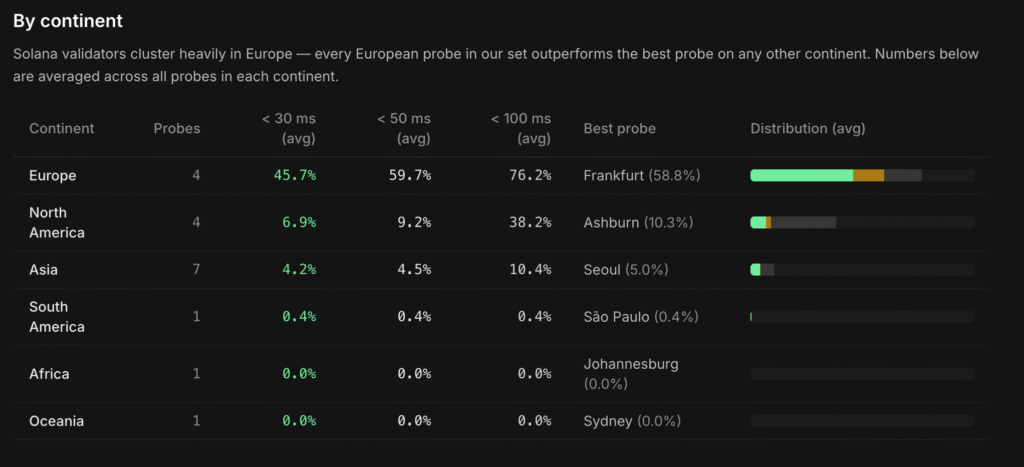
The Glassnode data as of early November 2026 depicts similar situation:
Is Geographic Clustering Unique to Solana?
No. Every PoS network examined shows regional clustering, although each dataset measures a different thing.
A GPoS study of 5 PoS chains found that a few regions dominate consensus voting power. Its stake data, collected in September 2024, put the top 3 countries above 33% of stake on every chain.
| Network | Metric | Largest shares | Source and date |
| Solana | Delegated stake | Europe 72.8% | Bitwise, October 2026 |
| Solana | Leader slots | Europe 72.9%; Frankfurt 35.3% | Crypto Briefing, September 2026 |
| Ethereum | Lido validators | Europe 60.0%; North America 18.6% | Lido data via Four Pillars, Q4 2025 (older snapshot) |
| Ethereum | Stake by country | US 27.28%; Netherlands 18.65%; Finland 12.11% | GPoS study, September 2024 data |
| Avalanche | Stake by country | US 29.72%; Germany 14.14%; Ireland 8.32% | GPoS study, September 2024 data |
| Sui | Stake by country | US 18.30%; Germany 13.76%; UK 10.62% | GPoS study, September 2024 data |
| Aptos | Stake by country | Germany 12.07%; US 11.47%; Singapore 10.30% | GPoS study, September 2024 data |
Ethereum research describes validators clustering along the Atlantic corridor, where latency is favorable. The Four Pillars summary of Lido data follows the same concentration pattern.
- Validator count shows the number of operating validator instances.
- Stake shows voting weight.
- Leader slots show who produces blocks.
- Node datasets count CL and EL clients, including nodes that run no validator, and one beacon node can serve validators in separate locations.
Lido’s own Q2 2026 metrics show some easing for its Curated Module validators. Germany’s share of validator servers fell from about 20% to 16.31%, and the US share declined to 12.53%.
Why Do Validators Cluster in the Same Places?
Rewards depend on timing, so validators move toward the places where blocks and votes travel fastest. That pull emerges from latency-sensitive incentives that apply on every chain. Both block-building paradigms create location-dependent payoffs. Attestation thresholds and slot times can strengthen the geographic clustering.
The cost of distance is measurable. A 2025 study cited by Four Pillars found that a Sydney node saw 10% of block messages arrive after 4 seconds and received 10% lower average rewards, while a Singapore node recorded no missed proposals.
Hosting supply reinforces geo clustering. Premium bare-metal configurations in Frankfurt sold out in April 2026, according to ERPC.
Delegation scoring added another incentive. Before October 2026, Shinobi gave vote latency metrics about 67% of its score weight, and other programs set vote-credit thresholds.
What Does the Latency Tax Cost on Solana?
At 250ms slots, fewer votes from Asia and South America landed within 1 slot, yet nearly all votes still arrived within 2 slots. The cost is now harder to track because Solana changed its voting mechanism.
At 400ms, more than 98% of votes from Europe, North America, and Asia arrived within 1 slot. At 250ms, the shares were:
- Europe: 95.8%
- North America: 92.8%
- Asia: 70.7%
- South America: 70.3%
Median skip rates fell from 0.08% to 0.04%. The Solana Foundation found that validators with more stake lose proportionally fewer vote credits at 250ms: 0.0874% stake-weighted against 1.6360% unweighted.
The slot target reached 200ms at epoch 1053 on October 9, 2026, and the first full epoch averaged 218.3ms per slot. Check out the Everstake explainer on Solana block time covers the four-step rollout.
After Alpenglow went live the votes became direct validator messages and vote credits ended, so the vote-latency penalty measured at 250ms no longer exists in that form..
As of November 3, 2026, there was no published regional breakdown covering 200ms or Alpenglow. Early fast-finalization scores for validators in Singapore and Brazil looked near zero, yet that metric reflects the observer’s position at least as much as the validator’s.
Even the 250ms sample is thin. The Foundation counted only 7 Asia to Oceania and 35 Europe to Oceania leader handoffs, and it suggested caution about 200ms before Alpenglow.
Does Geographic Distance Protect a Network?
Distance helps only when outages are independent. Shared providers make them correlated, as the TeraSwitch incident on August 12, 2026 showed.
Two arguments compete:
- Low-stake validators in Brazil or Japan pay the performance cost without holding enough stake to keep the chain live during a regional outage.
- Concentration in shared regions, providers, and networks creates correlated risk.
The incident informs both. A routing fault at TeraSwitch took 28.83% of delegated SOL offline, per Marinade estimates, and reports count about 90 to 102 validators and 33 to 40 minutes of disruption.
The affected sites included:
- Amsterdam
- London
- Frankfurt
- Singapore
- Tokyo
One autonomous system, AS20326, carried 27.34% of total stake, above the 25% per-ASN limit in the SFDP criteria. Only 3 of 74 measured validators recovered automatically through redundancy. Read more in Everstake analysis of Solana validator concentration risk after the TeraSwitch halt.
Hosting concentration appears on Ethereum too. Execution-layer hosting nodes run on a few providers:
- AWS: 35.53%
- Hetzner: 13.75%
- OVHcloud: 9.69%
Operator concentration can hide inside a distant region. South Korea hosted 8,886 Lido validators at Q4 2025, largely through A41, and they effectively disappeared when that operator ceased operations in early 2026.
Geographic spread lowers correlated risk only when hosting providers and network paths differ too. The proposed geo-aware leader schedule, SIMD-0675, shows the same trade-off: grouping nearby leaders cuts handoff latency and lengthens same-region runs, which lowers resilience to regional outages.
Should Every Validator Chase the Shortest Slot Time?
The answer depends on what delegation programs reward. Engineering determines the limits while scoring policy agrees on the incentive.
Some operators argue that third-party block builders already weaken the case for tuning every independent validator to the minimum slot time. Others argue that applications may route around slower leaders as slot times and finality improve, which creates a soft penalty for distant operators.
Applications adjust to slot-time changes in other ways, including priority fee settings, as the Everstake explainer on priority fees on Solana describes. The Foundation frames the remaining 200ms question as largely economic and philosophical.
What Reduces Correlated Risk?
Four levers reduce correlated risk, and each belongs to a different party:
- Protocol design. The GPoS proposal adds location diversity to stake-based voting power. In experiments it improved geospatial decentralization by 45% on average with minimal overhead in simulated HotStuff and CometBFT consensus, and its authors list formal security proofs as future work.
- Network infrastructure. DoubleZero connected 462 validators, 59% of Solana stake weight, across 166 dedicated links and 10.14 Tbps as of Q2 2026. Its Phase II Delegation Program, launched March 9, 2026, directed 2.4M SOL toward validators in distant hubs such as Sao Paulo and Tokyo.
- Delegation policy. For epoch 1067, SFDP lowered its vote-credit threshold from 93% to 0%, kept a skip-rate test, and retained concentration limits. Shinobi now stakes validators far from the network’s stake concentration, with 65 validators and 939,949 SOL in epoch 1066. Lido attributes early diversification among Curated operators to its CMv2 assessment criteria, published before launch, and reports that non-cloud infrastructure now hosts 55.88% of Curated validators.
- Operator practice. Multi-provider and multi-ASN setups, tested failover, and multi-region capacity address the shared-upstream pattern from August 2026.
Connection to a dedicated network does not by itself change where a validator operates.
Solana also has a protocol proposal of its own. SIMD-0675, opened on September 29, 2026, would order consecutive leaders by proximity while keeping each validator’s number of leader windows.
Its own simulation on epoch 1038 data cut mean handover latency from 36.2ms to 17.0ms. A Solana Foundation study of synthetic networks put the gain at 29.1ms at run length 7, with 4.3 seconds of added same-region persistence.
The proposal is open and unmerged, and its companion SIMD-0674, which registers validator locations, was still in draft when SIMD-0675 moved to review on September 30, 2026.
What Should Institutions Ask About Validator Concentration?
Institutions can assess any validator set or delegation across 4 fault domains, each with its own question for operators.
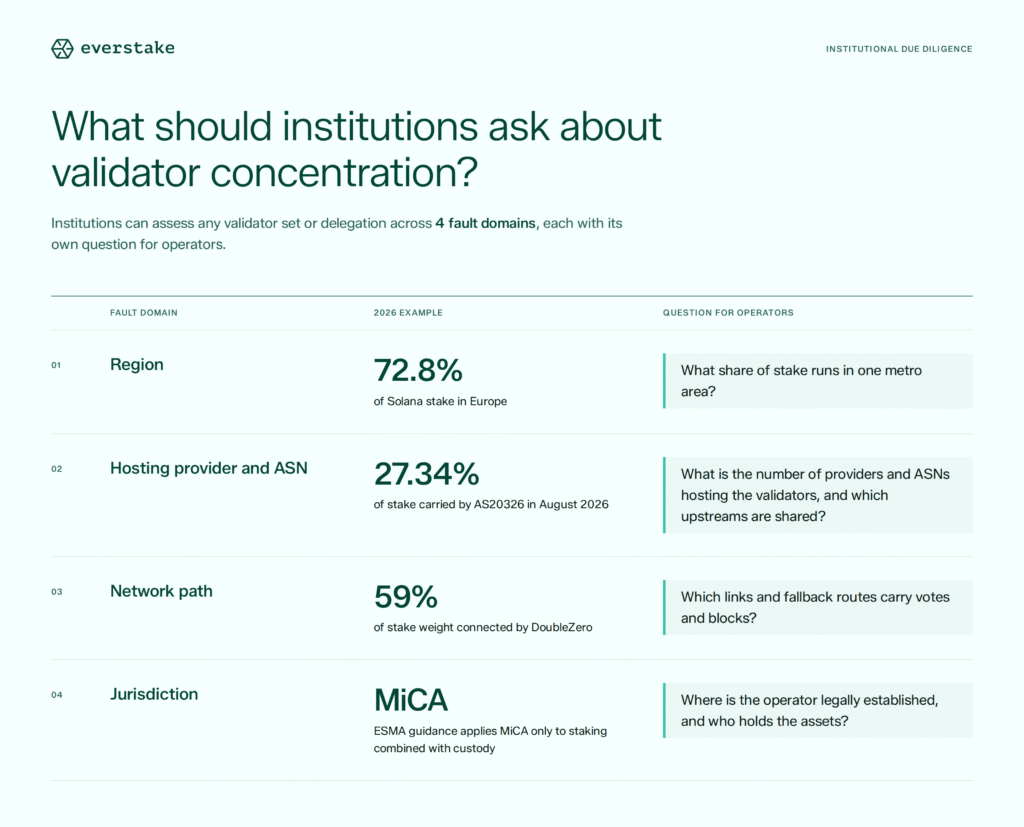
Geographic decentralization is worth the latency tax when it lowers the chance that one event takes out multiple validators at once. Without that effect, the added latency buys nothing.
Everstake is a non-custodial validator and staking provider and has operated as a Solana validator since the network’s testnet. For institutions, Everstake publishes SOC 2 Type II and ISO 27001:2022 certifications for its security controls and offers dedicated validators from 50,000 SOL through Validator-as-a-Service.
Questions stakers and delegation programs can put to operators:
- What share of your stake runs in one metro area, and which one?
- What number of hosting providers and ASNs carry your validators, and what share does the largest hold?
- Which upstream routes or backbones do your providers share?
- How is failover tested, and what number of validators recovered automatically in your last drill?
- Which entity operates the validators, and in which jurisdiction does it hold custody, if any?
FAQ
What percentage of Solana stake is in Europe?
72.8% of delegated SOL is assigned to European validators, per the Bitwise Q4 2026 Staking Report.
Why do validators cluster in Frankfurt?
Frankfurt produces 35.3% of Solana leader slots, and operators locate near leaders to keep votes and blocks inside tight slot windows.
Does Alpenglow change the penalty for distant validators?
Alpenglow ended vote credits on October 21, 2026, and no regional data under the new mechanism had been published as of November 3, 2026.
What is Solana’s current slot time?
The target is 200ms since October 9, 2026, and the first full epoch averaged 218.3ms.
What is a fault domain in staking?
A fault domain is a shared dependency, such as a region, hosting provider, network path, or jurisdiction, whose outage can affect multiple validators at once.
Share with your network