ethereum
What Is ePBS? Ethereum Enshrined Proposer-Builder Separation (EIP-7732) Explained
ePBS changes how every Ethereum block is produced and is the main consensus change in the Glamsterdam upgrade.
NOV 04, 2026
Last updated NOV 04, 2026 · V1
TL;DR
- About 90% of Ethereum blocks are built through MEV-Boost, which relies on trusted middlemen called relays, and ePBS embeds that process into the protocol.
- Each block comes in 2 parts, a beacon block with the builder’s bid and an execution payload with the transactions, and a 512-member committee checks that the payload arrived on time.
- Builders pay from a protocol deposit of at least 1 ETH or through a trusted transfer inside the payload.
- The window for spreading transaction data grows from about 2 seconds to roughly 9 seconds, which makes room for larger blocks.
- MEV remains, and builders can withhold payloads when prices move, leaving slots empty.
- Validator operators must update their software, while delegators and ETH holders need to take no action.
- Status: Live on the Sepolia testnet since October 6, 2026, with no mainnet date.
What Is ePBS?
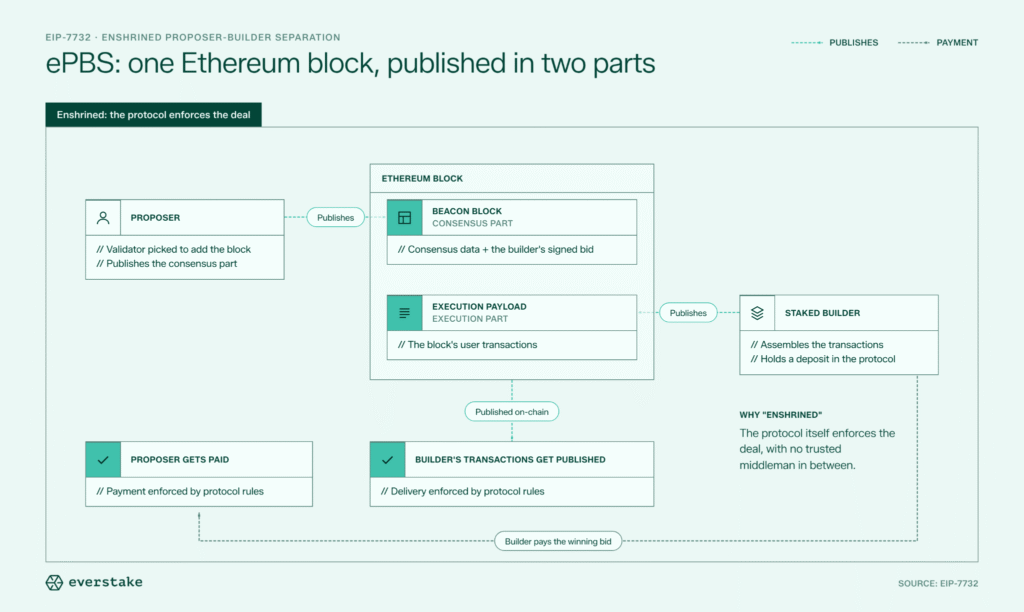
ePBS (enshrined proposer-builder separation), defined in EIP-7732, divides each Ethereum block into a consensus part published by the proposer, the validator picked to add the block, and an execution part published by a staked builder. “Enshrined” means the protocol itself enforces the deal, so the proposer gets paid and the builder’s transactions get published.
ePBS is 1 of 2 Glamsterdam headliners, alongside block-level access lists (BALs, EIP-7928), which let nodes process transactions in parallel. Co-author Mike Neuder, a former Ethereum Foundation researcher, notes that the proposal was reframed around delayed execution, which made scaling its main purpose.
Why Ethereum Needs ePBS: The Limits of MEV-Boost
Ethereum needs ePBS because today’s block market runs on trust and because validators get a short window to check each block. MEV, or maximal extractable value, is the value captured by choosing which transactions go into a block and in what order, and builders pay part of it to proposers for the right to build.
MEV-Boost connects proposers and builders through relays, which hold the builder’s block until the proposer commits and make sure the proposer receives the winning bid. About 90% of blocks are built this way, no protocol rule enforces the relay’s role.
Timing is the second constraint: 4 seconds into each 12-second slot, validators called attesters vote on the block, and before that vote they must download and execute it and confirm that its blob data, posted by rollups, is available.
The Ethereum Glamsterdam roadmap estimates that nodes have about 2 seconds to distribute and verify block data, limiting the amount of computation each block can contain.
How ePBS Works
ePBS publishes the 2 parts of a block a few seconds apart, with 2 new protocol roles checking each step.
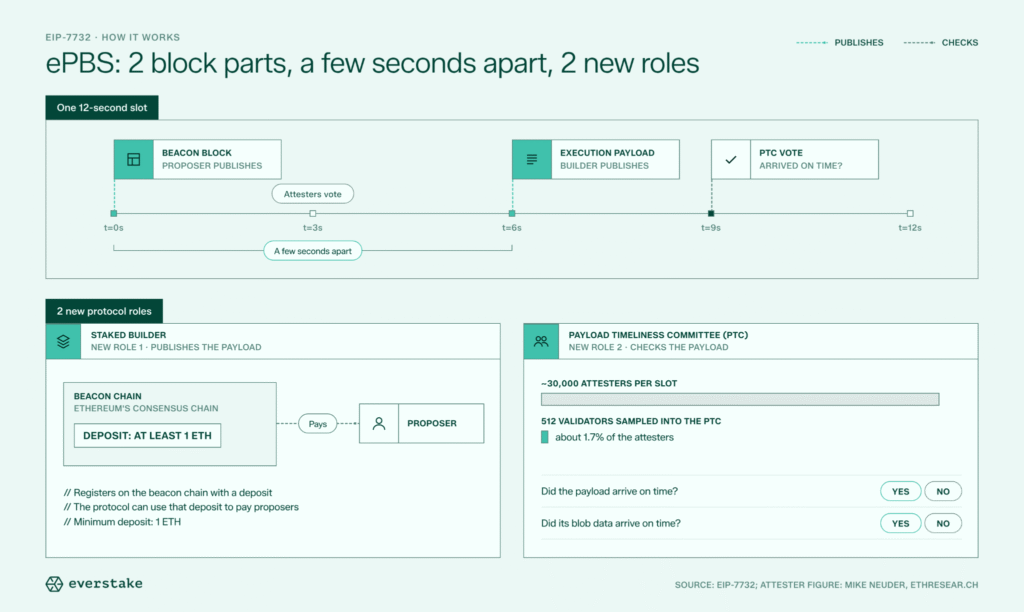
- Staked builders register on the beacon chain, Ethereum‘s consensus chain, with a deposit of at least 1 ETH that the protocol can use to pay proposers.
- The Payload Timeliness Committee (PTC) samples 512 validators per slot, compared with roughly 30,000 attesters, and votes yes or no on whether the payload and its blob data arrived on time
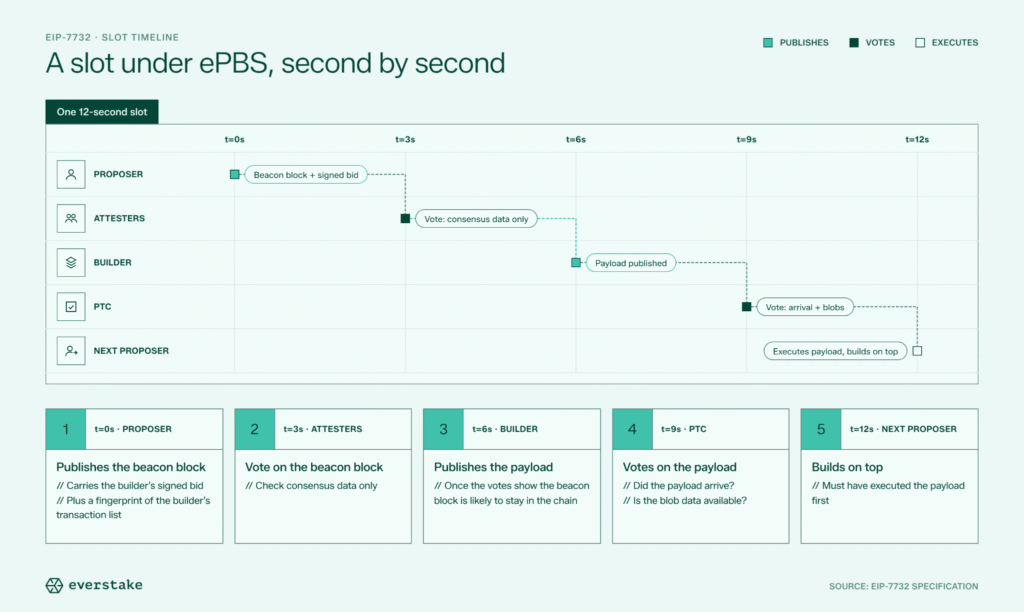
| Slot event | Today (MEV-Boost) | Under ePBS |
| Attestation vote | t=4 | t=3 |
| Payload publication | Inside the block at t=0 | t=6, by the builder |
| Payload timeliness vote | No separate vote | t=9, 512-member PTC |
| Window for spreading and checking execution data | About 2 seconds | Roughly 9 seconds, to t=3 of the next slot |
How Builders Pay Proposers
Builders pay proposers through a trustless payment taken from their deposit or a trusted transfer inside the payload. Proposers can also build their own blocks with a bid of 0.
Trustless payments. Under the EIP-7732 rules, the proposer is paid when the payload lands on-chain, or when the beacon block received votes from at least 60% of the slot’s assigned stake. If the payload is missing and votes fall under 60%, the builder pays nothing, which protects builders when a beacon block arrives late.
Trusted payments. The builder sends an ordinary ETH transfer inside the payload, as with MEV-Boost today, so the proposer relies on the builder. Proposers can cap the trusted amount per builder with the max_execution_payment setting.
| Slot outcome | What reached the chain | Trustless payment | Trusted payment |
| Full | Beacon block and payload | Paid | Paid |
| Empty | Beacon block only | Paid at 60% of votes or more | Unpaid |
| Skipped | No beacon block | Unpaid, builder not charged | Unpaid |
What ePBS Improves
ePBS reduces reliance on trusted middlemen and gives validators more time to check each block.
- Trust-minimized exchange. The protocol enforces delivery and payment, so relays become optional, and potentially relays to register as in-protocol builders.
- Larger blocks. Moving execution after the first vote widens the data window to roughly 9 seconds, and core developers target a gas limit of about 200M, up from 60M today. Sepolia already runs a 200M schedule, and no mainnet gas limit has been announced.
- Accountable builders. Builders get an on-chain identity and deposit, and FOCIL (EIP-7805), the consensus headliner of the next upgrade, Hegotá, is designed to work alongside EIP-7732.
What ePBS Doesn’t Fix: Limitations and Open Questions
ePBS leaves MEV in place and adds new trade-offs in consensus design.
- MEV remains. Ordering strategies such as sandwich attacks continue, and censorship resistance is the job of FOCIL.
- Trust may persist. Builders prefer trusted payments, since the top 0.1% of slots carried 25.48% of all MEV in the first half of 2026 and trustless bids that size would lock up hundreds of ETH.
- Free option problem. A builder commits at t=0 and publishes at t=6, so it can withhold a payload that lost value in between and leave the slot empty, a risk known as the free option problem.
- More complex fork choice. Nodes must now track whether each block’s payload arrived.
What ePBS Means for Validators and Stakers
Validator operators take on a new duty and new configuration work, while delegators who stake through a provider need to take no action.
- New duty: Validators are periodically sampled into the PTC and must vote by t=9.
- Software: Operators must update both their execution and consensus clients.
- Builder endpoints: Proposers configure the builders and relays they request bids from, as they choose relays in MEV-Boost today.
- Reporting: Labels for execution-side rewards may change, which Blockdaemon notes affects dashboards and reconciliation.
Institutions can ask their staking provider:
- Which builders and relays will you accept bids from?
- Will you cap trusted payments per builder?
- How will execution-side rewards appear in reports?
- How will you monitor empty slots from withheld payloads?
Everstake has staked ETH since the first day of proof-of-stake on Ethereum, the Beacon Chain launch on December 1, 2020, nearly 2 years before The Merge, and has supported every Ethereum upgrade since. A dedicated team of engineers and researchers follows Ethereum protocol development continuously, and Everstake plans to deploy Glamsterdam client updates across its validator infrastructure ahead of activation.
For institutions, Everstake is a non-custodial validator operator active since 2018, with infrastructure aligned with SOC 2 Type II and ISO 27001. Its controls are also aligned with NIST CSF 2.0 and were independently assessed against selected DORA requirements, as of June 5, 2026.
ePBS Timeline
ePBS is live on the Sepolia testnet and has no mainnet date.
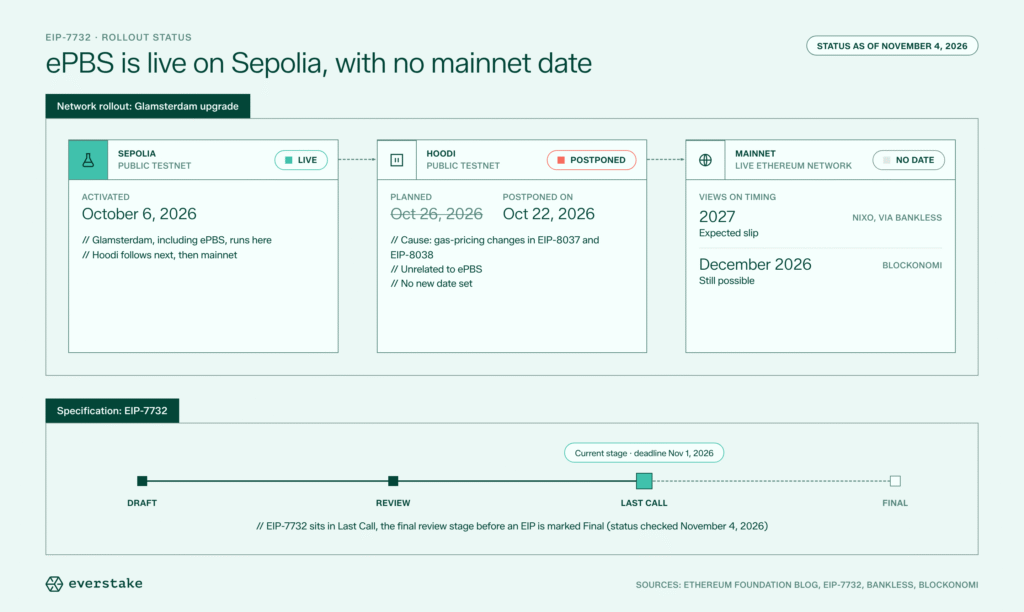
- EIP status: EIP-7732 is in Last Call, the final review stage, with a deadline of November 1, 2026.
- Sepolia: Glamsterdam activated on October 6, 2026.
- Hoodi: The second testnet fork, planned for October 26, 2026, was postponed on October 22, 2026 over gas-pricing changes in EIP-8037 and EIP-8038, unrelated to ePBS.
- Mainnet: Nixo, quoted by Bankless, expects mainnet to slip to 2027.
FAQ
Is ePBS the same as PBS?
PBS is the general model of proposers selling block-building rights to builders, and ePBS is the version written into Ethereum‘s protocol rules by EIP-7732.
Does ePBS get rid of MEV?
No, ePBS changes how builders and proposers trade block space and leaves MEV extraction in place.
Do ETH stakers need to do anything for ePBS?
Delegators need to take no action, while validator operators must update both clients and configure builder endpoints before activation.
Does ePBS remove MEV relays?
No, relays become optional, and Mike Neuder expects them to register as in-protocol builders.
When will ePBS go live on Ethereum mainnet?
As of November 4, 2026, Glamsterdam has no mainnet date, and the Hoodi testnet fork that precedes it was postponed on October 22, 2026.
What is the Payload Timeliness Committee?
The PTC is a group of 512 validators per slot that votes on whether the builder’s payload and blob data arrived on time.
Share with your network