Institutional
solana
SIMD-123: Solana Block Reward Distribution for Delegators, Explained
SIMD-123 is a Solana protocol change that lets validators share block revenue with delegators automatically. Validators set a block revenue commission, and the protocol distributes the remainder to stake accounts after each epoch.
OCT 14, 2026
Last updated OCT 14, 2026 · V1
TL;DR
- SIMD-123 lets validators share block revenue, meaning transaction fees, with delegators through the protocol under a new commission.
- Status: approved in March 2025; as of mid October, 2026, not yet scheduled for activation on any Solana cluster.
- Sharing is opt-in: the default block revenue commission is 100%, so delegators receive nothing extra until a validator lowers it.
- Payouts arrive at the start of each epoch as unstaked SOL, which delegators need to stake for it to compound.
- Jito MEV tips stay outside the protocol, so delegators now compare three commissions: inflation, block revenue, and MEV.
What Is SIMD-123 and Why Was It Proposed?
SIMD-123 is a Solana Improvement Document that creates an in-protocol path for validators to share block revenue with delegators.
A validator with more delegated stake receives more leader slots per epoch, so it produces more blocks and collects more fees. Before SIMD-123, sharing that block revenue with delegators depended on each validator’s own off-protocol arrangements.
Delegators supply the stake that wins these leader slots. SIMD-123 gives them a protocol-enforced claim on the share of block revenue that each validator chooses to pass on.
How SIMD-0096 Impacted Priority Fees
Priority fees are optional payments users add to get their transactions processed sooner. SIMD-0096 changed how they are handled in February 2025.
Before SIMD-0096, 50% of each priority fee was burned and 50% went to the block producer. After it, 100% goes to the block producer.
Blockworks Research estimated that the change raised annualized SOL inflation from 3.7% to 4.6%, since less SOL was burned. The added fee revenue stayed in validator identity accounts, because the protocol had no payout path for fees to delegators.
What SIMD-123 Is Designed to Achieve
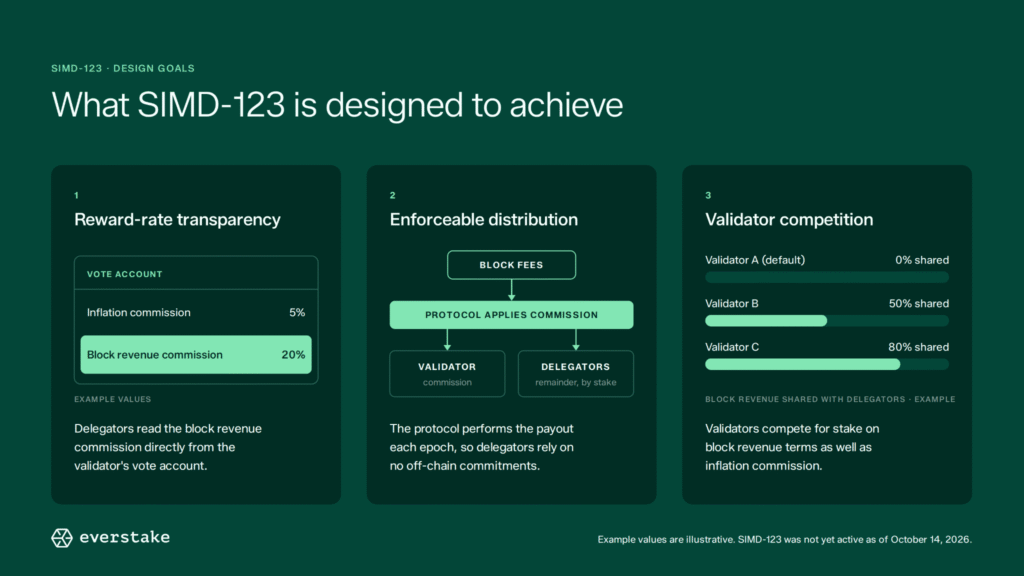
SIMD-123 targets:
- Reward-rate transparency: delegators can read the block revenue commission directly from the validator’s vote account.
- Enforceable distribution: the protocol performs the payout, which removes reliance on off-chain commitments.
- Validator competition: validators can compete for stake on block revenue terms as well as inflation commission.
How Solana Block Revenue Works Today
Solana block revenue consists of base fees and priority fees, and the block producer’s share currently goes to its validator identity account. Every transaction pays a base fee, and users can pay an extra priority fee.
The base fee is 5,000 lamports (0.000005 SOL) per signature. 50% of it is burned, and the other 50% goes to the slot leader.
The priority fee is priced per compute unit, a measure of the processing work a transaction requires. Since SIMD-0096, 100% of it goes to the slot leader; see how priority fees work for the user side.
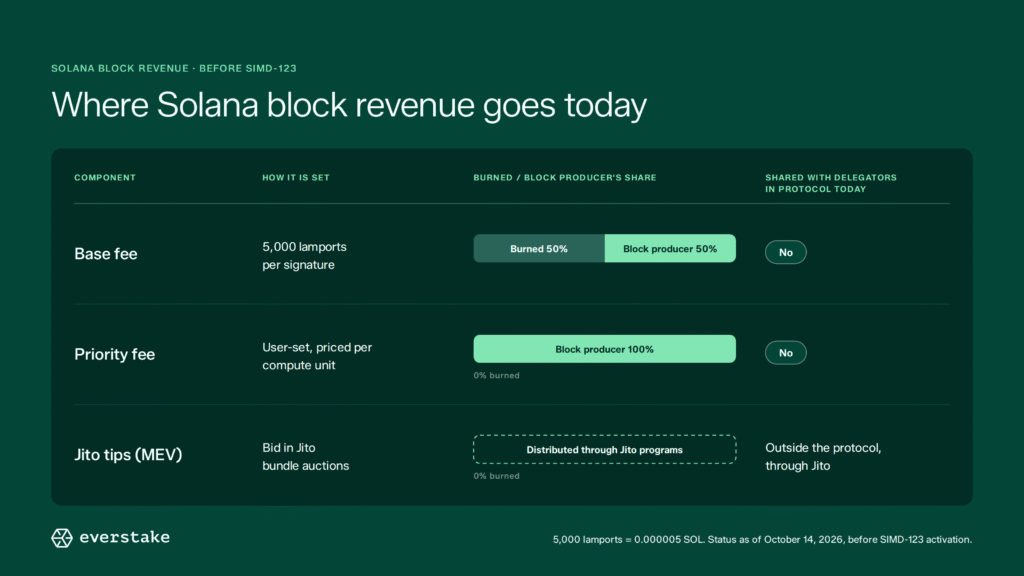
Solana block rewards from fees, including Solana priority fees, reach delegators today only through out-of-protocol programs that each validator chooses to run. Jito tips are separate payments made to Jito programs, outside the protocol’s fee accounting.
What the Revenue Data Shows
According to SolanaFloor, Solana network revenue was about $1.4 billion in 2025. MEV revenue accounted for $720.1 million (about 51.3%) and priority fees for $576.3 million (about 41.1%).
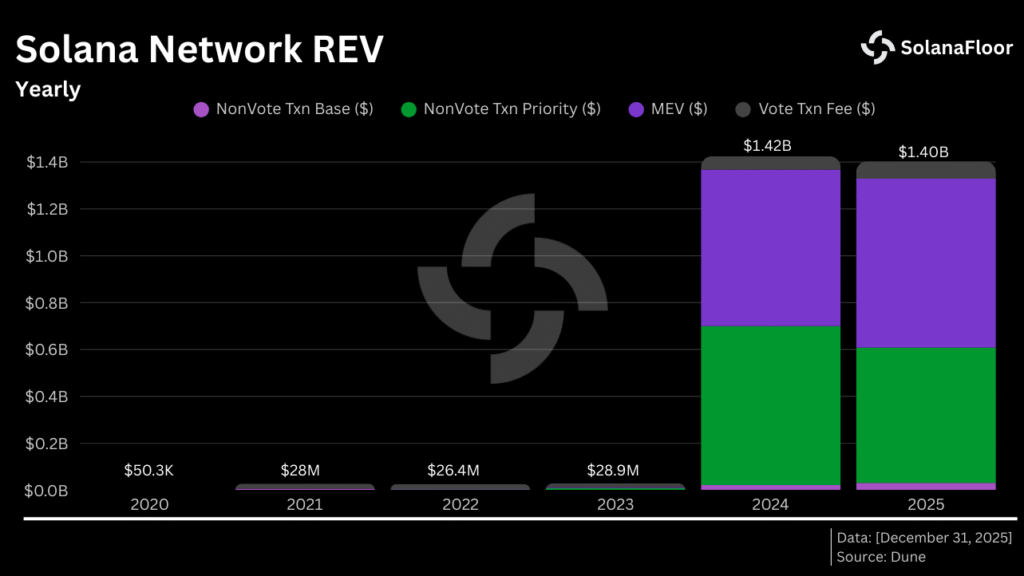
Source: SolanaFloor
SIMD-123 applies to the priority fee portion and the leader’s base fee share. Jito tips, the larger MEV portion, stay with Jito distribution unless a validator deposits them into the protocol payout.
Blockworks Research found that SOL issuance made up 97.5% of estimated staking revenue in Q1 2026. That estimate covered issuance and Jito tips only, because priority fee sharing could not be tracked at the protocol level.
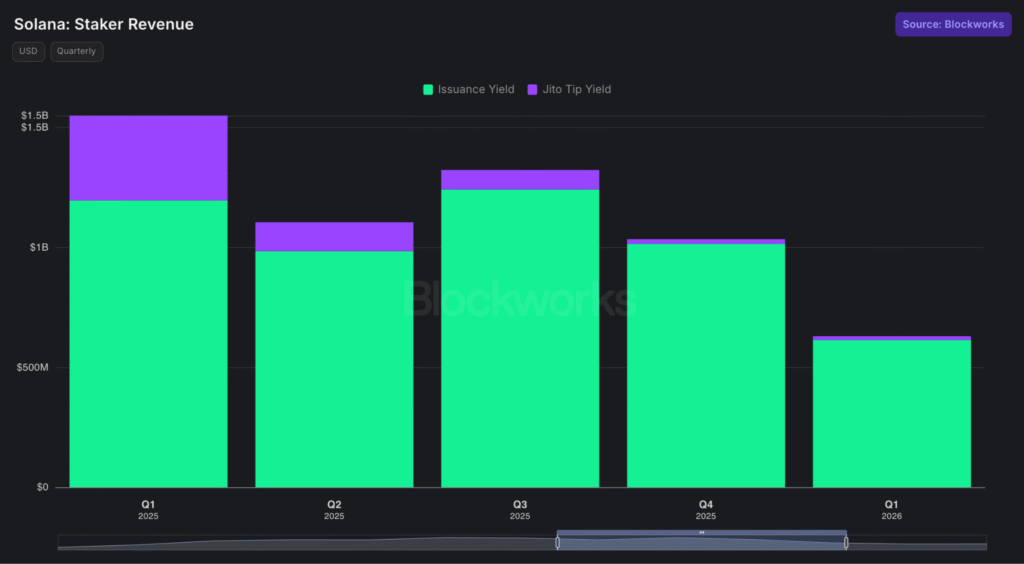
Source: Blockworks
What SIMD-123 Changes in Solana Block Reward Distribution
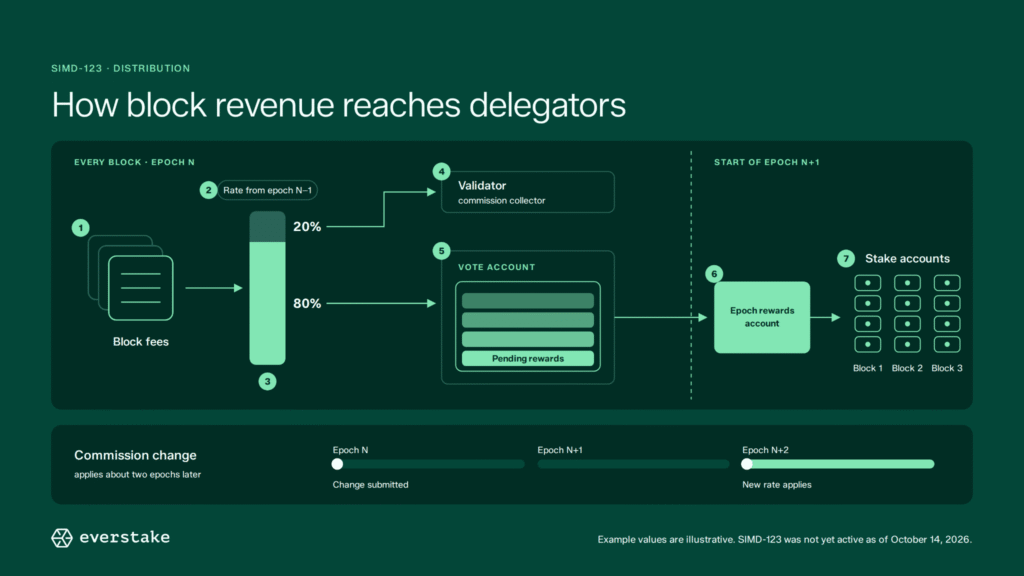
SIMD-123 divides a block producer’s fee revenue after each block between the validator’s commission collector and a pending pool for delegators. The pool is paid out to stake accounts at the start of the next epoch.
Solana block reward distribution under SIMD-123 works in seven steps:
- The validator produces a block and collects its fee revenue.
- The protocol looks up the producer’s vote account settings, as they stood at the start of the previous epoch.
- The protocol applies the block revenue commission, set in basis points and capped at 10,000 bps (100%).
- The commission goes to a collector account the validator chooses, as defined in SIMD-0232.
- The remainder is recorded in the vote account as pending delegator rewards (
pending_delegator_rewards). - At the start of the next epoch, pending rewards move to the epoch rewards sysvar account.
- Payments to stake accounts are spread across the first blocks of the epoch, as defined in SIMD-0118.
The protocol reads settings from the start of the previous epoch because that state built the current leader schedule. As a result, a commission change takes effect about two epochs after the validator submits it.
The epoch rewards sysvar account is a system account that holds rewards while the protocol pays them out. Spreading payments across blocks under SIMD-0118 keeps any one block from carrying every payout.
How Block Revenue Reaches Eligible Stake Accounts
A stake account qualifies when it had active stake delegated to the validator during the epoch that generated the revenue. Each qualifying account receives a share equal to its portion of the validator’s total active stake.
Distributed block revenue is credited as unstaked SOL inside the stake account. Unstaked SOL accrues no inflation rewards until the delegator stakes it.
The SIMD-0123 text leaves this balance to stakers to manage. SIMD-0022 proposes a way to delegate it inside the same stake account.
Vote state version 4 is the updated vote account format from SIMD-0185, and it adds the block revenue fields. Without version 4 and a configured commission, all block revenue goes to the validator identity account.
The protocol checks that the collector account is a standard system account with enough balance to stay open. If the collector account fails these checks, the commission is burned and removed from supply.
The proposal also adds a DepositDelegatorRewards instruction, which lets any account add SOL to a vote account’s pending delegator rewards. A validator could use it to pass MEV tips to delegators through the same payout.
What Stays the Same
- SOL issuance follows the existing inflation schedule.
- Inflation rewards keep their own distribution path and commission.
- 50% of each base fee is still burned.
- Jito tip distribution programs remain outside the protocol.
- Validators that do not configure the feature keep 100% of block revenue.
How Solana Validator Commission Works Under SIMD-123
Under SIMD-123, each validator sets two independent commissions in its vote account: an inflation commission and a block revenue commission. A validator can share 0% of one and 100% of the other.
A third rate, the MEV commission, is set in Jito programs and applies to Jito tips. Delegators therefore compare three commissions when they evaluate a validator.
| Commission | Applies to | Default | Where it is set | When a change applies |
| Inflation commission | Newly issued SOL rewards | Validator-set | Vote account | ~2 epochs after submission (SIMD-0249) |
| Block revenue commission | Base fee share and priority fees | 10,000 bps (100%) | Vote account, version 4 | About two epochs after submission |
| MEV commission | Jito tips | Validator-set | Jito tip distribution account | Per Jito program rules |
Under SIMD-0249, a commission change is visible on-chain for at least one epoch before it applies. Delegators can use that window to review a change before it affects their rewards.
SIMD-0291 moved commissions from whole percentages to basis points, from 0 to 10,000. The legacy RPC commission field, which wallets and explorers read, rounds up, so 501 bps (5.01%) displays as 6%.
What Determines Actual Rewards
Actual block revenue rewards depend on:
- the validator’s block revenue in the epoch, driven by its leader slots, skipped slots, and network fee demand;
- the block revenue commission in force for that epoch;
- the delegator’s active stake as a share of the validator’s total active stake.
Block Revenue vs. Inflation Rewards vs. MEV
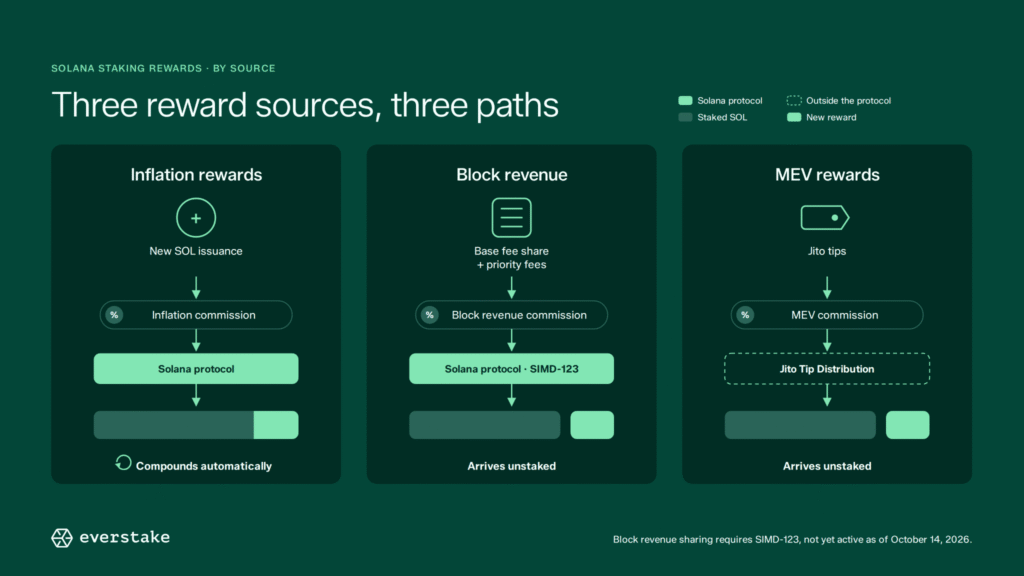
Solana staking rewards come from three places with different commissions and distribution paths. Today, only inflation rewards are distributed in protocol.
- Solana inflation rewards: newly issued SOL, distributed by the protocol each epoch and added to the staked balance automatically.
- Block revenue: transaction fees from produced blocks, distributed by the protocol under SIMD-123 as unstaked SOL.
- Solana MEV rewards: Jito tips paid by searchers, distributed by Jito programs to stake accounts each epoch.
A reward compounds automatically when it is added to the staked balance and starts accruing rewards itself. Rewards credited as unstaked SOL compound only after the delegator stakes them.
SIMD-123 vs. Jito Tip Sharing and Other Distribution Methods
SIMD-123 is enforced by the Solana runtime, while Jito tip sharing and other methods depend on third-party software and off-chain calculation. Validators can use more than one method at the same time.
Jito Tips and TipRouter
Searchers are automated traders that pay Jito tips to place bundles, groups of transactions executed in a set order. Validators running Jito-compatible software collect these tips in tip distribution accounts.
At each epoch end, TipRouter node operators record stake balances and agree on a merkle root by stake-weighted vote. A merkle root is a compact cryptographic summary of every payout, which lets each stake account’s amount be verified on-chain.
Jito then submits the payout proofs on-chain and transfers SOL to each stake account. Jito MEV staking rewards carry a 3% protocol fee, and 97% goes to validators and stakers. Like SIMD-0123 payouts, Jito-distributed tips arrive as unstaked SOL.
Jito Priority Fee Sharing
Jito extended TipRouter to distribute priority fees under JIP-16, a Jito governance proposal. Validators run a separate priority-fee-sharing service that transfers priority fees to dedicated distribution accounts.
Jito documentation lists a 1.5% fee on priority fee distributions, divided among three recipients:
- 90% to the Jito DAO, Jito‘s governance body;
- 5% to LST vault operators that secure TipRouter with staked assets;
- 5% to JTO vault operators, where JTO is Jito‘s governance token.
JIP-25 revised JitoSOL ranking to prioritize commission rate, MEV commission, and validator age, and paused the priority fee sharing implementation from JIP-16.
Third-Party Programs and Validator LST Routes
The SIMD-0123 text cites Cogent as a validator-run program, which directed part of its fee revenue to NFT holders. Those holders had to audit compliance themselves.
Validators that run their own LST can pass block revenue to token holders through the stake pool. Terms, timing, and reporting depend on each operator.
| Method | Enforcement | Third-party fee | Operational dependency | Delivery | Transparency |
| SIMD-123 | Solana runtime | None | Vote account version 4 and feature gate | Epoch boundary, unstaked SOL | Commission readable in vote account |
| Jito tip distribution | Jito programs and TipRouter vote | 3% of tips | Jito-Solana or compatible client | Merkle-proof payouts each epoch | Merkle roots posted on-chain |
| Jito priority fee sharing | Jito programs | 1.5% of distributed fees | priority-fee-sharing service | Merkle-proof payouts each epoch | Distribution accounts on-chain |
| Validator LST or custom program | Operator policy | Operator-defined | Operator infrastructure | Operator-defined | Depends on operator reporting |
While SIMD-123 covers fee revenue, Jito tips remain a separate stream. Delegators who receive both should confirm that each priority fee is reported through one channel only.
What SIMD-123 Means for Delegators and Institutional Staking Teams
SIMD-123 gives delegators a protocol-level view of block revenue terms, and gives institutional teams new data to compare, report, and reconcile. Both groups see block revenue distributions only after the feature gate activates and a validator lowers its block revenue commission.
For Delegators
- Reward changes: block revenue reaches a stake account only if the validator sets a commission below 10,000 bps.
- Commission visibility: the blockRevenueCommissionBps field in the vote account shows the exact rate in basis points.
- Account management: distributed block revenue arrives unstaked, so delegators decide whether to stake it.
Delegators can track your SOL staking rewards to separate inflation rewards from block revenue entries. Shorter Solana epochs also change reward cadence: at 200ms slots, a 432,000-slot epoch lasts about 24 hours.
For Institutional Staking Teams
Institutional teams face:
- Validator comparison: rank validators on all three commissions, using the basis-point fields.
- Reporting: confirm how custodians, reporting tools, and RPC providers label block revenue distributions.
- Reconciliation: revenue produced in one epoch is paid early in the next, and commission changes apply about two epochs after submission.
- Accounting: unstaked SOL balances and protocol-distributed fees may need separate treatment; legal and tax review required.
Possible Commission Strategies
Validators could adopt four commission strategies, each a possibility for planning purposes:
- A validator sets a low or 0% block revenue commission to attract delegations.
- A validator pairs a higher inflation commission with a lower block revenue commission.
- A validator keeps 100% of block revenue and competes on inflation commission and services.
- Stake pools add SIMD-123 commission criteria to delegation rules, as the JitoSOL Steward did for priority fees.
How to Choose a Solana Validator Under the New Model
Choosing a Solana validator now requires checking three commissions and the operational data behind them. In Solana validator economics under SIMD-123, the vote account stores both protocol commission rates in basis points.
How to choose a Solana validator comes down to seven checks:
- Inflation commission: read inflationRewardsCommissionBps in the vote account.
- Block revenue commission: read
blockRevenueCommissionBps; 10,000 or an absent field means no sharing. - MEV commission: check the rate set in the validator’s Jito tip distribution account.
- Commission history: review past changes, including small basis-point moves that whole-percent dashboards round away.
- Uptime and skip rate: missed votes reduce inflation rewards, and skipped leader slots reduce block revenue.
- Stake concentration: the superminority is the smallest validator group holding over 33% of stake, enough to halt the network.
- Client diversity: stake spread across clients limits the effect of a bug in any one client.
Skip rate is the share of a validator’s assigned leader slots in which it produced no block. Delegating outside the superminority spreads control of the network across more operators.
Everstake has operated a Solana validator since the network’s testnet period, and a dedicated team of Solana engineers handles validator maintenance and tracks every protocol update firsthand. Everstake also built Blockspace, a suite of Solana MEV infrastructure tools that includes ShredStream for sub-10ms shred delivery and SWQOS for stake-weighted transaction routing. Teams evaluating block revenue terms can review institutional Solana staking with Everstake.
FAQ
What is SIMD-123 on Solana?
SIMD-123 is an approved Solana proposal that lets validators share block revenue with delegators through the protocol. Validators set a block revenue commission from 0 to 10,000 bps, and the remainder goes to stake accounts each epoch.
Does SIMD-123 increase SOL staking rewards?
SIMD-123 increases rewards only for delegators whose validator opts in. The default block revenue commission is 10,000 bps (100%), so delegators receive block revenue only after a validator lowers it.
When will SIMD-123 activate on mainnet?
No mainnet activation date was confirmed as of mid October, 2026, and the feature was not yet queued on testnet.
How does block revenue commission differ from inflation commission?
Block revenue commission applies to transaction fees from produced blocks, and inflation commission applies to newly issued SOL. Both are set in basis points from 0 to 10,000 (0% to 100%) and can differ for the same validator.
Do delegators need to claim or restake the rewards?
Claiming is automatic: the protocol credits SIMD-123 rewards to stake accounts at the start of each epoch.
Does SIMD-123 replace Jito tip sharing?
SIMD-123 and Jito tip sharing run side by side, because they cover separate revenue streams. Jito tip distribution carries a 3% protocol fee, while SIMD-123 charges no third-party fee.
How can delegators check a validator’s block revenue commission?
Delegators can read the blockRevenueCommissionBps field in the validator’s vote account through a block explorer or an RPC call. The legacy commission field rounds up, so 501 bps appears as 6%.
Share with your network