solana
How to Track SOL Staking Rewards
Staking SOL lets you help secure the Solana network and receive protocol staking rewards in return. Learn how to check that those rewards are landing, using your wallet and explorer websites.
JAN 24, 2022
Last updated NOV 20, 2026 · V1
TL;DR
- Staking rewards are distributed to your stake account about once a day, so track that account as well as your wallet.
- What you receive depends on Solana’s inflation rate, how much SOL is staked overall, how reliably your validator performs, and its commission.
- Free explorers such as Solana Explorer, Solana Beach, and Solscan show your rewards and holdings without connecting your wallet.
- Tools such as validators.app and StakeWiz show whether your validator stays online.
Staking SOL lets you help secure the Solana network and receive rewards in return. This guide shows how to check that those rewards are arriving, using your wallet and free explorer websites; Everstake also has staking guides for each wallet.
Why track transactions or staking rewards?
Wallets don’t always show staking details clearly, so an explorer is a useful second check. It lets you confirm:
- that your rewards were paid,
- how much SOL you have staked,
- which validator your stake is delegated to,
- whether your stake is active.
How SOL Staking Rewards Work
Solana pays staking rewards once per epoch, a cycle that lasts about 24 hours. Rewards for each epoch are added to your stake account at the start of the next one.
How Solana’s inflation rate affects your rewards
Rewards come from new SOL the network issues, so the inflation rate sets the size of the rewards. Everyone who stakes is entitled to the protocol rewards, so when more SOL is staked overall, each staked SOL gets a slightly smaller slice.
Inflation currently falls by 15% a year toward a long-term 1.5%. Validators voted on August 28, 2026 to speed that up to 30% a year, which will lower rewards faster once it takes effect; it had not taken effect as of mid-November 2026.
The Everstake analysis of SGP-0002 explains what the change means for stakers.
How your reward is calculated each epoch
Each epoch, your reward works out in three steps:
- The network sets aside a certain rewards portion of newly issued SOL.
- Then it is split between validators by how much stake is delegated to them, as long as they vote on time and produce their blocks.
- The Solana protocol automatically calculates each staker’s rewards based on delegated stake and credits them directly to your stake account, after deducting the validator’s commission.
More stake, a reliable validator, and a lower commission all mean more rewards for you.
What can lower your rewards
- Downtime: a validator receives nothing while it is offline, so 10% downtime means roughly 10% less for that epoch.
- Skipped blocks: a validator that misses its turns to produce blocks loses part of its rewards; this is its skip rate.
- Commission: a higher commission leaves less for you.
- Unpaid network fee: a validator that can’t pay its 0.8 SOL per-epoch fee sits out the next epoch, and its stakers receive nothing for it.
When rewards start and stop
- New stake starts generating rewards after the next epoch begins, so your first reward usually arrives within 1–2 days.
- When you unstake, your SOL keeps generating rewards until that epoch ends and can usually be withdrawn about a day later.
- If a lot of SOL is staked or unstaked across the network at once, a 9% per-epoch limit can add an extra epoch or more.
Check out Everstake commission and current reward estimates on the Everstake Solana staking page.
Rewards compound automatically
Your rewards are added to your staked balance each epoch, so your staked SOL grows over time. MEV tips from Jito are the exception: they arrive as unstaked SOL and start generating protocol rewards only after you stake them again.
Track transactions
Paste your wallet address into Solana Explorer, Solscan or Solana Beach to see its full transaction history, then click any transaction for details. Your staked SOL is in a separate stake account, and that is where your reward history is recorded.

See everything a wallet holds, including NFTs and staked SOL
Paste the address into Solscan for the most complete one-page view:
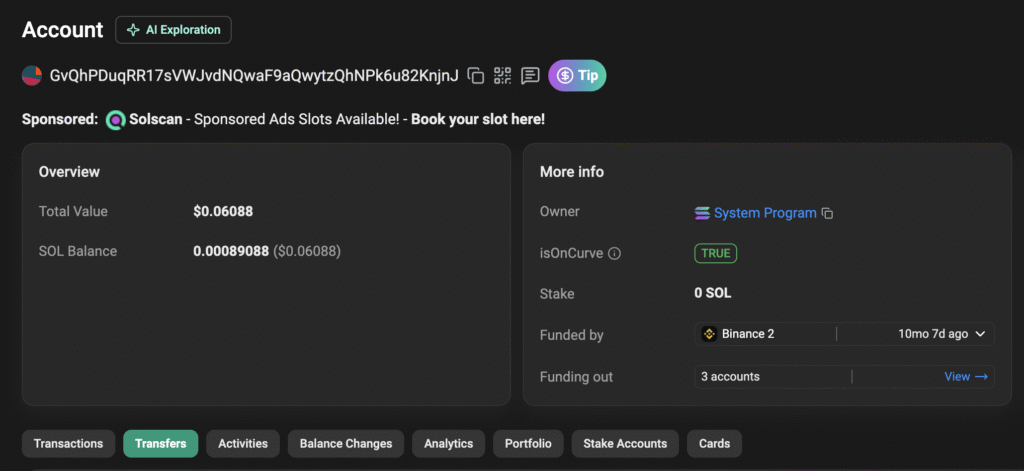
- The overview shows the wallet’s total value and how much SOL it has staked.
- The “Portfolio” tab lists tokens, NFTs, and DeFi positions.
- The “Stake Accounts” tab lists each stake account.
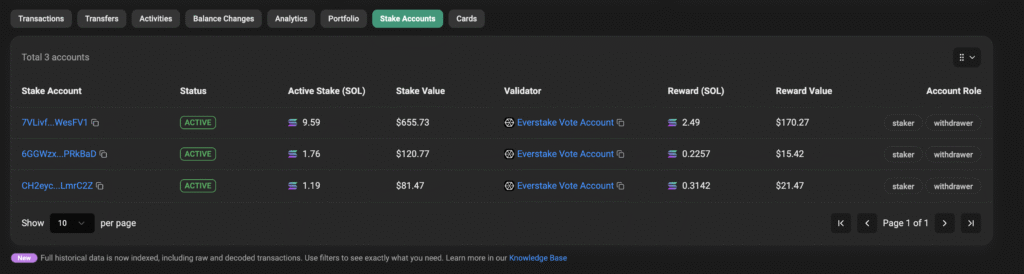
Liquid staking tokens such as JitoSOL show up as regular tokens, not as stake accounts.
Track staking rewards
To see your rewards, you first need your stake account address. You can find it in your transaction history on an explorer, or copy it from your wallet.
Track rewards on Solana Explorer without a wallet app
- Open Solana Explorer and check that “Mainnet” is selected.
- Search your wallet address, open a staking transaction from the history, and click the stake account address inside it.
- The stake account page shows your staked balance, your validator, and whether the stake is active.
- Open the “Rewards” tab to see each epoch’s reward and your balance after it.
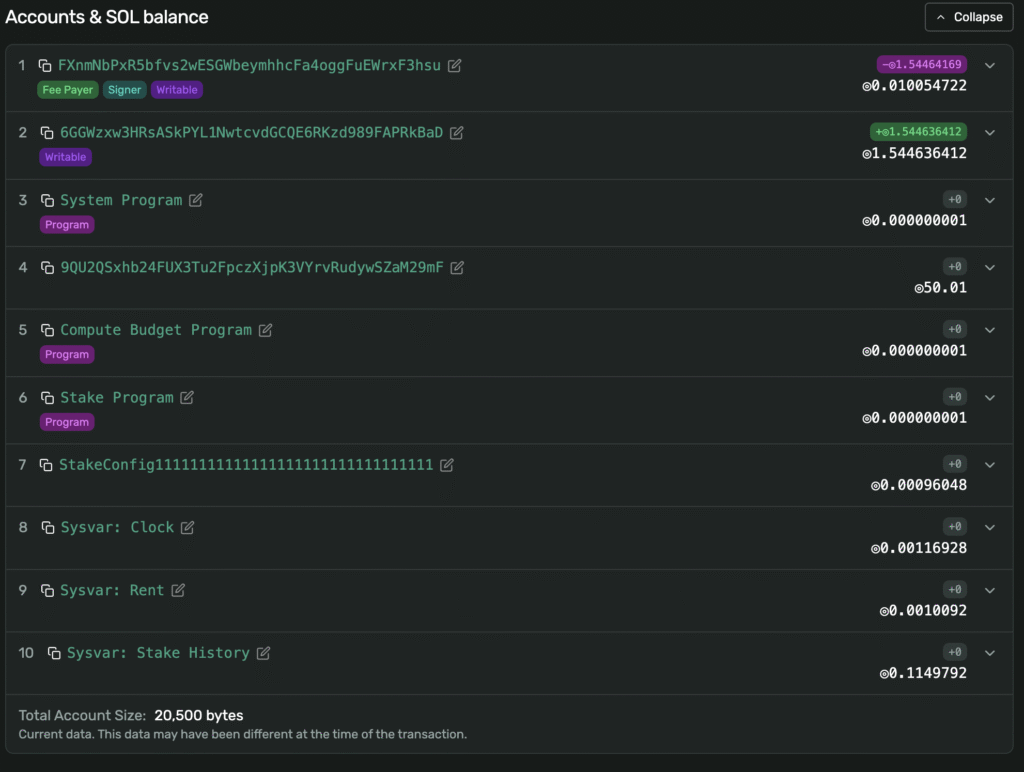
A new reward appears about once a day, shortly after each new epoch begins. If you already know your stake account address from Solscan or Solana Beach, search it directly.
Track staking rewards in the Phantom Wallet
Phantom shows your latest reward in the app, and Solana Beach shows your full history.
To check your latest reward in Phantom:
- Select Solana in your portfolio.
- Select “Your Stake”, then “Other”.
- Select a stake account and look under “Last Reward”.
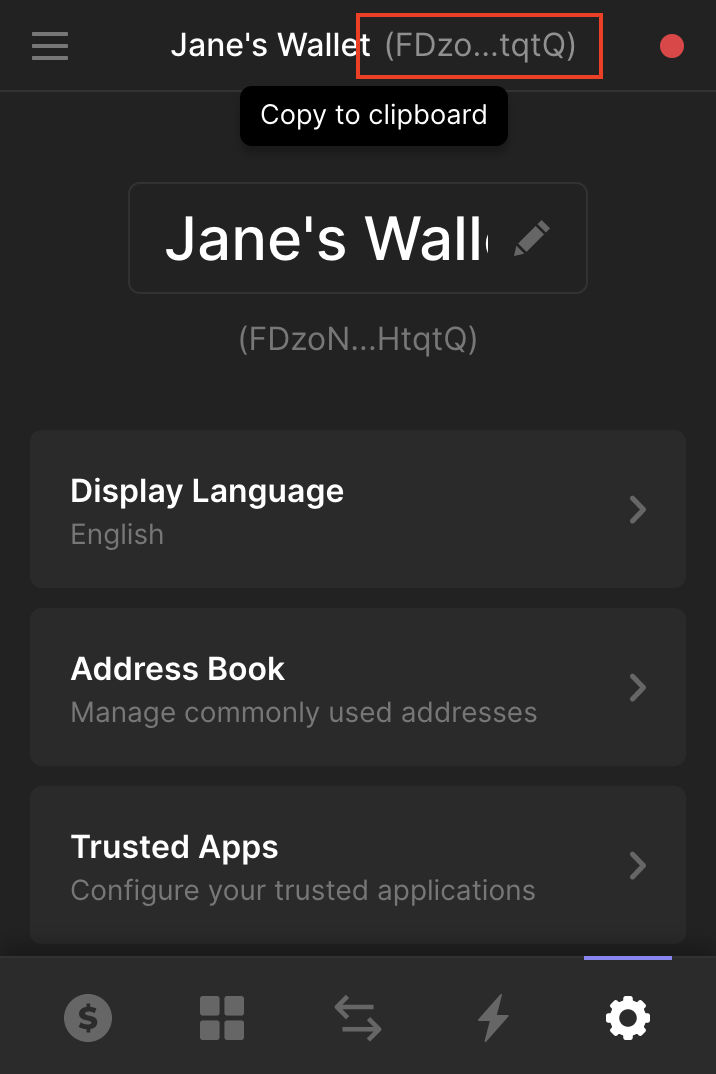
To see your full history on Solana Beach:
- In Phantom, select “Receive” and copy your Solana address.
- Paste it into Solana Beach and open the “Stake Accounts” tab.
- Select a stake account and open “Staking Rewards”.
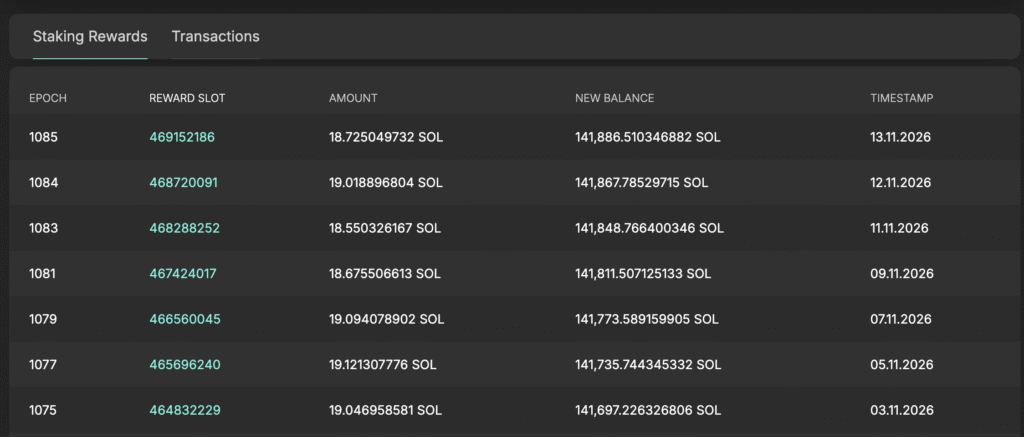
If you used Phantom liquid staking, you hold PSOL instead and won’t see a stake account. New to staking in Phantom? Follow the Everstake guide to staking SOL in Phantom.
Track staking rewards in the Solflare Wallet
Solflare shows the reward for each epoch inside the app.
- Open the “Staking” tab.
- Select a stake account to see its reward for each epoch.
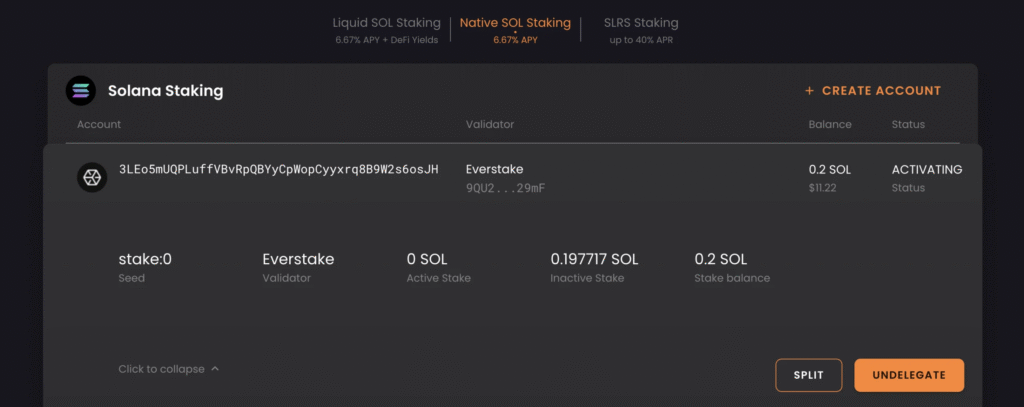
To start staking from Solflare, follow the Everstake guide to staking SOL in the Solflare web wallet.
Best Tools for Tracking SOL Staking Rewards
For reward history, Solana Beach and Solana Explorer are free and need only an address. Solscan is best for seeing everything a wallet holds, and Jupiter Portfolio lets you watch multiple wallets together.
| Tool | Best for | CSV export |
| Solana Beach | Reward history for every stake account in a wallet | Yes, rewards |
| Solana Explorer | Checking a stake account’s balance, validator, and rewards | No |
| Solscan | Tokens, NFTs, staked SOL, and balance history | Yes, transactions |
| Jupiter Portfolio | Multiple wallets and staking positions in one view | No |
| Phantom, Solflare | A quick check inside your wallet | No |
No single free dashboard shows rewards, past balances, and a full CSV history together. Solscan plus Solana Beach covers all three.
How to Monitor Solana Network Status and Validator Uptime
The official Solana status page shows network-wide problems, while validator dashboards show whether your own validator stays online. Check both, because the network can run normally while one validator is down.
| Tool | Use it to check |
| Solana status page | Network-wide outages and incidents |
| validators.app | A validator’s skipped blocks, commission history, and location |
| StakeWiz | A validator’s 30-day skip rate, downtime, and overall score |
| Solana Compass | Validator rankings based on speed, skipped blocks, and uptime |
To check Everstake, search its vote account 9QU2QSxhb24FUX3Tu2FpczXjpK3VYrvRudywSZaM29mF on any of these sites, or visit:
Why Are My SOL Staking Rewards Missing?
Most missing rewards come down to timing or looking in the wrong place:
- Your stake is still activating, so it hasn’t generated anything yet.
- You staked partway through an epoch, so your first reward comes one epoch later.
- A new epoch has just started and rewards are still being paid out.
- The explorer hasn’t caught up yet; check again later.
- You’re looking at your wallet address instead of your stake account.
- Your validator was offline or missed its turns that epoch.
If your validator shows no rewards for 2 or more epochs, check its uptime on validators.app and consider switching. To switch, unstake first and then stake with the new validator.
Related guides: how to stake SOL: the complete Everstake guide and what Alpenglow means for SOL staking rewards.
Solana Staking FAQ
What is a Solana epoch?
An epoch is Solana’s reward cycle, which now lasts about 24 hours, and the rewards for each epoch arrive at the start of the next one.
What do activating and deactivating mean?
“Activating” means your new stake will start generating at the next epoch, and “deactivating” means your unstaked SOL will be ready to withdraw once the current epoch ends.
I staked all my SOL, but I can’t see my stake. What should I do?
Look up your wallet on Solana Beach or Solscan to confirm the stake account exists, and keep a little SOL in your wallet to pay the fees for unstaking and withdrawing later.
How long does it take to unstake SOL?
Usually about a day, after which you withdraw the SOL from your stake account in a separate step.
How does Solana’s inflation rate affect staking rewards?
Rewards come from newly issued SOL, so as inflation falls toward 1.5% a year, the reward rate for stakers falls with it.
How are Solana staking rewards calculated?
The Solana protocol natively and automatically credits rewards directly to the delegator’s stake account based on stake amount.
Do SOL staking rewards compound automatically?
Yes, native staking rewards are added to your staked balance every epoch, except Jito MEV tips, which you need to stake again yourself.
How can I track my rewards without a wallet app?
Search your stake account address on Solana Explorer or Solana Beach and open the rewards tab, with no wallet connection needed.
What is the best Solana address lookup explorer?
Solscan shows a wallet’s tokens, NFTs, and staked SOL on one page.
Which tools show Solana network status and validator uptime?
The official Solana status page covers network-wide problems, and validators.app, StakeWiz, and Solana Compass show how reliably each validator stays online.
Can I track multiple wallets at once?
Yes, Jupiter Portfolio lets you add multiple wallet addresses and view them together.
Why are my staking rewards not showing?
Your stake may still be activating, the new epoch’s rewards may still be arriving, or you may be looking at your wallet address instead of your stake account.
Share with your network