Aptos
What is Aptos MonoMove?
Aptos MonoMove is a rebuilt Move execution engine, introduced October 6, 2026, that executed contract tasks up to 55x faster in internal tests. It operates inside Block-STM, targets feature completeness by end of 2026, and needs an on-chain governance vote before a 2027 mainnet rollout.
NOV 06, 2026
Last updated NOV 06, 2026 · V1
TL;DR
- Aptos spent the past year upgrading its consensus and widening its institutional ecosystem.
- On October 6, 2026, Aptos Labs introduced Aptos MonoMove, a rebuilt execution engine that ran smart contracts up to 55x faster in internal benchmarks.
- Aptos Labs targets feature completeness by the end of 2026 and a mainnet rollout in 2027, subject to an on-chain governance vote.
The New Execution Engine: Aptos MonoMove
Aptos MonoMove is one of the most significant upgrades to Aptos’s execution infrastructure. Introduced on October 6, 2026, it is designed to replace the existing Move virtual machine with an engine that compiles specialized instructions ahead of execution and runs them through a register-based interpreter inside Block-STM.
In internal tests that replayed Decibel mainnet transactions, it executed individual smart contract tasks up to 55x faster and raised end-to-end sequential throughput up to 11x. Aptos Labs targets feature completeness by the end of 2026 and a mainnet rollout in 2027, subject to a governance vote.
Aptos Developments Before MonoMove
Aptos entered 2026 with faster consensus, new protocol features, and a growing base of institutional products. Everstake tracks the full timeline in its Aptos 2026 news and roadmap overview.
Institutional traction
Aptos institutional adoption expanded through 2025 and 2026:
- BlackRock‘s BUIDL expanded to Aptos in November 2024 and added another $500 million in tokenized assets in October 2025.
- Aptos RWA value excluding stablecoins stood at $768.5M as of November 5, 2026, according to RWA.xyz, with $574.7M represented and $193.8M distributed.
- Bitnomial launched the first US APT futures on January 14, 2026.
- The March 2026 SEC/CFTC interpretive release defined 16 tokens as digital commodities, including Aptos.
- Mastercard launched its Crypto Partner Program on March 11, 2026 with 85+ companies, and Aptos is among them.
Protocol changes
Aptos mainnet reached sub-50ms block times in December 2025. The planned Archon upgrade targets ~10ms block times and ~30ms inclusion confirmations.
As a result of three governance proposals, passed and executed in March 2026, APT tokenomics changed:
- #183: a hard supply cap of 2.1 billion APT,
- #184: a staking rewards cut from 5.19% to 2.6%,
- #185: a 10x gas fee increase.
Everstake explains the supply model behind these proposals in Aptos tokenomics and APT inflation. Early-backer vesting closed on October 12, 2026, as covered in Aptos vesting schedule and what follows it.
Confidential APT went live on April 24, 2026, through Proposal 188. Decibel went live on February 26, 2026.
How Does Aptos MonoMove Work?
Aptos MonoMove rebuilds the Move virtual machine that executes each transaction’s smart contract code. Block-STM still schedules which transactions run in parallel, and MonoMove runs inside it as the per-transaction executor.
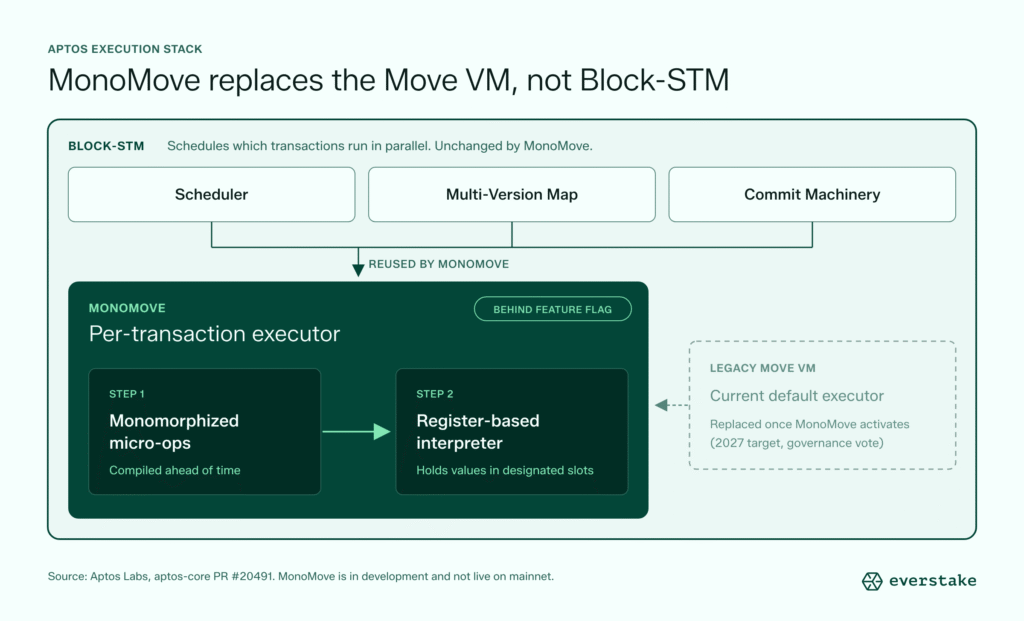
In the MonoMove execution engine, monomorphized micro-operations generate specialized code ahead of time. A register-based interpreter then holds values in designated slots.
The MonoMove Block-STM integration runs inside Block-STM‘s sequential pass, behind a feature flag, and reuses existing Block-STM components:
- the scheduler,
- the multi-version map,
- the commit machinery.
Aptos Labs published this executor infrastructure in pull request #20491 of the aptos-core repository. A parallel MonoMove executor is in development, and Block-STM v2 is the default execution path in Aptos node release v1.49.1, published September 23, 2026.
As the new Aptos execution engine, MonoMove keeps Move‘s asset rules and adds redundant checks against verifier or VM faults.
How Much Faster Is MonoMove?
In Aptos Labs internal tests, MonoMove executed individual contract tasks up to 55x faster and raised end-to-end sequential throughput up to 11x. Aptos has published no full-network throughput figure.
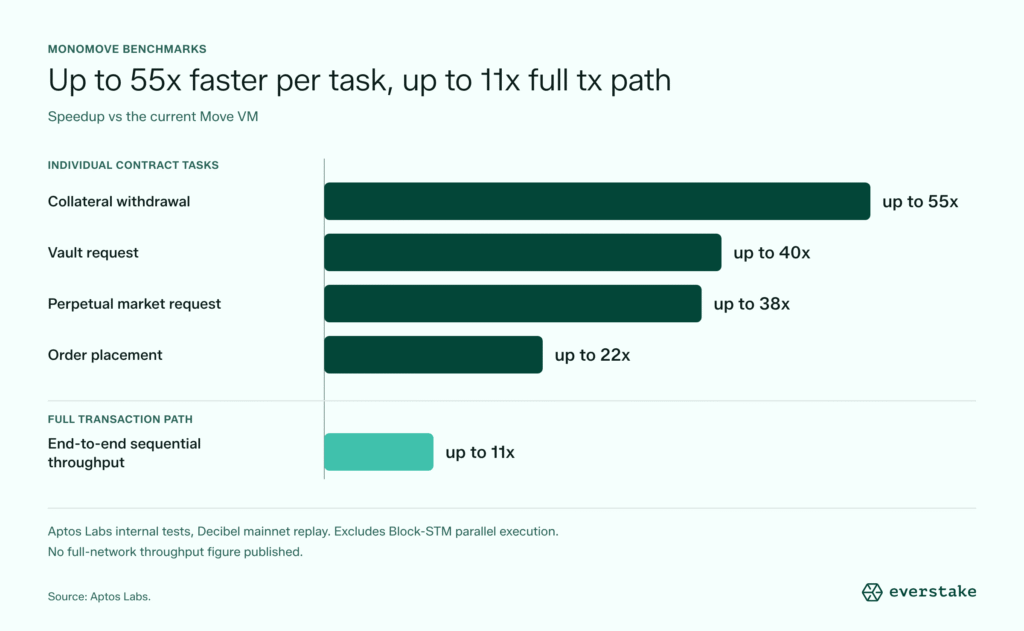
| Workload (Aptos Labs internal test, Decibel replay) | Speedup vs current Move VM |
| Collateral withdrawal | up to 55x |
| Vault request | up to 40x |
| Perpetual market request | up to 38x |
| Order placement | up to 22x |
| End-to-end sequential throughput | up to 11x |
The benchmarks cover three separate measurement levels:
- individual task speedups,
- end-to-end sequential throughput,
- full-network throughput.
A 55x task speedup applies to contract execution alone, so the end-to-end figure in the same tests reached 11x. The tests excluded Block-STM parallel execution.
The remaining bottlenecks lie between execution and storage. Gas metering and reentrancy protection will add overhead once they ship.
Why Did Aptos Build MonoMove?
Aptos Labs built MonoMove for three purposes:
- to cut execution overhead,
- to harden asset safety in the engine,
- to prepare for trading, lending and payment applications.
MonoMove targets execution overhead: how fast the VM processes the code inside each transaction. Consensus upgrades such as sub-50ms block times speed up block production, and MonoMove speeds up the work inside each block.
On asset safety, Aptos Labs co-founder Avery Ching said institutions will build markets only on infrastructure that keeps pace with them, and will entrust client assets only to infrastructure they can rely on.
Everstake analysis of the Aptos 2026 roadmap identifies three components that demand faster execution:
- a framework-level CLOB,
- Raptr consensus,
- Block-STM v2, which shipped as the default in node release v1.49.1.
Faster execution in the Move VM keeps pace with those upgrades.
What Comes Next for MonoMove?
Aptos Labs targets MonoMove feature completeness by the end of 2026. Mainnet deployment in 2027 remains a target that depends on a governance vote.
Differential tests are underway: each block runs on the legacy VM and then on MonoMove from the same state, and the writes must match byte for byte.
Components still being built:
- native functions,
- reentrancy checks,
- gas metering,
- stronger parallel execution.
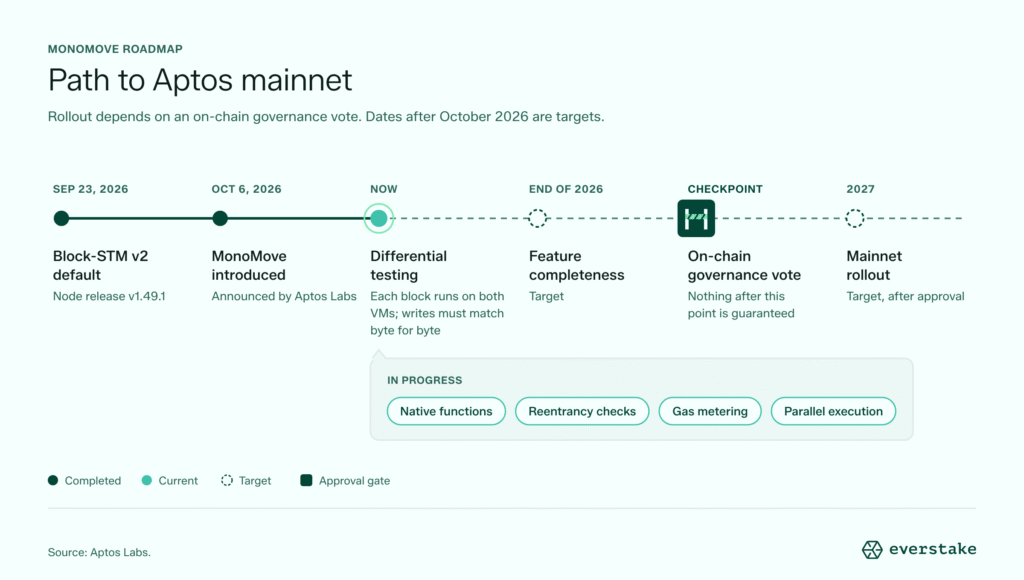
Aptos Labs plans fuzzing and formal verification of critical components. The MonoMove mainnet 2027 target requires a governance vote first, with rollout after approval.
What Does MonoMove Mean for Aptos Validators?
MonoMove, the rebuilt Aptos execution engine, reaches mainnet only through on-chain governance, so validator operators and delegators should both track the proposal. Voting power comes from the backing stake pool, and delegation pool stakers can vote in proportion to their stake or delegate their votes.
Operators need to run node releases that include MonoMove and monitor performance after activation. Operators planning upgrade budgets can compare validator node cost by network.
Delegators should weigh a validator’s upgrade track record alongside the other factors in how to choose an Aptos validator. APT holders can stake through Everstake Aptos staking, and institutions can use Everstake Institutional Staking.
FAQ
What is Aptos MonoMove?
Aptos MonoMove is a rebuilt Move VM execution engine from Aptos Labs, introduced on October 6, 2026, that ran smart contract tasks up to 55x faster in internal benchmarks.
Is MonoMove live on Aptos mainnet?
No, MonoMove is in development behind a feature flag, and mainnet deployment targets 2027 after a governance vote.
Does MonoMove make the Aptos network 55x faster?
No, the 55x figure applies to individual contract tasks in internal tests, end-to-end sequential throughput rose up to 11x, and Aptos has published no full-network throughput figure.
Does MonoMove replace Block-STM?
No, MonoMove runs inside Block-STM as the per-transaction executor, and Block-STM still schedules parallel execution.
When will MonoMove launch?
Aptos Labs targets feature completeness by the end of 2026 and mainnet deployment in 2027, subject to an on-chain governance vote.
Who approves the MonoMove upgrade?
Aptos on-chain governance approves the upgrade, with voting power drawn from stake pools and delegation pool stakers able to vote directly or delegate their votes.
Share with your network