Aptos
Institutional
Aptos Consensus Mechanism: How AptosBFT Works and What Raptr Changes
How does Aptos agree on block order so quickly? Find out how AptosBFT, Quorum Store and Raptr work together, and what delegators and institutions should check when choosing a validator.
NOV 17, 2026
Last updated NOV 16, 2026 · V1
TL;DR
- AptosBFT is the consensus mechanism used by Aptos. Based on Jolteon, it weights votes by stake and tolerates faults affecting less than one-third of total voting power.
- In the common case, a block is ordered 3 hops after its proposal through order votes (AIP-89). A 4-hop 2-chain commit rule serves as a fallback. Although the AIP-89 file is still labeled Draft, order votes are already part of the current mainnet pipeline.
- Quorum Store separates transaction data dissemination from block ordering. This allows leaders to order compact proofs of availability instead of carrying full transaction batches in their proposals.
- Baby Raptr went live in June 2025 through AIP-106. It reduced Quorum Store and consensus latency under medium and high load from 6 hops to 4 hops. Velociraptr (AIP-131) subsequently shortened the block interval.
- Full Raptr remains on the roadmap. Its reported 260,000 TPS capacity comes from a testing environment.
- Aptos epochs last 2 hours, and a validator pool needs at least 1,000,000 APT to join the active set.
- Slashing is not currently implemented on Aptos.
- Third-party sources report between 82 and 152 validators and a Nakamoto coefficient between 13 and 18.
- Institutions and delegators can assess validators based on their upgrade history, proposal success rate, and stake concentration. Everstake provides Aptos staking and Validator-as-a-Service infrastructure.
What Is AptosBFT?
AptosBFT is the consensus protocol, based on Jolteon, responsible for ordering transactions on Aptos.
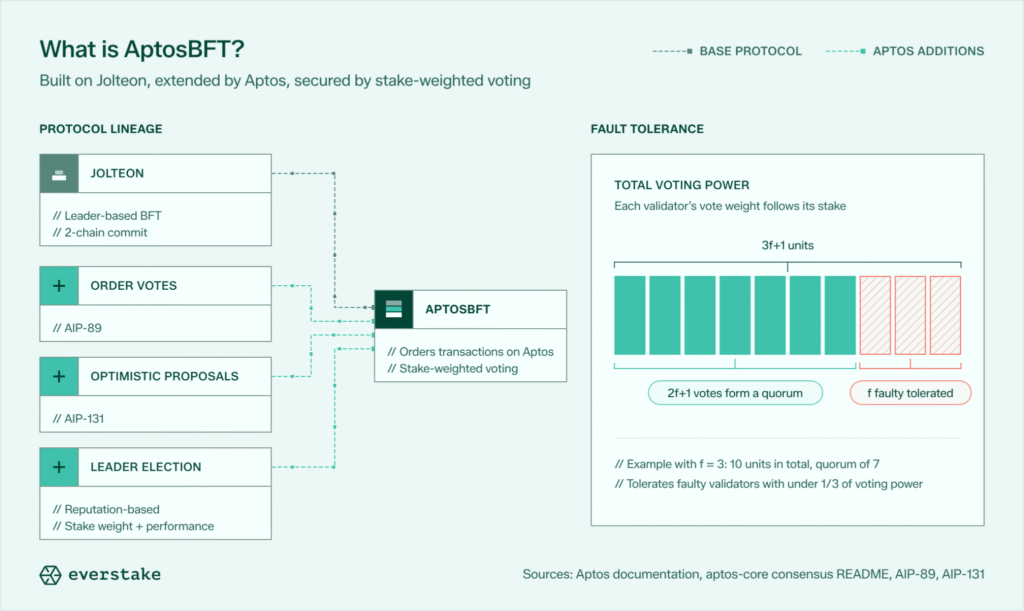
Jolteon is a leader-based, latency-optimal Byzantine Fault Tolerant (BFT) protocol. AptosBFT builds on Jolteon’s 2-chain commit mechanism and adds order votes (AIP-89) and optimistic proposals (AIP-131). It also uses reputation-based leader election, which takes both stake weight and validator performance into account.
Voting power is proportional to stake, following the same principle used in delegated proof of stake. With 3f+1 total voting power, the network can tolerate up to f faulty units and requires 2f+1 votes to form a quorum.
This security threshold is the ability to tolerate compromised or faulty validators holding up to one-third of total voting power.
How Does a Block Get Ordered?
In the common case, AptosBFT orders a block 3 hops after its proposal using the order votes introduced in AIP-89.
A hop represents one network message delay between validators.
The process works as follows:
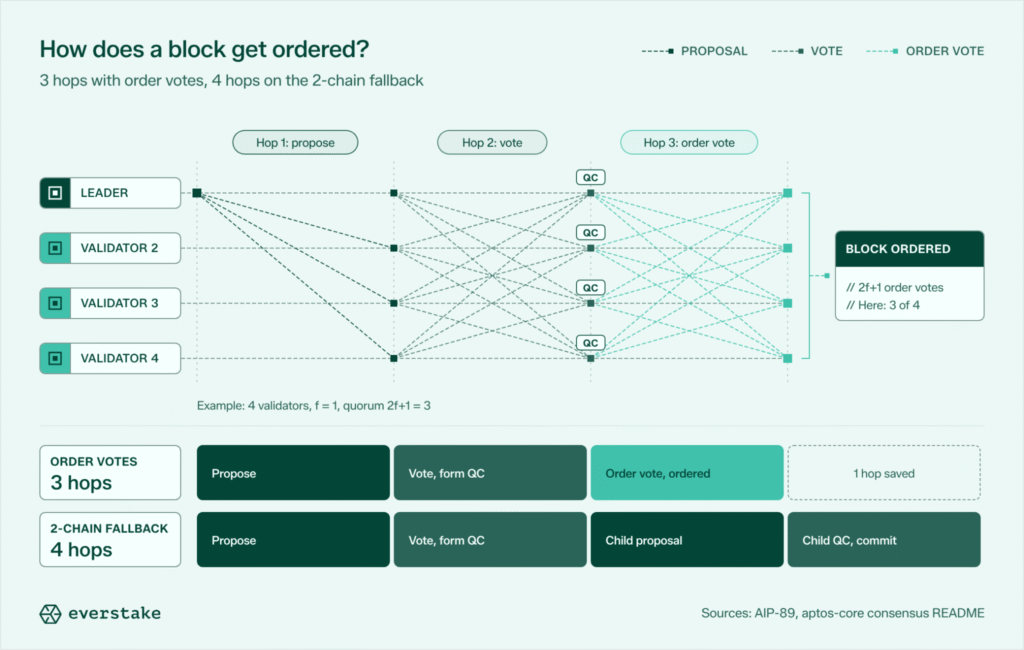
- Hop 1: The leader broadcasts a proposal containing the block.
- Hop 2: Validators verify the block and broadcast their votes to the other validators. Each validator can then aggregate
2f+1votes into a quorum certificate (QC). - Hop 3: Validators broadcast an order vote for that QC. Once
2f+1order votes are collected, the block is ordered.
If order votes are not used, AptosBFT falls back to its 2-chain commit rule. Under this rule, a block commits once its child block also receives a QC, a process that takes 4 hops.
AIP-89, authored by Satya Vusirikala, Daniel Xiang, and Zekun Li, introduced order votes to reduce block ordering from 4 hops to 3.
The copy of AIP-89 in the Aptos Foundation repository is still marked Draft. However, the implementation shipped in release v1.14 behind the order_vote_enabled flag. Order votes are now part of the baseline mainnet pipeline described in AIP-132, and the v1.25.1 mainnet release further optimized order-vote verification.
This improvement also introduces additional verification work for validators. AIP-89 estimated that, with 130 validators producing 5 blocks per second, each validator would need to verify approximately 650 order votes per second.
What Does Quorum Store Do?
Quorum Store separates the distribution of transaction data from the process of ordering blocks. This means the leader no longer needs to handle all transaction data when proposing a block, removing a major bandwidth constraint on throughput. Aptos Labs launched Quorum Store in May 2023 as the first deployed implementation of Narwhal.
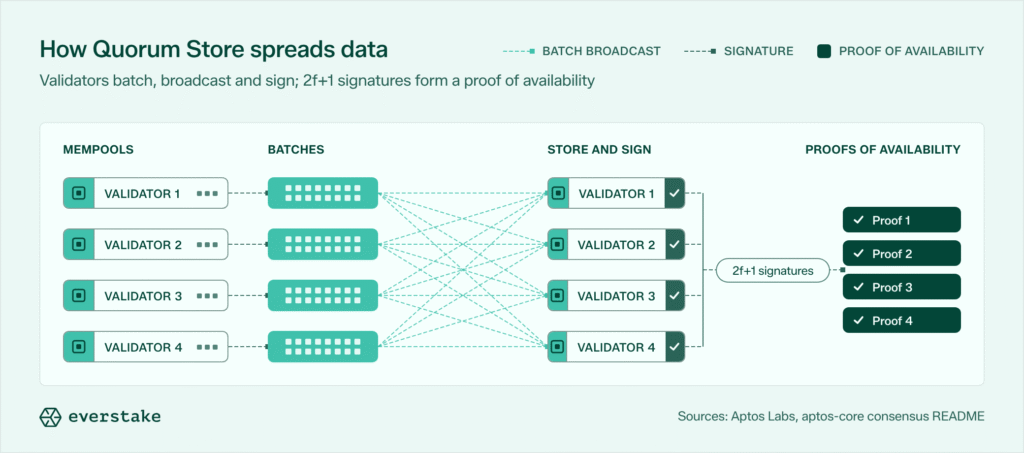
Here’s how it works: validators collect transactions from their mempools, organize them into batches, and broadcast those batches to other validators. Once a quorum of validators signs a batch, their signatures form a proof of availability.
A proof of availability is a compact certificate confirming that enough validators hold the transaction batch and can provide it when requested.
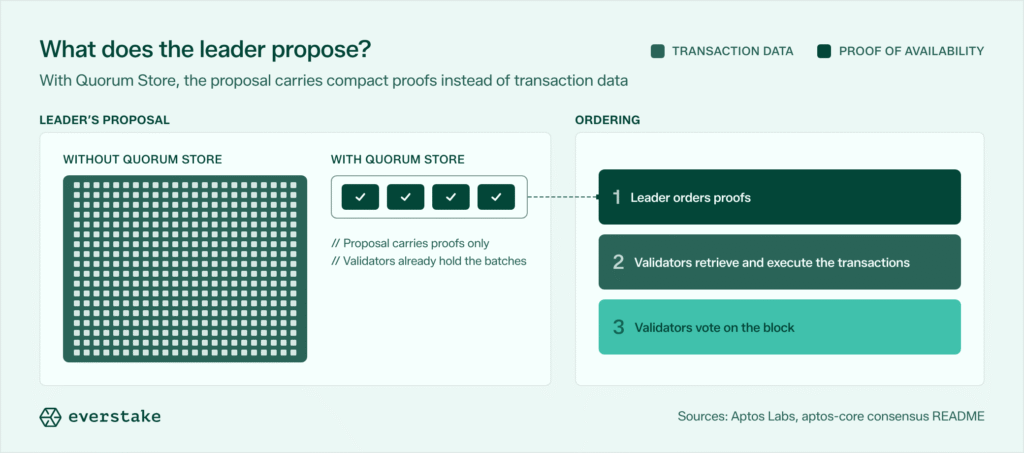
Instead of including the full transaction data in a proposal, the leader orders these proofs. Validators then retrieve and execute the corresponding transactions before voting on the resulting block.
What Changes With Baby Raptr and Raptr?
Baby Raptr is already live on Aptos mainnet, while full Raptr remains on the roadmap. Baby Raptr is also known as Optimistic Quorum Store (OptQS).
Before Baby Raptr, Quorum Store required a “proof of store” certificate before a proposal could proceed under medium and high network load. This added 2 hops to the 3-phase agreement process, bringing the total to 6 hops. Under low load, defined as fewer than 100 transactions per block, Quorum Store is bypassed and the process takes 4 hops.
Baby Raptr removes this additional wait. The proposer can include batch digests in a proposal without waiting for a separate proof-of-store certificate. Validators only vote after retrieving and verifying the full batch, so the quorum certificate also serves as proof of availability.
Following the June 2025 rollout, Aptos Labs reported a 20% reduction in validator finality latency, or approximately 100 ms to 150 ms. Under load, the combined Quorum Store and consensus path decreased from 6 hops to 4 hops.
| Component | Status | What it changes |
| AptosBFT | Live | 3 hops from proposal to ordering via order votes; 4-hop 2-chain fallback |
| Quorum Store | Live since May 2023 | Separates transaction data dissemination from ordering |
| Order votes (AIP-89) | Live in mainnet pipeline; AIP file still marked Draft | Reduces ordering from 4 hops to 3 hops |
| Baby Raptr (AIP-106) | Live since June 2025 | Reduces the combined Quorum Store and consensus path from 6 hops to 4 hops under load |
| Velociraptr (AIP-131) | Live per Delphi Digital | Reduces the block interval from 2 hops to 1 hop |
| Full Raptr | Roadmap | Introduces prefix voting and prefix commit |
| Archon | Announced, early design | Introduces proxy-primary consensus |
Velociraptr focuses on the time between successive block proposals. According to Delphi Digital report, the target was to reduce the block interval from approximately 100 ms to 60 ms. The improvement was reached in December 2025.
Full Raptr takes the optimization further with prefix voting. Instead of voting on individual blocks, validators vote on the longest block prefix they have received.
The Raptr paper reports up to 260,000 TPS with sub-second latency. In a geo-distributed test involving 100 nodes, the system achieved approximately 755 ms of latency at 250,000 TPS.
What Secures the Network?
Aptos relies on stake-weighted voting and a one-third fault threshold to maintain consensus. If validators controlling more than one-third of total voting power coordinate to act maliciously or stop participating, they can prevent the network from reaching consensus.
Four properties are particularly relevant to understanding the network’s security and validator economics:
- Epoch duration: Epochs last 2 hours (7,200 seconds), with their duration determined by governance.
- Validator entry requirement: A validator pool needs at least 1,000,000 APT to join the active validator set.
- Slashing: Aptos does not currently implement slashing. Validators that underperform receive fewer rewards, but their delegated stake is not automatically penalized.
- Genesis stake: Locked genesis tokens can be staked. The Aptos Foundation also delegates stake outside the protocol to help distribute it across validators.
Stake concentration is another important part of the network’s security picture. The Nakamoto coefficient measures the smallest number of entities whose combined stake can disrupt consensus. Published estimates vary depending on the reporting date and methodology.
| Source | Date | Validators | Nakamoto coefficient |
| AIP-89 | Mid-2024 | 130 | Not stated |
| Messari | Q2 2025 | 152 | 18 |
| Chainspect via Merlin | April 28, 2026 | Not stated | 15 |
| TheStreet | Mid-2026 | 92 | 13 |
| web3decentralization | September 3, 2026 | About 145 | About 18 |
| Chainspect | November 16, 2026 | 82 | 13 |
For current validator counts and stake distribution, consult the Aptos Explorer and recalculate the Nakamoto coefficient using the latest stake data.
To keep up with network’s progress, learn more on the MonoMove, the latest and most impactful upcoming Aptos upgrade.
What Do Validator Operators See?
For validator operators, Aptos consensus is closely tied to software upgrades, epoch boundaries, and performance metrics. Aptos Labs release notes identify whether a particular version requires validators to upgrade, helping operators plan maintenance and stay compatible with the network.
For example, the v1.49.1 release incorporates emergency fixes into a standard mainnet release. An earlier maintenance notice, published on June 8 for v1.45.5, described a consensus fix that skips signing round 0 ledger info.
Validator performance also affects reward distribution. A validator’s reward depends on its stake, the applicable rewards rate, and its proposal success rate during an epoch. Proposal success rate measures the number of successful proposals relative to the total number of proposals made.
Network latency is another operational consideration. Each hop introduces communication delay between validators. Under Baby Raptr, validators must also retrieve and verify the full transaction batch before voting, making network connectivity and geographic distribution relevant to performance.
Everstake operates validator infrastructure on Aptos. Its guide on how to choose an Aptos validator provides additional context on the criteria delegators can use when evaluating operators.
What Should Institutions Check in an Aptos Validator?
For institutions, validator due diligence should focus on operational performance and reliability. Since Aptos does not currently implement slashing, the assessment should also account for how underperformance affects rewards and network participation.
A practical review can cover the following areas:
- Upgrade record: How quickly the operator adopts releases such as v1.49.1 and coordinates changes that affect consensus.
- Proposal success rate and uptime: Whether the validator consistently participates in consensus and proposes blocks successfully across epochs.
- Stake concentration: How much of the active stake is delegated to the validator and to other validators controlled by the same operator.
- Infrastructure distribution: Which hosting providers and geographic regions support the validator, and whether the infrastructure has sufficient redundancy.
- Custody and reporting integrations: Whether the validator supports the institution’s operational, custody, and reporting requirements.
Everstake supports institutional staking through its staking infrastructure and Validator-as-a-Service offering for teams that require dedicated validator infrastructure.
For a broader comparison of the two ecosystems, readers can also explore Sui and Aptos staking or consult the Aptos news overview for 2026.
Stake APT With Everstake
Delegators can stake APT through the Everstake Aptos staking page, while institutions and infrastructure teams can explore Validator-as-a-Service for dedicated validator operations.
For a comparison with a different consensus design, see our explanation of Solana’s Proof of History.
FAQ
What is the difference between block time and finality on Aptos?
Block time is the interval between successive block proposals. Finality refers to the point at which a block is irreversibly committed and its transactions can be treated as finalized.
Is Block-STM part of Aptos consensus?
No. Block-STM is Aptos’s parallel execution engine. Consensus first determines the order of transactions, and Block-STM processes them in parallel afterward.
Does Aptos have slashing?
No. Slashing is not currently implemented on Aptos. Validators that underperform receive reduced rewards, but their delegated stake is not slashed.
Is Raptr live on Aptos mainnet?
Baby Raptr, the first component of the Raptr roadmap, went live in June 2025. Full Raptr, including prefix voting, remains on the roadmap.
What is the current validator count on Aptos?
Third-party sources report between 82 and 152 validators, depending on the reporting date and methodology. Check the Aptos Explorer for the latest validator count.
What does 3f+1 mean in AptosBFT?
The 3f+1 model means the network has enough voting power to tolerate up to f faulty units. A quorum requires 2f+1 votes, allowing consensus to proceed as long as faulty or compromised voting power remains below one-third of the total.
Share with your network